Home monitoring for AMD aims to catch the switch from dry to wet disease while vision is still good.
Patients with intermediate AMD or a wet fellow eye are at high risk, and every week of delay in treatment can also cost vision.
A device that detects change at home can also shorten that delay.
Why Home Monitoring for AMD Matters
Anti-VEGF drugs work best when started before the membrane has caused scarring, and patients whom doctors treat at better acuity keep better vision (see anti-VEGF therapy).
Symptoms often appear late, and many patients do not notice a loss in one eye because the other eye compensates.
Home Monitoring for AMD: The Amsler Grid
- A simple chart of straight lines, viewed with each eye separately
- Patients look for distortion, missing areas, or blur
- Cheap and easy, but its sensitivity is limited, and many patients do not use it regularly (see Amsler grid monitoring)
Fundus Explorer Pro
Photograph the retinal findings described here with the phone already in your pocket — 22 D optics and built-in illumination in one handheld unit.
From Choroida — the team behind this siteHyperacuity Testing
Preferential hyperacuity perimetry presents patients with a pattern of dotted lines, and asks them to mark the places where lines look distorted.
A home device, ForeseeHome, records the results and sends them to a monitoring center, which alerts the physician if the data change.
Home Monitoring for AMD: Evidence From the HOME Study
In a randomized trial of patients with intermediate AMD, investigators added home monitoring with the device to standard care.
Also, clinicians found eyes that converted to wet AMD earlier, with a larger share retaining visual acuity of 20/40 or better at diagnosis, about 94 percent compared with 62 percent in the control group (see the references).
Also, the study supported the use of the device in high-risk patients.
Home OCT
Home OCT devices let patients scan their own eyes, and algorithms analyze fluid and thickness.
- They allow frequent measures, even daily, so changes can be seen early
- Some systems have been cleared in several regions, and trials show good agreement with clinic OCT (see the references)
- They may also guide treatment intervals in patients on injections
Cost and access limit use today.
Home Monitoring for AMD: Who Should Use Home Monitoring?
- Patients with intermediate AMD in both eyes
- Patients with neovascular AMD in one eye, since the other eye has a high risk
- Those who can also use the device, and who will act on alerts
It is less suited to patients with advanced disease or poor vision in both eyes.
Limits
- False alarms can lead to extra visits and anxiety
- Patients need training and regular use
- The device cannot replace regular examinations and imaging
- Cost and insurance coverage vary
Home Monitoring for AMD: Practical Tips for Clinics
- Teach each patient how to check each eye separately, using their reading glasses
- Ask patients to call the same day if they notice any new distortion
- Keep a rapid access slot for suspected conversion
- Review the device data at visits
Counselling
Explain that monitoring does not prevent wet AMD, but it helps to treat it earlier.
Encourage patients to use the tool consistently, and to report changes at once.
Combining Tools
A sensible plan for a high-risk patient is to use the Amsler grid weekly, to attend regular clinic visits with OCT, and, if available, to add a home device.
In addition, each tool catches a different change, and together they improve the chance of finding wet AMD early.
Documenting the Baseline
Record the baseline distortion, the visual acuity, and the OCT, and give the patient a copy of the plan, with a phone number to call.
Home Monitoring for AMD: Risk Factors That Raise Priority
- Large drusen and pigment changes in both eyes
- Wet AMD in the fellow eye
- Smoking and family history (see AMD risk factors)
- Poor access to care
Telemedicine Links
A clinic can review remote monitoring data and see urgent patients within days, which is a good model for rural areas.
Example Case
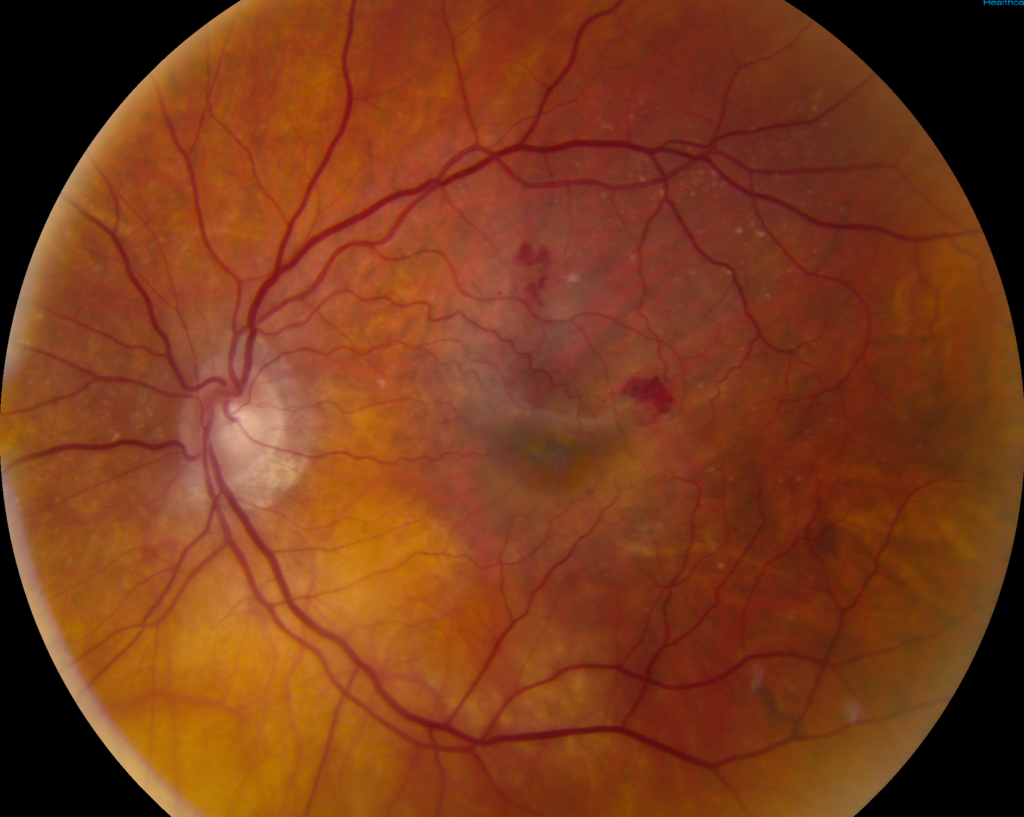
A 68-year-old man with wet AMD in the right eye and large drusen in the left eye receives a home device and an Amsler grid.
Six months later the device sends an alert, and the clinic sees him within three days, with a new neovascular membrane in the left eye, and 20/32 vision.
Treatment starts at once, and his vision stays at 20/32, which would have been less likely if he had waited for symptoms.
Cost and Coverage
In some regions, patients may rent devices, or insurance may cover them, and clinics can help patients with paperwork, so that cost does not stop high-risk patients from using them.
For the latest studies, see the PubMed results for home monitoring for AMD.


Document what you see
Two smartphone imaging tools built for everyday clinic use — one for the slit lamp, one for the fundus.
From Choroida — the team behind this siteReferences
- Chew EY, Clemons TE, Bressler SB, et al. Randomized trial of a home monitoring system for early detection of choroidal neovascularization: Home Monitoring of the Eye (HOME) study. Ophthalmology. 2014;121:535-544.
- Liu Y, Holekamp NM, Heier JS. Prospective, longitudinal study: daily self-imaging with home OCT for neovascular age-related macular degeneration. Ophthalmol Retina. 2022;6:575-585.
- Ryan SJ, Schachat AP, Wilkinson CP, et al, eds. Retina. 6th ed. Elsevier; 2018.
- American Academy of Ophthalmology. Basic and Clinical Science Course, Section 12: Retina and Vitreous. AAO; current edition.

Writes and reviews the clinical articles on Educate. Every post is checked against peer-reviewed sources before it goes live.