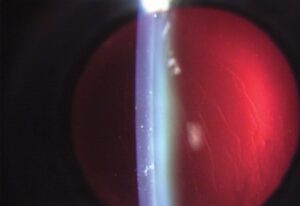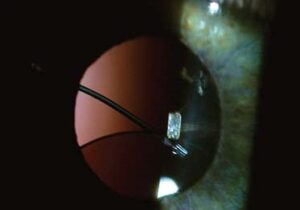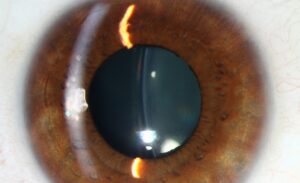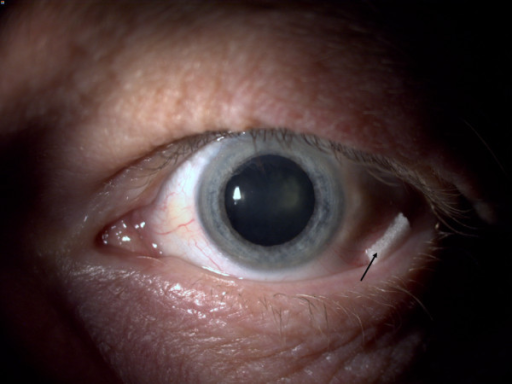
Intraoperative floppy iris syndrome (IFIS) is a cataract surgery complication in which the iris billows, the pupil keeps shrinking, and the iris slides toward the incision. The link between floppy iris syndrome tamsulosin use and this problem is well established, since tamsulosin (Flomax) is the most common cause. Surgeons who know the drug history beforehand can plan around it.
What Floppy Iris Syndrome Means
Floppy iris syndrome describes an iris that loses its normal tone and moves unpredictably during cataract surgery. Chang and Campbell named it in 2005 after noticing the pattern in patients taking tamsulosin. Surgeons also call it IFIS, and patients sometimes search for floppy iris or floppy eye syndrome.
Do not confuse it with floppy eyelid syndrome, a lax upper eyelid condition tied to sleep apnea. IFIS involves the pupil and iris, appears only during intraocular surgery, and causes no symptoms beforehand. The two conditions share a word and nothing else.
Floppy Iris Syndrome Tamsulosin: Why the Drug Affects the Iris
The iris dilator muscle contracts under sympathetic alpha-1 adrenergic control. Tamsulosin, a selective alpha-1A antagonist, relaxes prostate smooth muscle and improves urinary flow in benign prostatic hyperplasia. Its selectivity is not absolute, so it also blocks receptors in the iris dilator muscle.
Long-term blockade appears to leave the dilator muscle atrophic and poorly responsive, so the pupil cannot hold its size once surgery begins. That change helps explain why the effect can outlast the medication itself. The exact mechanism is still debated, but the clinical pattern is consistent.
All-fit Slit-Lamp Adapter
Record and share exactly what you see at the slit lamp. One adapter fits any slit lamp or surgical microscope — and any smartphone.
From Choroida — the team behind this siteDoes Tamsulosin Cause Floppy Iris Syndrome?
Yes. Tamsulosin is the best-documented cause, and its association with the syndrome is stronger than that of any other drug. Flomax is the brand name, so a patient who takes Flomax belongs in the same higher-risk group.
Other alpha-1 antagonists, including alfuzosin, doxazosin, and silodosin, have also been linked to it, generally to a lesser degree. Some alpha-blockers used for hypertension carry a weaker association, and isolated reports implicate other drugs such as finasteride. Tamsulosin remains the main concern because doctors prescribe it so widely.
Not every tamsulosin user develops the full triad, and severity ranges from mild billowing to severe prolapse with a small pupil. Because no test reliably predicts who will be affected, surgeons treat every current or past user as at risk.
Iris Billowing and the Other Signs of IFIS
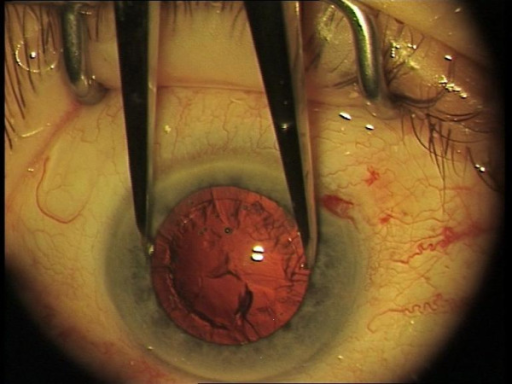
Surgeons recognize the syndrome by a triad that develops during the case. Any one sign should prompt a change in plan, even when the pupil dilated well at the start.
- Iris billowing: the flaccid stroma undulates with ordinary irrigation currents, instead of staying stable as a normal iris does.
- Progressive miosis: a pupil that dilated well before surgery constricts steadily despite the usual measures to hold it open.
- Iris prolapse: the loose iris moves toward and through the incisions, raising the risk of iris trauma.
Each sign follows from a weak dilator muscle. Surgical trauma releases prostaglandins that constrict the pupil, and a damaged dilator cannot oppose that pull, so miosis progresses. The same loss of tone lets the iris billow and drift toward the wound.
Is Floppy Iris Syndrome Reversible?
Not reliably. Because chronic tamsulosin use appears to change the dilator muscle structurally, stopping the drug does not dependably remove the risk, and the syndrome has been reported in patients who stopped it long before surgery. Recovery of iris tone after discontinuation is inconsistent.
Stopping the drug just before surgery has no proven benefit, and it can bring back urinary symptoms. Surgeons therefore plan for the syndrome rather than ask patients to stop. A normally dilating pupil in clinic does not rule it out either.
Tamsulosin and Cataract Surgery: Planning Ahead
The value of a medication history is to let the surgeon prepare, not to start a stopping strategy. Ask specifically about current or past tamsulosin use, because patients seldom connect a urinary medication with eye surgery. Record the drug, the dose, and roughly when it was taken.
- Ask women as well as men, since tamsulosin is also prescribed for urinary retention and to help pass ureteral stones
- Check pupil size and iris appearance before surgery, knowing that good dilation does not exclude IFIS
- Flag the chart so the operating team has devices and medications ready before the first incision
Intraoperative Management Strategies
Surgeons combine several measures, and most begin before the first incision.
- Mechanical expansion: a pupil expansion ring or iris hooks, placed early to hold the pupil open and support the iris margin
- Pharmacologic dilation: intracameral phenylephrine with ketorolac in the irrigating solution, or preservative-free intracameral epinephrine, to sustain dilation; some surgeons also prescribe preoperative atropine drops
- Viscoelastic: a dispersive or viscoadaptive agent that tamponades the iris and keeps the pupil open
- Fluidics: lower flow rate, vacuum, and bottle height to reduce the currents that provoke billowing
- Incisions: well-constructed, slightly longer tunnels that resist prolapse, with careful handling at the iris margin
A well-sized, centered opening in the capsule also helps, so review our guide to capsulorhexis technique and pitfalls. A small pupil makes the rhexis harder, and an error there can extend into a larger problem.
If the pupil starts to shrink despite these measures, pause and reassess rather than push on. Placing a ring or hooks late is still better than working through a small, floppy pupil, where iris tears and capsule tears become likely.
Outcomes When the Syndrome Is Anticipated
With preoperative recognition and these strategies, cataract surgery in eyes with IFIS can be done safely, and results approach those of unaffected eyes. The real danger is surprise. Once severe miosis and prolapse develop mid-case, rescue is harder and complication rates rise.
An unplanned case risks iris trauma, sphincter damage, posterior capsule rupture, and vitreous loss. Longer, more difficult surgery also adds to endothelial cell loss after cataract surgery. Planning removes much of that risk.
What Patients Should Do Before Cataract Surgery
Give your eye surgeon a complete medication list, including any prostate or urinary medicine you take now or took in the past. Do not stop tamsulosin on your own, because stopping does not remove the risk and may worsen urinary flow.
Expect your surgeon to mention a pupil expansion device or medications placed inside the eye during the operation. These measures protect the eye, and most patients recover vision just as others do after cataract surgery.
Prognosis
With a prepared surgeon, most patients with a history of tamsulosin use have successful cataract surgery without complications related to the syndrome. A thorough medication history, including drugs that seem unrelated to the eye, belongs in every cataract evaluation.


Document what you see
Two smartphone imaging tools built for everyday clinic use — one for the slit lamp, one for the fundus.
From Choroida — the team behind this siteReferences
- Chang DF, Campbell JR. Intraoperative floppy iris syndrome associated with tamsulosin. J Cataract Refract Surg. 2005;31:664-673.
- Chang DF, Osher RH, Wang L, Koch DD. Prospective multicenter evaluation of cataract surgery in patients taking tamsulosin (Flomax). Ophthalmology. 2007;114:957-964.
- Bell CM, Hatch WV, Fischer HD, et al. Association between tamsulosin and serious ophthalmic adverse events in older men following cataract surgery. JAMA. 2009;301:1991-1996.
- Chang DF, Braga-Mele R, Mamalis N, et al. Clinical experience with intraoperative floppy-iris syndrome. J Cataract Refract Surg. 2008;34:1201-1209.
Test yourself
A few questions straight from this article.
-
Which triad defines intraoperative floppy iris syndrome?
The recognised triad is flaccid iris billowing in normal fluid currents, progressive intraoperative miosis despite standard measures, and iris prolapse toward the phacoemulsification incision. -
Tamsulosin, the drug most strongly linked to intraoperative floppy iris syndrome, is prescribed for which condition?
Tamsulosin is a highly selective alpha-1A antagonist used to relax prostatic smooth muscle and improve urinary flow in benign prostatic hyperplasia. -
Tamsulosin provokes floppy iris syndrome by blocking alpha-1 receptors in which structure?
The iris dilator muscle is under sympathetic alpha-1 adrenergic control, and tamsulosin blocks those receptors because its selectivity for the prostate is not absolute. -
Why can intraoperative floppy iris syndrome persist years after tamsulosin has been stopped?
Chronic alpha-1 blockade appears to cause a degree of iris dilator muscle atrophy, so the syndrome is not a simple reversible drug effect that resolves on stopping the medication. -
A patient on tamsulosin dilates well in clinic before cataract surgery. What does that finding establish?
A pupil that dilates normally before surgery does not reliably predict the absence of intraoperative floppy iris syndrome. -
What is the principal value of identifying tamsulosin use before cataract surgery?
Because stopping the drug does not reliably remove the risk, the value of the history is to let the surgeon anticipate the syndrome and prepare appropriate intraoperative strategies. -
Which mechanical measure maintains pupil size during cataract surgery in intraoperative floppy iris syndrome?
Iris hooks or a pupil expansion ring device, placed early in the case, mechanically maintain dilation and support the iris margin throughout surgery. -
How are phacoemulsification fluidic parameters adjusted in intraoperative floppy iris syndrome?
Reduced flow rates minimise the intraocular fluid currents that provoke iris billowing in an affected eye. -
With preoperative recognition and appropriate intraoperative strategies, what are complication rates in these eyes?
Surgery can be done safely with complication rates similar to unaffected eyes when the syndrome is anticipated; risk rises when it must be managed reactively after miosis and prolapse develop. -
Besides tamsulosin, which other drugs have been associated with intraoperative floppy iris syndrome?
Other alpha-1 antagonists used for benign prostatic hyperplasia, and alpha-blockers used for other indications including certain antihypertensives, carry a generally lesser association.

Writes and reviews the clinical articles on Educate. Every post is checked against peer-reviewed sources before it goes live.