
Case Study
A 32-year-old man presented with night blindness since childhood, although his day vision was unaffected. He had no significant medical history and reported no family history of similar symptoms.

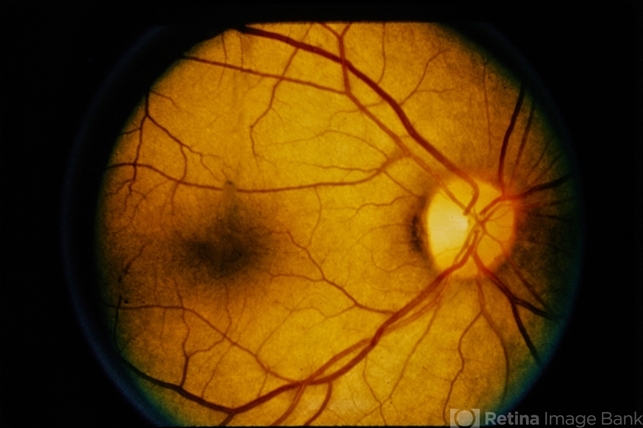
Fundus examination revealed a golden-yellow sheen across the retina, which disappeared after prolonged dark adaptation, a phenomenon known as the Mizuo-Nakamura phenomenon.
Genetic testing confirmed a mutation in the SAG gene, associated with Oguchi disease. The patient was counseled about the benign nature of the condition and reassured that no treatment was necessary.
Disease Entity
Oguchi disease is a rare autosomal recessive congenital stationary night blindness (CSNB) characterized by impaired scotopic (night) vision and a distinct golden-yellow discoloration of the retina.
This retinal appearance normalizes after prolonged dark adaptation, a unique feature distinguishing Oguchi disease from other forms of night blindness.
All-fit Slit-Lamp Adapter
Record and share exactly what you see at the slit lamp. One adapter fits any slit lamp or surgical microscope — and any smartphone.
From Choroida — the team behind this sitePathophysiology
Oguchi disease results from mutations in genes involved in the phototransduction cascade, which is essential for retinal rod photoreceptor function in low-light conditions. The two most commonly implicated genes are:
- SAG: Encodes arrestin, a protein critical for deactivating rhodopsin in rod cells.
- GRK1: Encodes rhodopsin kinase, another protein required for proper phototransduction deactivation.
Mutations in these genes lead to dysfunctional rod photoreceptors, causing night blindness. However, cone photoreceptors, responsible for daylight and color vision, remain unaffected, explaining the preservation of day vision.
Epidemiology
- Prevalence: Oguchi disease is rare worldwide, with higher prevalence in certain populations, particularly in Japan.
- Inheritance: It is inherited in an autosomal recessive pattern, requiring mutations in both copies of the affected gene for the disease to manifest.
- Demographics: The condition equally affects males and females, with symptoms typically present from birth or early childhood.

Clinical Features
- Night Blindness: The primary symptom is lifelong difficulty seeing in dim or dark environments.
- Golden-Yellow Retina: A characteristic yellow or grayish sheen across the retina, observed during fundus examination under normal lighting.
- Mizuo-Nakamura Phenomenon: The golden retinal sheen disappears after several hours of dark adaptation and reappears upon exposure to light. This reversible change is pathognomonic for Oguchi disease.
- Normal Day Vision: Patients retain normal vision during the day, as cones are unaffected.
Diagnosis
The diagnosis of Oguchi disease involves clinical examination, specialized testing, and genetic analysis.
- Fundus Examination: Identifies the golden retinal sheen and documents its disappearance after dark adaptation.
- Electroretinography (ERG): Shows reduced or absent rod responses, consistent with impaired scotopic function, while photopic (cone-mediated) responses are typically normal.
- Genetic Testing: Confirms mutations in SAG or GRK1, establishing a definitive diagnosis.
- Family History: Pedigree analysis can reveal autosomal recessive inheritance patterns.
Differential Diagnosis
Oguchi disease should be differentiated from other conditions causing night blindness or abnormal retinal appearances:
- Retinitis Pigmentosa (RP): Progressive condition with rod and cone degeneration, leading to peripheral vision loss and eventual central vision impairment. RP lacks the Mizuo-Nakamura phenomenon.
- Fundus Albipunctatus: Another form of stationary night blindness characterized by punctate white spots on the retina, without the golden sheen seen in Oguchi disease.
- Vitamin A Deficiency: Causes night blindness but is associated with systemic symptoms like xerophthalmia and keratomalacia.
- Congenital Stationary Night Blindness (CSNB): A group of non-progressive disorders affecting rod function but without the unique retinal sheen or Mizuo-Nakamura phenomenon.
Management
Oguchi disease is a benign, non-progressive condition that does not require specific treatment. Management focuses on patient education and reassurance.
- Counseling: Patients should be informed about the benign nature of the disease and the lack of progression.
- Low-Light Safety: Advising precautions in dim environments to prevent accidents due to impaired night vision.
- Genetic Counseling: Providing guidance to affected individuals and their families about inheritance patterns and reproductive risks.
Prognosis
The prognosis for individuals with Oguchi disease is excellent, as the condition is non-progressive and does not affect day vision. Most patients lead normal lives with appropriate accommodations for their night blindness.
Conclusion
Oguchi disease is a rare autosomal recessive disorder characterized by stationary night blindness and a distinctive golden retinal sheen that disappears after dark adaptation.

It is caused by mutations in genes essential for rod photoreceptor function, with no impact on cone-mediated day vision. Early diagnosis and patient education ensure optimal management and quality of life for affected individuals.
Would you be interested in taking retinal images with your smartphone?

Document what you see
Two smartphone imaging tools built for everyday clinic use — one for the slit lamp, one for the fundus.
From Choroida — the team behind this siteReferences
- Mizuo G. On a peculiar change of the reflex from the fundus oculi during dark adaptation in a case of retinitis pigmentosa. Acta Soc Ophthalmol Jpn. 1913;17:1313.
- Nakamura M. Studies on a peculiar change of the reflex from the fundus oculi in Oguchi’s disease. Acta Soc Ophthalmol Jpn. 1954;58:839.
- Dryja TP, McGee TL, Berson EL, et al. Identification of mutations in the SAG gene in Oguchi disease. Nature Genetics. 1999;22(3):255-259.
- Hayashi T, Katagiri S, Yoshitake K, et al. Genetic features of Oguchi disease in Japanese patients. Clinical Ophthalmology. 2018;12:1833-1839.
- Audo I, Michaelides M, Robson AG, et al. Phenotypic variability in Oguchi disease. Investigative Ophthalmology & Visual Science. 2008;49(8):1330-1336.
Test yourself
A few questions straight from this article.
-
How is Oguchi disease best classified?
Oguchi disease is a rare autosomal recessive form of congenital stationary night blindness with impaired scotopic vision and a golden-yellow retinal discolouration. -
What is the Mizuo-Nakamura phenomenon seen in Oguchi disease?
The golden retinal sheen vanishes after several hours of dark adaptation and returns on light exposure; this reversible change is pathognomonic for Oguchi disease. -
Which two genes are most commonly mutated in Oguchi disease?
SAG encodes arrestin and GRK1 encodes rhodopsin kinase; both are required to deactivate rhodopsin in rods, and mutations cause the phototransduction defect. -
Why is daytime vision preserved in patients with Oguchi disease?
The mutated genes disrupt rod phototransduction only; cones, which mediate daylight and colour vision, remain unaffected so day vision is normal. -
In which population is Oguchi disease reported to be more prevalent?
Oguchi disease is rare worldwide but has a higher reported prevalence in certain populations, particularly in Japan. -
What pattern does electroretinography show in Oguchi disease?
ERG shows reduced or absent rod responses reflecting impaired scotopic function, while photopic cone-mediated responses are typically normal. -
Which feature separates Oguchi disease from retinitis pigmentosa?
Retinitis pigmentosa is a progressive rod and cone degeneration that lacks the reversible Mizuo-Nakamura change characteristic of Oguchi disease. -
Which condition causes night blindness with punctate white retinal spots rather than a golden sheen?
Fundus albipunctatus is another stationary night blindness, but it shows punctate white retinal spots and not the golden sheen of Oguchi disease. -
Which systemic clue points to vitamin A deficiency rather than Oguchi disease as a cause of night blindness?
Vitamin A deficiency also causes night blindness but is accompanied by systemic ocular surface signs such as xerophthalmia and keratomalacia. -
What is the appropriate management for a patient diagnosed with Oguchi disease?
Oguchi disease is benign and non-progressive, so no specific treatment is needed; care focuses on reassurance, precautions in dim light, and genetic counselling.
