

Case Study
A 35-year-old male presented with recurrent episodes of unilateral blurry vision and mild eye discomfort lasting several days.
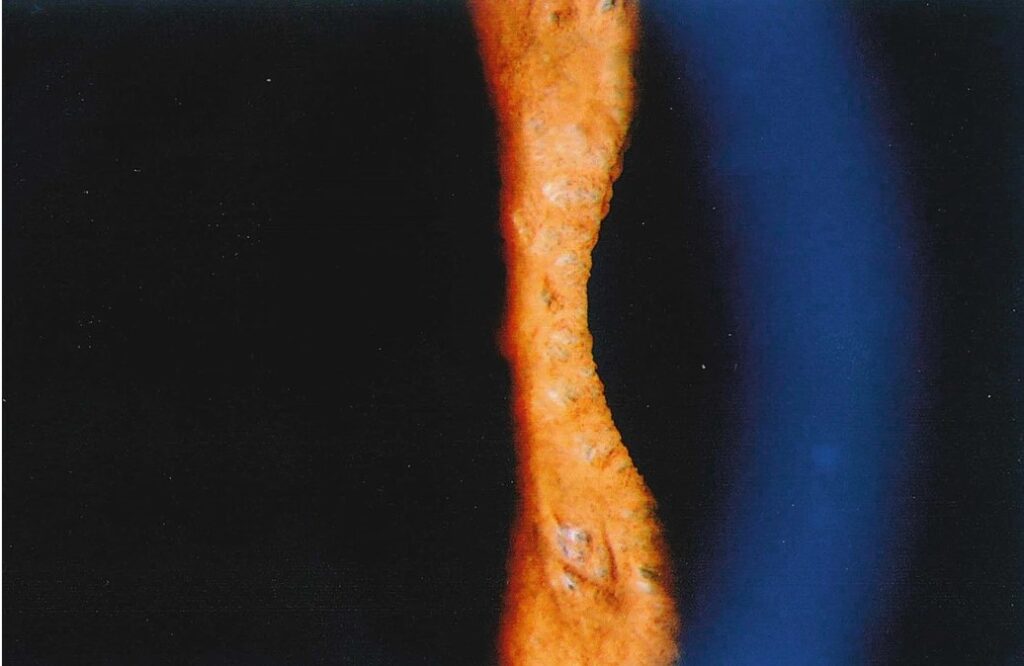
He reported no significant past ocular history but noted periodic mild eye redness that resolved spontaneously.
On examination, his intraocular pressure (IOP) in the affected eye was 38 mmHg, with minimal conjunctival injection and mild corneal edema.
Slit-lamp examination revealed fine keratic precipitates (KPs) and no posterior synechiae. The gonioscopy showed open angles without peripheral anterior synechiae.
A diagnosis of Posner-Schlossman Syndrome (PSS) was made, and the patient was managed with topical steroids and intraocular pressure-lowering medications.
Disease entity
Posner-Schlossman Syndrome (PSS), also known as glaucomatocyclitic crisis, is a rare, idiopathic, and recurrent condition characterized by episodes of unilateral, acute intraocular pressure elevation and mild anterior uveitis.
First described by Posner and Schlossman in 1948, this syndrome remains poorly understood, with debates about its etiology and long-term implications for vision.
Posner-Schlossman Syndrome (PSS) predominantly affects individuals in their third to fifth decades of life and has a male predilection.
While episodes are self-limiting, repeated attacks can increase the risk of secondary glaucoma, necessitating prompt diagnosis and management.
All-fit Slit-Lamp Adapter
Record and share exactly what you see at the slit lamp. One adapter fits any slit lamp or surgical microscope — and any smartphone.
From Choroida — the team behind this sitePathophysiology
The exact cause of PSS remains unclear, but several theories have been proposed.

- Viral Infection Hypothesis:
The presence of herpes simplex virus (HSV) or cytomegalovirus (CMV) DNA in aqueous humor samples from some patients supports a viral etiology. These infections may trigger inflammation in the trabecular meshwork, impairing aqueous outflow and causing a transient rise in IOP. - Immune Dysregulation:
An aberrant immune response has also been implicated. Inflammatory mediators released during uveitis episodes may disrupt trabecular meshwork function, leading to transient aqueous humor retention. - Autonomic Dysregulation:
Autonomic nervous system imbalances affecting ciliary body function have been suggested as contributing factors.
Regardless of the underlying cause, repeated episodes of high IOP can damage the optic nerve, emphasizing the importance of early diagnosis and management.
Epidemiology
Posner-Schlossman Syndrome (PSS) is a rare disorder with an estimated prevalence of less than 0.1% of the general population.
It predominantly affects adults between 20 and 50 years of age, with a slight male predilection. There are no significant racial or geographic predispositions, although viral etiologies may vary regionally.
Clinical Features
Posner-Schlossman Syndrome (PSS) presents with distinct clinical findings that aid in diagnosis:
- Intraocular Pressure (IOP) Elevation:
IOP typically ranges between 30-50 mmHg during an acute episode. The rise in pressure is painless or minimally symptomatic, distinguishing it from other glaucomas. - Mild Anterior Uveitis:
The hallmark of PSS is mild, unilateral anterior uveitis with fine, stellate keratic precipitates on the corneal endothelium. Unlike other forms of uveitis, posterior synechiae are absent. - Corneal Edema:
High IOP may cause mild corneal edema, leading to halos around lights or blurred vision. - Open Angles on Gonioscopy:
Gonioscopy reveals open anterior chamber angles without synechiae, ruling out angle-closure glaucoma. - Intermittent and Self-limiting Episodes:
Episodes may last from hours to weeks and resolve spontaneously. However, recurrence is common. - Minimal Systemic Symptoms:
Systemic involvement is rare, differentiating Posner-Schlossman Syndrome (PSS) from uveitis associated with systemic conditions like sarcoidosis or juvenile idiopathic arthritis.

Diagnosis
Diagnosis of PSS relies on a combination of clinical findings and the exclusion of other conditions.
- Clinical Examination:
- High IOP with mild anterior uveitis in a unilateral eye.
- Fine keratic precipitates without synechiae or significant anterior chamber reaction.
- Imaging:
- Optical Coherence Tomography (OCT): To evaluate the optic nerve for early glaucomatous damage.
- Anterior Segment OCT: This may help assess the angle and confirm open trabecular meshwork.
- Laboratory Testing:
Aqueous humor sampling for viral PCR (e.g., HSV or CMV) can help identify an infectious etiology in recurrent or severe cases. - Differential Diagnosis:
- Fuchs Heterochromic Iridocyclitis
- Herpetic anterior uveitis
- Secondary glaucomas, such as pigment dispersion or pseudoexfoliation syndrome
Management
Treatment of Posner-Schlossman Syndrome (PSS) focuses on controlling inflammation and lowering IOP during acute episodes.
- Topical Steroids:
Corticosteroids such as prednisolone acetate effectively reduce anterior chamber inflammation. Prolonged or inappropriate use, however, increases the risk of steroid-induced glaucoma. - IOP-lowering Medications:
- Beta-blockers (e.g., timolol)
- Alpha agonists (e.g., brimonidine)
- Carbonic anhydrase inhibitors (e.g., dorzolamide)
- Prostaglandin analogs are generally avoided due to their inflammatory potential.
- Antiviral Therapy:
If HSV or CMV is confirmed, systemic antivirals such as acyclovir or valganciclovir may be warranted. - Long-term Monitoring:
Patients with recurrent episodes should undergo regular glaucoma screening, as repeated attacks can lead to optic nerve damage and chronic open-angle glaucoma.
Prognosis
The prognosis of PSS is generally favorable if managed appropriately. Acute episodes typically resolve without significant visual impairment.
However, recurrent episodes pose a risk of chronic glaucoma, which can result in irreversible optic nerve damage and visual field loss.
Early recognition and treatment are key to preserving vision and preventing complications.

Prevention
While Posner-Schlossman Syndrome (PSS) cannot be entirely prevented, some measures can reduce recurrence:
- Regular follow-ups to monitor IOP and optic nerve health.
- Prompt treatment of acute episodes.
- Early antiviral intervention in suspected viral etiology cases.
Document what you see
Two smartphone imaging tools built for everyday clinic use — one for the slit lamp, one for the fundus.
From Choroida — the team behind this siteReferences
- Posner A, Schlossman A. Syndrome of unilateral recurrent attacks of glaucoma with cyclitic symptoms. Arch Ophthalmol. 1948;39(1):517-535.
- Jap A, Chee SP. Viral anterior uveitis. Curr Opin Ophthalmol. 2011;22(6):483-488.
- La Hey E, de Vries J, Lemij HG. Glaucomatocyclitic crisis and its association with open-angle glaucoma. J Glaucoma. 2003;12(4):271-275.
- Chee SP, Jap A. The role of cytomegalovirus in Posner-Schlossman syndrome. Am J Ophthalmol. 2008;145(5):831-836.
- Wakabayashi T, Okamoto F, Ikejima H, et al. Clinical features of Posner-Schlossman syndrome. Int Ophthalmol. 2020;40(5):1203-1209.
