
Case Study
A 65-year-old woman presented with rapidly deteriorating vision over six months. She complained of bilateral blurred vision, photophobia, and difficulty reading.
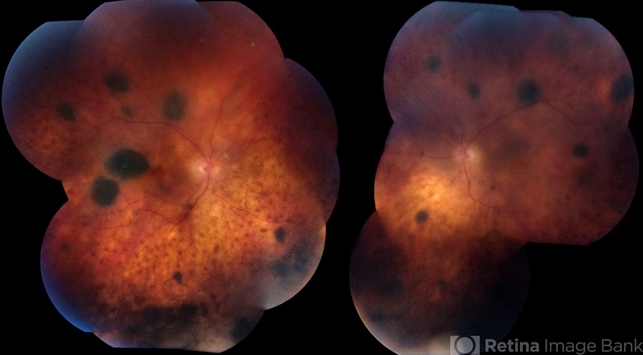
Her medical history revealed a recent diagnosis of ovarian carcinoma. On examination, her best-corrected visual acuity was 20/100 in both eyes.
Smartphone fundoscopy showed multiple pigmented patches in the posterior pole, thickened choroidal tissue, and serous retinal detachments.
B-scan ultrasonography revealed bilateral diffuse thickening of the choroid. Despite aggressive oncological management, her ocular condition worsened.
A diagnosis of Bilateral Diffuse Uveal Melanocytic Proliferation (BDUMP) associated with her malignancy was established, emphasizing the rare paraneoplastic nature of this disease.
Disease entity
Bilateral Diffuse Uveal Melanocytic Proliferation (BDUMP) is an exceedingly rare paraneoplastic syndrome characterized by bilateral proliferation of melanocytic cells in the uveal tract.
It is associated with systemic malignancies, most commonly gynecological cancers in women and pancreatic or lung cancers in men.
BDUMP is notorious for its aggressive course, often leading to profound visual loss despite the resolution of the underlying malignancy.
First described in 1966, BDUMP has since remained a topic of intrigue due to its enigmatic pathophysiology and challenging management.
Its rarity and nonspecific early symptoms often lead to delayed diagnosis, underscoring the need for heightened clinical awareness.
All-fit Slit-Lamp Adapter
Record and share exactly what you see at the slit lamp. One adapter fits any slit lamp or surgical microscope — and any smartphone.
From Choroida — the team behind this sitePathophysiology
The pathogenesis of Bilateral Diffuse Uveal Melanocytic Proliferation (BDUMP) involves an intricate interplay between systemic malignancy and ocular changes.
- Paraneoplastic Mechanism:
- BDUMP arises as a paraneoplastic syndrome wherein tumor-secreted factors trigger melanocytic proliferation in the uveal tract.
- Immunohistochemical studies suggest that melanocyte growth factors released by tumors stimulate abnormal proliferation.
- Role of Tumor Necrosis Factor (TNF):
- Elevated TNF levels are believed to alter the uveal environment, promoting melanocytic cell proliferation.
- This mechanism is supported by the systemic inflammatory milieu observed in many patients.
- Melanocytic Hyperplasia:
- Hyperplasia involves melanocytes in the iris, ciliary body, and choroid, leading to diffuse thickening of the uveal tract.
- Retinal Complications:
- Serous retinal detachments arise from alterations in choroidal vasculature and increased permeability.
Epidemiology
BDUMP is rare, with fewer than 100 cases reported in the literature.
- Gender Predilection:
- Women are more commonly affected, likely due to the strong association with gynecological malignancies.
- Age:
- BDUMP typically occurs in individuals over 50 years of age, coinciding with the peak incidence of associated cancers.
- Associated Malignancies:
- Ovarian, uterine, and breast cancers in women.
- Pancreatic, lung, and bladder cancers in men.
Clinical Features
The hallmark of Bilateral Diffuse Uveal Melanocytic Proliferation (BDUMP) is rapid, bilateral visual decline in the context of systemic malignancy.
- Ocular Symptoms:
- Blurred vision.
- Photophobia.
- Metamorphopsia (distorted vision).
- Central or paracentral scotomas.
- Ophthalmic Examination Findings:
- Anterior Segment:
- Pigmentation of the iris.
- Iris nodules.
- Posterior Segment:
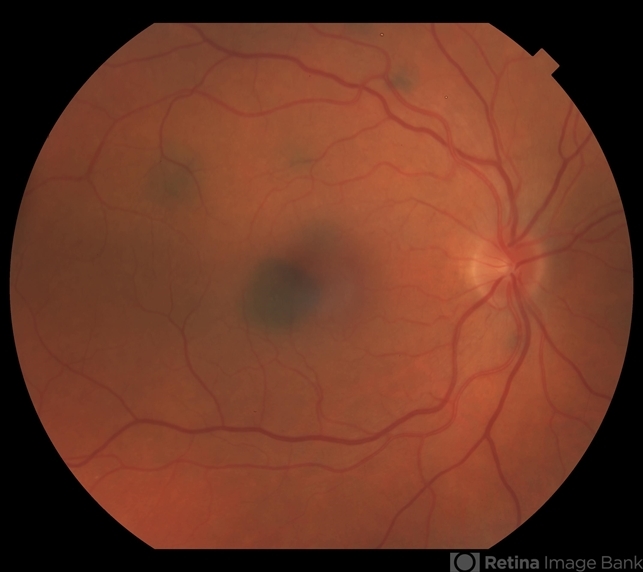
- Multiple pigmented and non-pigmented uveal patches.
- Thickening of the choroid.
- Serous retinal detachments without tears.
- Anterior Segment:
- Systemic Association:
- Symptoms of underlying malignancy, such as weight loss, fatigue, or abdominal pain, may be concurrent.
Diagnosis
Bilateral Diffuse Uveal Melanocytic Proliferation (BDUMP) diagnosis relies on a combination of clinical, imaging, and systemic investigations.
- Ocular Imaging:
- Ultrasound B-Scan: Reveals bilateral diffuse choroidal thickening.
- Fluorescein Angiography (FA): Hyperfluorescent patches in the posterior pole.
- Optical Coherence Tomography (OCT): Highlights serous retinal detachments and choroidal thickening.
- Systemic Work-Up:
- Comprehensive cancer screening is essential, including imaging and tumor marker analysis.
- Histopathology:
- Biopsies of the choroid or systemic tumor reveal melanocytic hyperplasia and tumor-specific findings.
- Paraneoplastic Antibodies:
- Testing for autoantibodies associated with paraneoplastic syndromes can support the diagnosis.
Differential Diagnosis
BDUMP must be distinguished from other causes of choroidal thickening and retinal detachment:
- Uveal Melanoma: Usually unilateral with localized lesions.
- Posterior Scleritis: Often associated with pain and anterior segment inflammation.
- Vogt-Koyanagi-Harada (VKH) Syndrome: Features systemic involvement, such as meningitis and auditory symptoms.
- Central Serous Chorioretinopathy (CSCR): Focal serous detachment without diffuse choroidal thickening.
Management
Management of Bilateral Diffuse Uveal Melanocytic Proliferation (BDUMP) is challenging due to its progressive nature and dependence on the underlying malignancy.
- Oncological Treatment:
- Effective management of the primary malignancy is paramount.
- Surgical resection, chemotherapy, or radiotherapy can stabilize systemic disease but may not halt ocular progression.
- Ocular Interventions:
- Corticosteroids: Limited efficacy in reducing inflammation and retinal detachments.
- Plasmapheresis/Intravenous Immunoglobulin (IVIG): Used in some cases to reduce the paraneoplastic autoimmune response.
- Anti-VEGF Therapy: Addresses retinal detachment but offers temporary relief.
- Low-Vision Rehabilitation:
- Visual aids and occupational therapy improve the quality of life in advanced stages.
Prognosis
The prognosis for BDUMP is generally poor, with progressive vision loss in most patients.
- Visual Outcome:
- Most patients experience significant central vision loss despite aggressive management.
- Survival:
- The prognosis of associated malignancy heavily influences overall survival.

Prevention
No specific preventive measures exist for BDUMP. Early cancer detection and treatment are critical for mitigating its systemic and ocular effects.
Conclusion
Bilateral Diffuse Uveal Melanocytic Proliferation (BDUMP) is a rare and devastating paraneoplastic syndrome that exemplifies the complex interplay between systemic malignancies and ocular health.
Its diagnostic and therapeutic challenges highlight the need for interdisciplinary collaboration between oncologists and ophthalmologists.
Advancements in paraneoplastic research may unlock new pathways for early detection and targeted therapies, offering hope to patients facing this relentless condition.

Document what you see
Two smartphone imaging tools built for everyday clinic use — one for the slit lamp, one for the fundus.
From Choroida — the team behind this siteReferences
- Gass JD, Gieser RG. Bilateral diffuse uveal melanocytic proliferation in patients with occult carcinoma. Arch Ophthalmol. 1997;115(11):1483-1487.
- Arepalli S, Shields CL, Kaliki S, et al. Multimodal imaging of BDUMP: Diagnostic and therapeutic challenges. Retina. 2018;38(2):217-225.
- Sen J, Shields JA, Shields CL. Bilateral diffuse uveal melanocytic proliferation: Paraneoplastic syndrome with systemic cancer. Curr Opin Ophthalmol. 2012;23(6):546-553.
- Kidd DP, Cree IA, Chisholm IH. Paraneoplastic melanocytic proliferation and uveal thickening in malignancy. Eye (Lond). 2019;33(4):607-614.
- Battista VM, Pelayes DE. Paraneoplastic ocular manifestations: Clinical update on BDUMP. Ophthalmic Res. 2021;64(4):192-202.
Test yourself
A few questions straight from this article.
-
How is bilateral diffuse uveal melanocytic proliferation (BDUMP) best characterised?
BDUMP is an exceedingly rare paraneoplastic syndrome in which melanocytic cells proliferate bilaterally throughout the uveal tract in association with systemic malignancy. -
Which malignancies are most commonly associated with BDUMP in women?
In women BDUMP is linked to ovarian, uterine and breast cancers; in men pancreatic, lung and bladder cancers are the usual associations. -
Which mediator is implicated in driving melanocytic proliferation in BDUMP?
Elevated tumor necrosis factor levels are believed to alter the uveal environment and promote melanocytic proliferation, supported by the systemic inflammatory milieu seen in patients. -
Roughly how many cases of BDUMP have been reported in the literature?
BDUMP is rare, with fewer than 100 cases reported in the literature, and typically occurs in individuals over 50 years of age. -
Which anterior segment findings may be seen in BDUMP?
Anterior segment examination in BDUMP may show pigmentation of the iris and iris nodules, alongside posterior findings of uveal patches and choroidal thickening. -
What does B-scan ultrasonography classically demonstrate in BDUMP?
Ultrasound B-scan reveals bilateral diffuse thickening of the choroid, while OCT highlights serous retinal detachments and choroidal thickening. -
Which feature distinguishes uveal melanoma from BDUMP?
Uveal melanoma is usually unilateral with localized lesions, whereas BDUMP produces bilateral diffuse melanocytic proliferation and choroidal thickening. -
Which condition presents with focal serous detachment but no diffuse choroidal thickening?
Central serous chorioretinopathy causes focal serous detachment without the diffuse choroidal thickening that characterises BDUMP. -
Which ocular intervention is used in BDUMP to reduce the paraneoplastic autoimmune response?
Plasmapheresis or IVIG has been used in some cases to reduce the paraneoplastic autoimmune response; corticosteroids and anti-VEGF give only limited or temporary benefit. -
What is the visual prognosis of BDUMP?
The prognosis is generally poor, with most patients suffering significant central vision loss despite aggressive treatment; survival depends on the associated malignancy.
