
CASE REPORT
A 55-year-old female presented with a complaint of central visual loss. On dilated fundus examination, peau d’orange, angioid streaks, and CNV were noted.
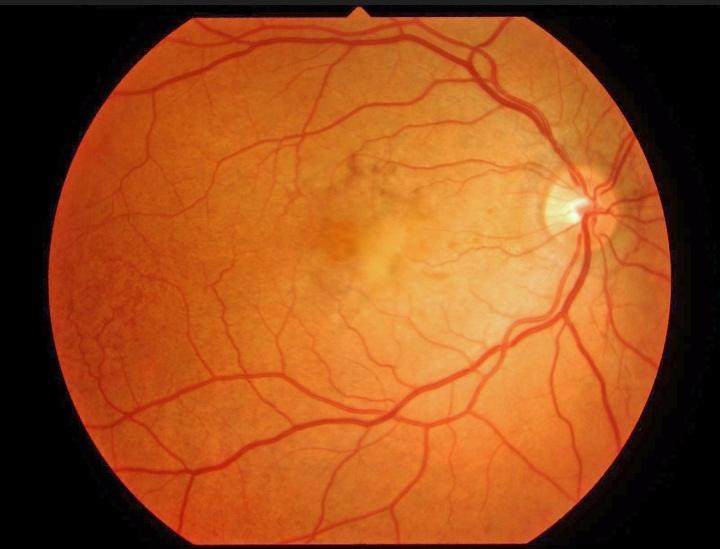
On physical examination, skin lesions were found in her neck region, so she was referred to a dermatologist for an incisional biopsy to confirm the diagnosis of Pseudoxanthoma Elasticum.
After getting the combined opinions of a dermatologist and an ophthalmologist, the diagnosis of Pseudoxanthoma Elasticum was confirmed.
Pseudoxanthoma Elasticum DISEASE entity
Pseudoxanthoma Elasticum is also known as Gronblad-Strandberg syndrome. It is a genetic disorder in which mutations in the ABCC6 gene occur. This gene is responsible for maintaining the elasticity of different body structures.
Still, due to hereditary mutations of the gene, calcium deposits are accumulated in elastic tissues of the body such as the skin, cardiovascular system, gastrointestinal system, and eyes thus leading to pseudoxanthoma elasticum. But all of these don’t need to be affected at a time.
It might be possible that skin lesions are present but visual and cardiac systems have not shown any abnormality yet.
When it affects the skin, it causes cobblestone-like rashes to be visible on the skin usually on the side of the neck
In the Cardiovascular system, it causes the Narrowing of blood vessels due to mineralization thus causing a decrease in blood flow. When blood flow is disrupted, the patient may feel cramps in his legs while walking.
In the gastrointestinal system, it causes bleeding in the stomach or intestine
In the eyes, it affects Bruch’s membrane, the elastic layer between the retinal pigment epithelium and the choroid.
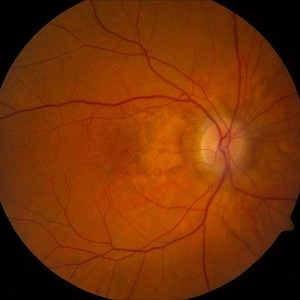
Due to gene mutations, the elasticity of Bruch’s membrane is lost, leading to cracks in Bruch’s membrane. These cracks show a resemblance with blood vessels but are named angioid streaks. These cracks allow the growth of abnormal blood vessels( neovascularization) which leak and bleed thus causing central loss of vision.
On examination, the retina shows:
- peau d’ orange or mottled hyperpigmentation.
- angioid streaks.
- CNV.
Fundus Explorer Pro
Photograph the retinal findings described here with the phone already in your pocket — 22 D optics and built-in illumination in one handheld unit.
From Choroida — the team behind this sitePseudoxanthoma Elasticum MANAGEMENT
In some cases of retinal hemorrhages, injectable medications and laser treatment are helpful but lost vision cannot be restored with laser treatments.

In such cases, the patient is referred to a low vision clinic to provide him with low vision aids to compensate for his vision loss and improve his quality of life with remaining vision.
Document what you see
Two smartphone imaging tools built for everyday clinic use — one for the slit lamp, one for the fundus.
From Choroida — the team behind this siteREFERENCES
- Georgalas I, Tservakis I, Papaconstaninou D, Kardara M, Koutsandrea C, Ladas I. Pseudoxanthoma elasticum, ocular manifestations, complications and treatment. Clin Exp Optom. 2011;94:169–80.
- Gliem M, Müller PL, Birtel J, Hendig D, Holz FG, Charbel Issa P. Frequency, phenotypic characteristics and progression of atrophy associated with a diseased bruch’s membrane in pseudoxanthoma elasticum. Invest Ophthalmol Vis Sci. 2016;57:3323–30.
- Orssaud C, Roche O, Dufier JL, Germain DP. Visual impairment in pseudoxanthoma elasticum: A survey of 40 patients. Ophthalmic Genet. 2015;36:327–32.
- Bennett JC, Plum F. eds. Cecil Textbook of Medicine. 20th ed. Philadelphia, PA: W.B. Saunders Co; 1996:1123-24.
- Yamada T, et al, eds. Textbook of Gastroenterology. 2nd ed. Philadelphia, PA: J.B. Lippincott Company; 1995:959-60.
- Beighton P, ed. McKusick’s Heritable Disorders of Connective Tissue. 5th ed. St. Louis, MO: Mosby-Year Book, Inc; 1993:335-65.
Test yourself
A few questions straight from this article.
-
Mutation of which gene causes pseudoxanthoma elasticum?
Pseudoxanthoma elasticum is a genetic disorder caused by mutations in the ABCC6 gene, which maintains the elasticity of body structures. -
What accumulates in elastic tissues to produce pseudoxanthoma elasticum?
Calcium deposits build up in elastic tissues of the skin, cardiovascular and gastrointestinal systems and eyes, although not all need to be affected at the same time. -
What skin lesion is typical of pseudoxanthoma elasticum?
Skin involvement produces cobblestone-like lesions, usually on the side of the neck, and may be present before any eye or heart abnormality appears. -
Which symptom reflects cardiovascular involvement in pseudoxanthoma elasticum?
Mineralisation narrows blood vessels and reduces blood flow, so patients may feel cramps in the legs while walking. -
What are angioid streaks in pseudoxanthoma elasticum?
Bruch's membrane loses its elasticity and cracks; the cracks resemble blood vessels, which is why they are called angioid streaks. -
How do angioid streaks lead to central vision loss in pseudoxanthoma elasticum?
The cracks allow abnormal new vessels to grow; these leak and bleed, causing the central visual loss seen in the article's 55-year-old patient. -
Besides angioid streaks and CNV, which fundus sign is described in pseudoxanthoma elasticum?
On examination the retina shows peau d'orange or mottled hyperpigmentation together with angioid streaks and CNV. -
How was pseudoxanthoma elasticum confirmed in the article's patient with angioid streaks and neck lesions?
Neck skin lesions led to referral for an incisional biopsy, and the combined opinions of a dermatologist and an ophthalmologist confirmed the diagnosis. -
What can laser and injectable treatment achieve for retinal haemorrhage in pseudoxanthoma elasticum?
Injectable medications and laser help in some cases of retinal haemorrhage but cannot restore lost vision, so patients are referred for low-vision aids.
