
CASE REPORT
A 26-year-old male was admitted to a hospital in a coma state with a previous history of malaria. He had no significant systemic history of diabetes, hypertension, and TB but the patient was tachycardic at the time of admission.

As the patient recovered from the coma after a week, his visual acuity was tested which was found to be decreased in both eyes. RE: 6/24 (unaided), LE: 6/36 (unaided).
Blood films of this patient confirmed the presence of malaria. Dilated Indirect ophthalmoscopy was done which reported the detailed fundus with marked bilateral retinal hemorrhages, discoloration of vessels in the peripheral retina, and retinal whitening.
OCT was also performed which revealed hyperreflectivity of vessels. This hyperreflectivity was consistent with parasites within the retinal blood vessels. Fluorescein Angiography showed retinal occlusion and associated retinal ischemia.
Diagnosis of Malarial Retinopathy was confirmed.
Malarial Retinopathy DISEASE entity
Malaria is a serious disease that occurs when humans are bitten by parasitic infected mosquitoes. It is such a toxic disease that it can change the mental status of patients leading to cerebral Malaria and sometimes fatal to such an extent that causes death.
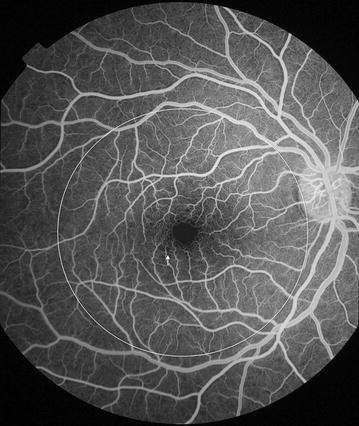
When this Malaria enters into the phase of severity it also affects the eye. In the eye, it affects the most sensitive inner layer which is responsible for providing sharp and clear vision called the retina.
In 1993, retinal changes due to severe malaria were the first time noticed in Malawian children. Malarial retinopathy was mostly seen in infections caused by Plasmodium falciparum.
It is commonly seen in children with cerebral Malaria. These children are presented with the following symptoms
- Coma
- Seizures
- Hypertonia
- Hyperventilation
- Anemia
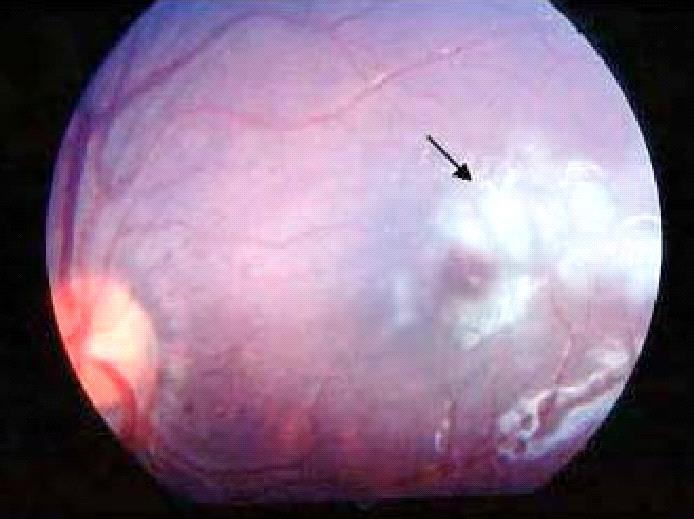
The person with malarial retinopathy shows the following signs:
Retinal whitening:
When malaria affects the central retina(macula), it is referred to as macular whitening. When it affects the retina other than the macula, it is called peripheral whitening.
Vessels discoloration:
Color of vessels changes to white or orange in the peripheral retina.
Retinal hemorrhages:
These intra-retinal blot hemorrhages show a resemblance with Roth spots. When severe malarial retinopathy occurs, the hemorrhages increase in number.
Optic disc edema:
Papilloedema may accompany the retinal whitening, vessel discoloration and hemorrhages of malarial retinopathy.

Papilloedema on its own, without these signs, is not specific to malarial retinopathy.
Fundus Explorer Pro
Photograph the retinal findings described here with the phone already in your pocket — 22 D optics and built-in illumination in one handheld unit.
From Choroida — the team behind this siteMalarial Retinopathy MANAGEMENT
Systemic and local antimalarial therapy is given otherwise no specific treatment for malarial retinopathy has been described.

Document what you see
Two smartphone imaging tools built for everyday clinic use — one for the slit lamp, one for the fundus.
From Choroida — the team behind this siteREFERENCES
- Lewallen S, Taylor TE, Molyneux ME, Wills BA, Courtright P. Ocular fundus findings in Malawian children with cerebral malaria. Ophthalmology. 1993;100(6):857-861.
- Beare NAV, Taylor TE, Harding SP, Lewallen S, Molyneux ME. Malarial retinopathy: a newly established diagnostic sign in severe malaria. Am J Trop Med Hyg. 2006;75(5):790-797.
- Conroy AL, Glover SJ, Hawkes M, et al. Angiopoietin-2 levels are associated with retinopathy and predict mortality in Malawian children with cerebral malaria: a retrospective case-control study. Crit Care Med. 2012;40(3):952-959.
-
World Health Organization. Severe falciparum malaria. Trans R Soc Trop Med Hyg. 2000;94:S1–S90.
-
Reyburn H, Mbatia R, Drakeley C, Carneiro I, Mwakasungula E, Mwerinde O, Saganda K, Shao J, Kitua A, Olomi R, Green-wood BM, Whitty CJ. Overdiagnosis of malaria in patients with severe febrile illness in Tanzania: a prospective study. BMJ. 2004;329:1212–1217.
-
Mwangi TW, Ross A, Snow RW, Marsh K. Case definitions of clinical malaria under different transmission conditions in Kilifi District, Kenya. J Infect Dis. 2005;191:1932–1939.
Test yourself
A few questions straight from this article.
-
In which patients is malarial retinopathy most commonly seen?
Malarial retinopathy is commonly seen in children with cerebral malaria; the eye becomes involved when malaria enters its severe phase. -
Which presentation is described in children with cerebral malaria who develop malarial retinopathy?
These children present with coma, seizures, hypertonia, hyperventilation and anaemia. -
How is retinal whitening classified in malarial retinopathy?
Whitening involving the central retina is called macular whitening; whitening of the retina outside the macula is called peripheral whitening. -
What vessel change is seen in the peripheral retina in malarial retinopathy?
Vessel discolouration turns peripheral retinal vessels white or orange, as seen in the article's comatose patient. -
Which lesion do the retinal haemorrhages of malarial retinopathy resemble?
The haemorrhages are intraretinal blot haemorrhages resembling Roth spots, and they increase in number as the retinopathy becomes more severe. -
What did fluorescein angiography show in the article's case of malarial retinopathy?
Fluorescein angiography showed retinal occlusion with associated retinal ischaemia, complementing the bedside fundus findings. -
What treatment does the article describe for malarial retinopathy?
Systemic and local antimalarial therapy is given; no specific treatment for malarial retinopathy itself has been described. -
Which test confirmed malaria in the article's comatose patient with retinal haemorrhages and whitening?
Blood films confirmed malaria, and dilated indirect ophthalmoscopy showed bilateral haemorrhages, peripheral vessel discolouration and retinal whitening.
