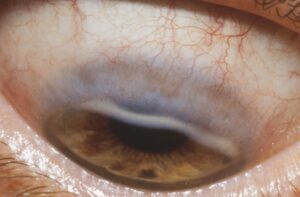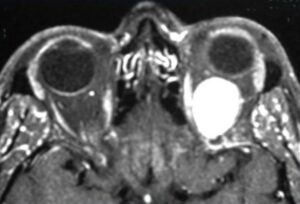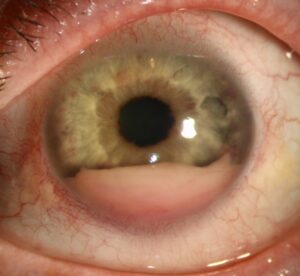
Cosmetic iris implants are colored silicone diaphragms that a surgeon places in the anterior chamber of healthy eyes to change eye color.
The surgeon folds the device, inserts it through a corneal incision and unfolds it over the natural iris. However, published case series describe serious complications that often threaten vision. Therefore, clinicians need to recognize these eyes and know when removal becomes necessary.
What Cosmetic Iris Implants Are
These devices rest on the anterior iris surface, and their fit within the angle holds them in place, with commercial names including NewColorIris and BrightOcular. Most procedures take place abroad, while patients return home for follow-up. Regulators such as the FDA have not approved them for cosmetic use in normal eyes.
Cosmetic Versus Prosthetic Iris Devices
Prosthetic iris devices treat aniridia, iris trauma and disabling photophobia. Surgeons usually place them in the sulcus or capsular bag, often with an intraocular lens. In contrast, cosmetic implants occupy the anterior chamber of a phakic, healthy eye, so they sit against the angle structures and close to the endothelium.
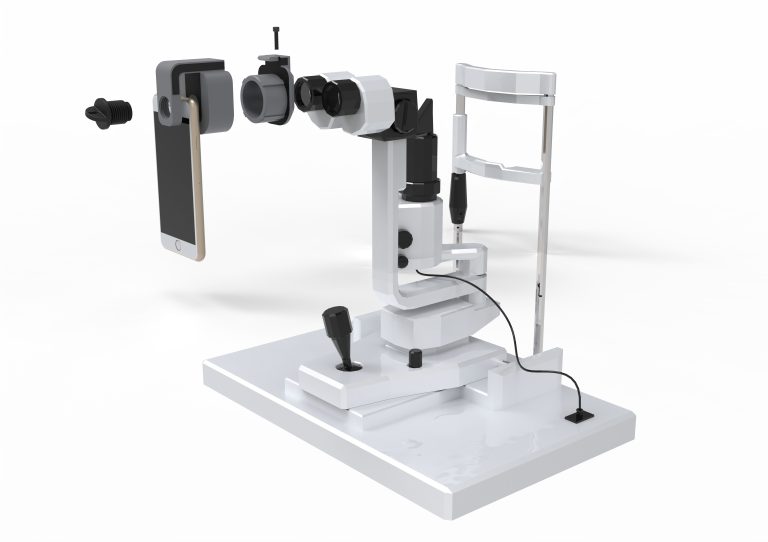
All-fit Slit-Lamp Adapter
Record and share exactly what you see at the slit lamp. One adapter fits any slit lamp or surgical microscope — and any smartphone.
From Choroida — the team behind this siteWhy Cosmetic Iris Implants Cause Damage
The anterior chamber tolerates foreign material poorly, and a stiff or oversized device rubs the iris with every pupil movement. Iris chafing then releases pigment and inflammatory cells into the aqueous, and contact with the angle and peripheral cornea injures the trabecular meshwork and endothelium.
Chronic Uveitis
Anterior uveitis is among the most frequently reported complications, and patients report redness, photophobia and blurred vision, sometimes months after surgery. At the slit lamp, the examiner sees cells, flare and keratic precipitates, and chronic inflammation can also produce posterior synechiae and cystoid macular edema. Steroids may calm the eye, but inflammation often returns while the device stays.
Glaucoma After Cosmetic Iris Implants
Raised intraocular pressure develops through several overlapping mechanisms, because pigment and inflammatory debris clog the trabecular meshwork. Meanwhile, peripheral anterior synechiae form where the implant edge touches the angle, and a steroid response may add to the problem during uveitis treatment. As a result, some eyes develop optic nerve damage despite maximal drops.
Corneal Endothelial Loss
Adult endothelial cells do not regenerate, so mechanical touch and chronic inflammation cause permanent cell loss. Specular microscopy may show low density and abnormal cell shape before edema appears. Once density falls far enough, the cornea decompensates (compare endothelial cell loss after cataract surgery), and patients may then need endothelial keratoplasty.
Other Complications of Cosmetic Iris Implants
- Cataract from lens contact or chronic inflammation
- Hyphema from iris chafing
- Implant decentration or dislocation
- Pupil distortion, glare and halos
Examining the Patient
First, ask directly about eye surgery abroad, because patients may not volunteer it. At the slit lamp, the implant looks flat, uniform and artificial in color, while gonioscopy shows whether the edge touches the angle and whether synechiae have formed. Next, measure pressure, count endothelial cells and image the optic nerve and macula.
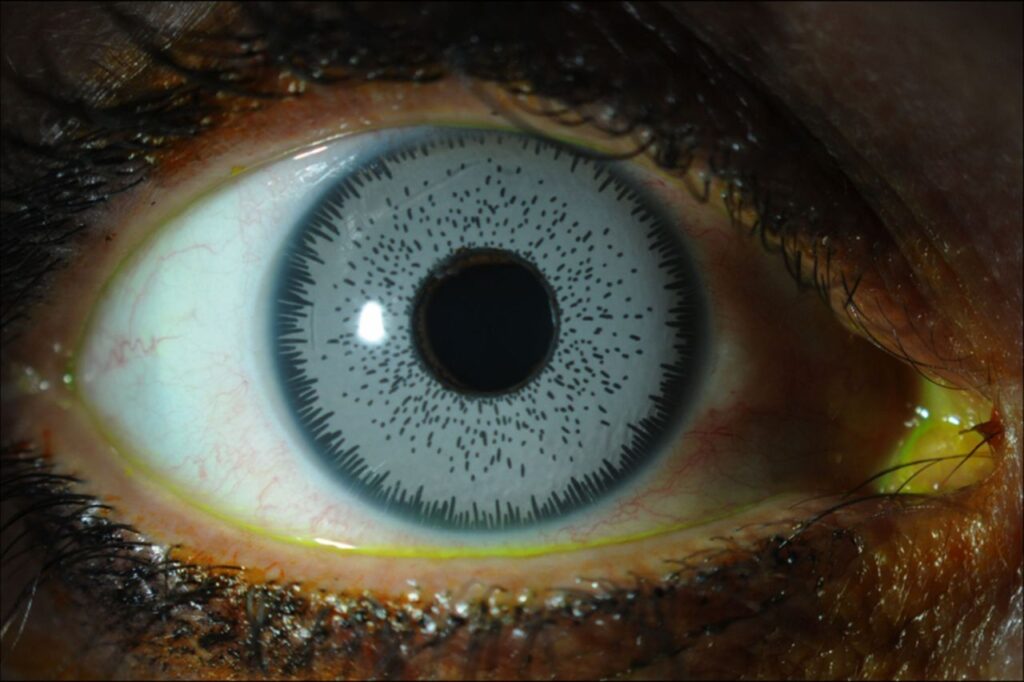
Monitoring Asymptomatic Eyes
Some patients feel well and decline removal, but damage can progress silently, so regular review matters. Check pressure, endothelial density, the angle and the optic nerve at each visit, and record baseline values so that a downward trend becomes obvious.
The Explant Decision in Cosmetic Iris Implants
Most published series favor removal once a complication appears, and persistent uveitis, rising pressure or falling endothelial density are strong triggers. Earlier removal may preserve more endothelium and angle function, whereas delay often lets irreversible damage accumulate.
Surgical Removal of Cosmetic Iris Implants
Surgeons usually extract the device through a small incision, sometimes after cutting it, and viscoelastic protects the endothelium during the maneuver. Synechiae may need careful lysis, and the surgeon may address a cataract in the same session, while removal carries its own risks, including further endothelial loss and hyphema.
Outcomes After Removal
Inflammation often settles once the device leaves the eye, but glaucoma and corneal edema may persist. Some patients then need filtering surgery, tube shunts or endothelial keratoplasty, so explantation stops further injury but cannot reverse established damage.
Managing Glaucoma in Cosmetic Iris Implants
Start with topical pressure-lowering drops and control inflammation, and if pressure stays high, surgery becomes necessary. Angle-based procedures may fail when synechiae and scarring are extensive (see minimally invasive glaucoma surgery). As a result, trabeculectomy or a tube shunt is often the more practical choice.
Counseling Patients About Cosmetic Iris Implants
Explain that the procedure places a foreign body inside a healthy eye, and describe the documented risks plainly, including permanent vision loss. For patients who already have implants, advise lifelong follow-up, and mention colored contact lenses from a qualified fitter as a reversible alternative.
Pitfalls to Avoid
- Do not label recurrent uveitis idiopathic before asking about eye surgery abroad
- Never rely on steroids alone while the implant remains in the eye
- Check pressure closely during steroid treatment
- Do not wait for corneal decompensation before discussing explant
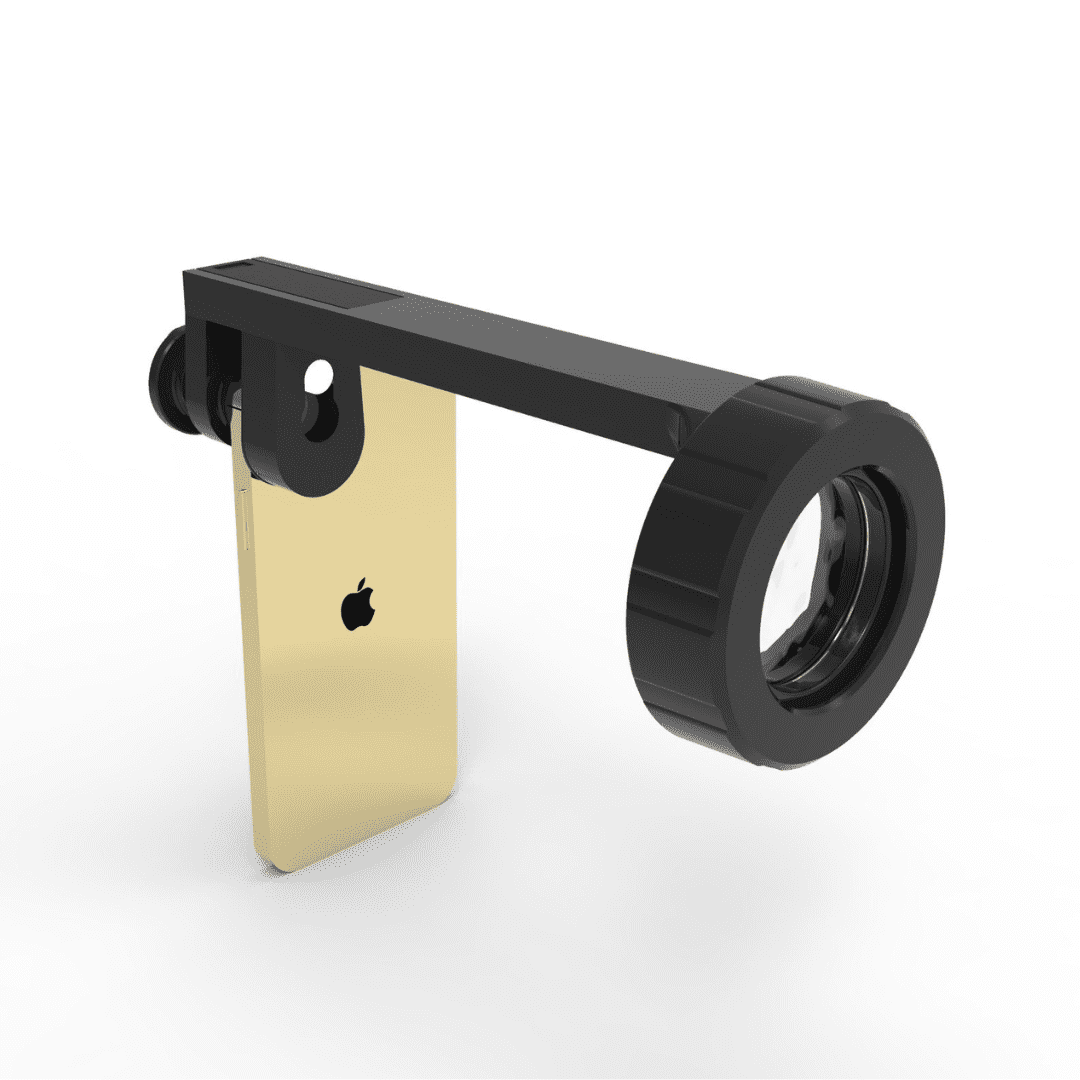
Document what you see
Two smartphone imaging tools built for everyday clinic use — one for the slit lamp, one for the fundus.
From Choroida — the team behind this siteReferences
- Thiagalingam S, Tarongoy P, Hamrah P, et al. Complications of cosmetic iris implants. J Cataract Refract Surg. 2008;34:1222-1224.
- Sikder S, Davis SW, Holz H, Moshirfar M. Complications of NewColorIris implantation in phakic eyes: a review. Clin Ophthalmol. 2011;5:435-438.
- Hoguet A, Ritterband D, Koplin R, et al. Serious ocular complications of cosmetic iris implants in 14 eyes. J Cataract Refract Surg. 2012;38:387-393.
- Galvis V, Tello A, Corrales MI. Postoperative results of cosmetic iris implants. J Cataract Refract Surg. 2016;42:1518-1526.

Writes and reviews the clinical articles on Educate. Every post is checked against peer-reviewed sources before it goes live.