Cataract surgery complications are uncommon after modern phacoemulsification, and they follow a predictable timeline.
Some occur on the table, others within days, and a few appear years later. Therefore, the timing of a new symptom often points to its cause.
Intraoperative Cataract Surgery Complications
Posterior capsule rupture is the most common serious intraoperative event, and the chamber may suddenly deepen or the nucleus may drift away from the tip. Vitreous then presents, so the surgeon must switch to anterior vitrectomy (see vitreous loss).
Zonular, Iris and Hemorrhagic Cataract Surgery Complications
Weak zonules cause phacodonesis and capsular folds during capsulorhexis, while alpha-1 antagonists such as tamsulosin can produce a billowing, prolapsing iris with progressive miosis. Suprachoroidal hemorrhage is rare, yet it firms the eye and darkens the red reflex within seconds.
All-fit Slit-Lamp Adapter
Record and share exactly what you see at the slit lamp. One adapter fits any slit lamp or surgical microscope — and any smartphone.
From Choroida — the team behind this siteRisk Factors for Cataract Surgery Complications
- Pseudoexfoliation or prior ocular trauma
- Small pupil or alpha-1 antagonist use
- Dense brunescent or white cataract
- High axial myopia
- Previous vitrectomy
- Diabetes, uveitis or epiretinal membrane, because they raise macular edema risk
Retained Lens Fragments
Nuclear pieces can drop into the vitreous after capsule rupture, and as a result the eye shows persistent inflammation, raised pressure or inferior corneal edema. A posterior fragment usually needs pars plana vitrectomy.
Early Pressure Rise
Retained viscoelastic is the usual cause of high pressure on day one, and the patient reports pain, nausea or blur while the cornea looks hazy. Therefore, measure pressure at the first visit, especially in glaucoma patients.
Corneal Edema in Early Cataract Surgery Complications
Mild edema near the incision is common and clears within days, while persistent diffuse edema suggests endothelial damage, particularly in Fuchs dystrophy.
Sharply bordered localized edema should also raise suspicion of a Descemet tear (see Descemet membrane detachment), and anterior segment OCT then confirms it and guides air tamponade.
Wound Leak and Shallow Chamber
A leaking incision gives a shallow chamber and low pressure, and the Seidel test shows aqueous diluting the fluorescein. Because a leak raises infection risk, surgeons usually hydrate or suture the wound promptly.
Endophthalmitis Among Cataract Surgery Complications
Acute endophthalmitis usually presents within the first week with pain, redness and falling vision, and examination then shows hypopyon, fibrin and a dim red reflex. The Endophthalmitis Vitrectomy Study found that eyes with light perception vision benefited from immediate vitrectomy, and the ESCRS study showed that intracameral cefuroxime lowered the infection rate.
TASS Versus Infection
Toxic anterior segment syndrome is a sterile reaction to material entering the eye during surgery, and it typically starts within 12 to 24 hours with diffuse limbus-to-limbus corneal edema. However, pain is often milder, and the vitreous usually stays clear. Intensive topical steroids help, yet doubtful cases still need a vitreous tap.
Pseudophakic Macular Edema
Irvine-Gass syndrome usually appears four to eight weeks after surgery, and patients describe blurred or distorted vision after an initially good result. OCT shows cystoid spaces in the inner nuclear and outer plexiform layers. Topical NSAIDs and steroids are first line, while chronic cases may need intravitreal steroid.
Refractive Surprise
An unexpected refraction usually reflects a biometry or lens power error, so refract again once the cornea clears, then recheck the measurements. Options include glasses, a piggyback lens, lens exchange or laser refractive surgery.
Posterior Capsule Opacification
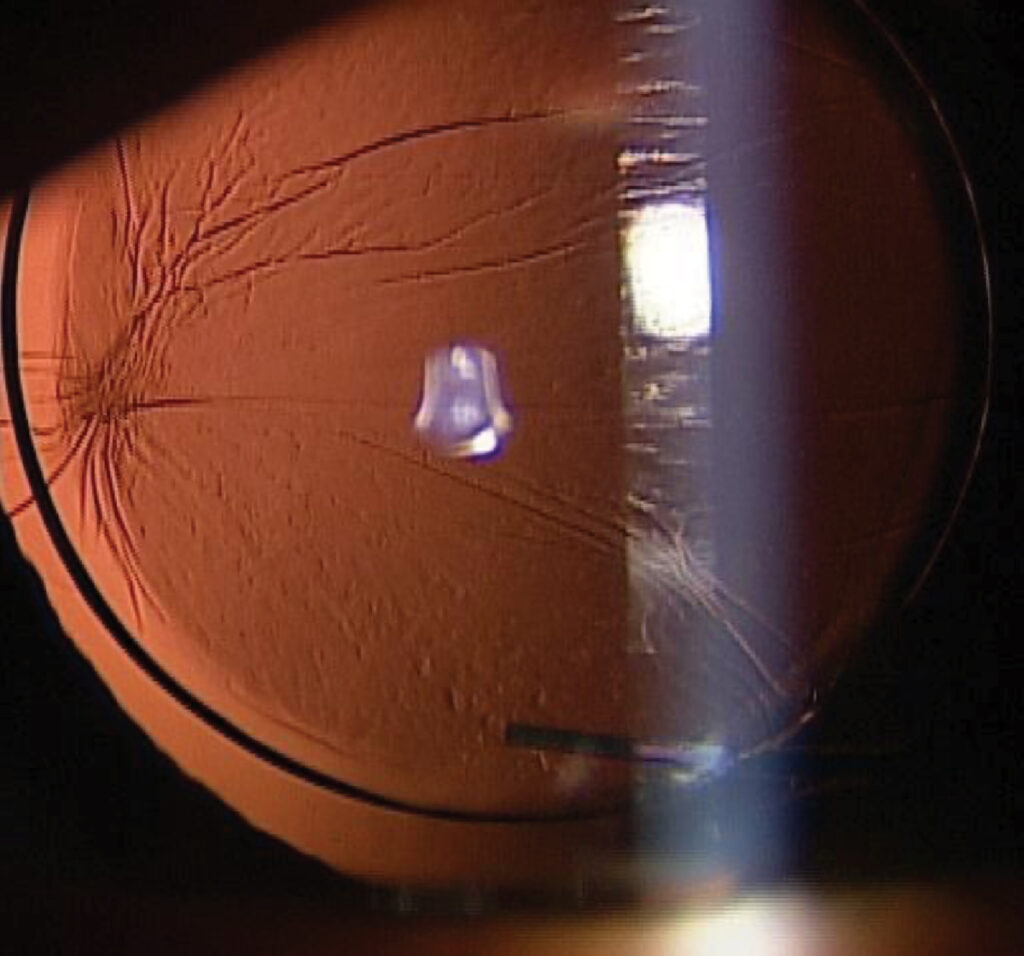
Posterior capsule opacification is the most common late complication, and patients notice gradual haze and glare months or years after surgery. Retroillumination shows Elschnig pearls or fibrous wrinkling behind the implant, and Nd:YAG capsulotomy restores clarity, although it can raise pressure and slightly increase detachment risk.
Retinal Detachment in Late Cataract Surgery Complications
Pseudophakic eyes carry a higher detachment risk than phakic eyes, and high myopia, male sex, younger age and capsule rupture also add to that risk. Therefore, warn every patient about new floaters, flashes or a curtain.
Late Lens Dislocation
An implant can decenter or fall years after an uneventful operation, and pseudoexfoliation and progressive zonular weakness are the usual causes. Patients notice blur, monocular diplopia or a lens edge in the pupil (see late in-the-bag IOL dislocation).
Chronic Inflammation and UGH Syndrome
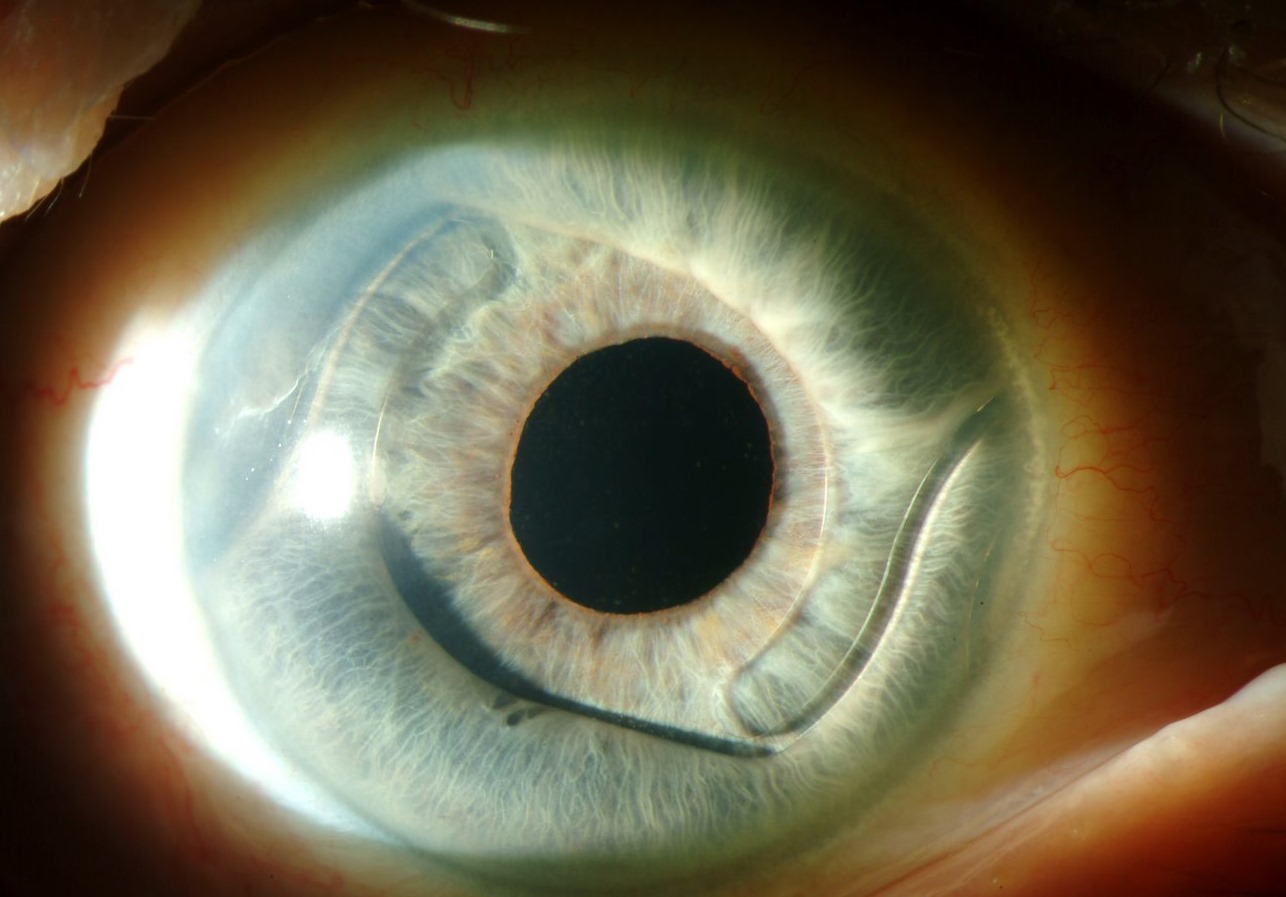
Inflammation that persists beyond the usual taper needs an explanation, so first consider retained lens material, low-grade Cutibacterium acnes infection or underlying uveitis. A haptic chafing the iris can also cause uveitis, glaucoma and hyphema together, and transillumination defects and ultrasound biomicroscopy support that diagnosis.
Counseling Patients About Cataract Surgery Complications
Explain that most complications are treatable when found early, and next give written warning signs: pain, worsening vision, increasing redness, flashes or a curtain. Finally, match each follow-up visit to the complications most likely at that stage.
Pitfalls to Avoid
- Do not call a painful eye with hypopyon TASS without considering a tap
- Check pressure before blaming a hazy cornea on surgical trauma
- Rule out macular edema on OCT before attributing late blur to capsule haze
Document what you see
Two smartphone imaging tools built for everyday clinic use — one for the slit lamp, one for the fundus.
From Choroida — the team behind this siteReferences
- Endophthalmitis Vitrectomy Study Group. Results of the Endophthalmitis Vitrectomy Study. Arch Ophthalmol. 1995;113:1479-1496.
- ESCRS Endophthalmitis Study Group. Prophylaxis of postoperative endophthalmitis following cataract surgery: results of the ESCRS multicenter study and identification of risk factors. J Cataract Refract Surg. 2007;33:978-988.
- Jaycock P, Johnston RL, Taylor H, et al. The Cataract National Dataset electronic multi-centre audit of 55,567 operations: updating benchmark standards of care in the United Kingdom and internationally. Eye. 2009;23:38-49.
- Chang DF, Campbell JR. Intraoperative floppy iris syndrome associated with tamsulosin. J Cataract Refract Surg. 2005;31:664-673.
- Mamalis N, Edelhauser HF, Dawson DG, et al. Toxic anterior segment syndrome. J Cataract Refract Surg. 2006;32:324-333.
Test yourself
A few questions straight from this article.
-
What is the most common serious intraoperative complication of phacoemulsification cataract surgery?
Posterior capsule rupture is the most common serious intraoperative event; vitreous then presents and the surgeon switches to anterior vitrectomy. -
During cataract surgery, what iris behaviour do alpha-1 antagonists such as tamsulosin produce?
Alpha-1 antagonists such as tamsulosin can cause a billowing, prolapsing iris with progressive miosis during surgery. -
What is the usual cause of high intraocular pressure on day one after cataract surgery?
Retained viscoelastic usually causes a day-one pressure rise with pain, nausea, blur and a hazy cornea, so pressure is measured at the first visit. -
After cataract surgery, sharply bordered localized corneal edema should raise suspicion of what?
Sharply bordered localized edema suggests a Descemet tear; anterior segment OCT confirms it and guides air tamponade. -
In post-cataract endophthalmitis, which eyes benefited from immediate vitrectomy in the Endophthalmitis Vitrectomy Study?
The Endophthalmitis Vitrectomy Study found that eyes with light perception vision benefited from immediate vitrectomy. -
Which feature favours toxic anterior segment syndrome over infectious endophthalmitis after cataract surgery?
TASS is a sterile reaction starting within 12 to 24 hours with limbus-to-limbus corneal edema, milder pain and usually a clear vitreous. -
When does Irvine-Gass pseudophakic cystoid macular edema usually appear after cataract surgery?
Irvine-Gass syndrome usually appears four to eight weeks after surgery, with OCT cysts in the inner nuclear and outer plexiform layers. -
How is posterior capsule opacification, the most common late cataract surgery complication, treated?
Nd:YAG capsulotomy restores clarity in posterior capsule opacification, though it can raise pressure and slightly increase detachment risk. -
After posterior capsule rupture, how is a nuclear fragment retained in the vitreous usually managed?
Dropped nuclear pieces cause persistent inflammation, raised pressure or inferior corneal edema, and a posterior fragment usually needs pars plana vitrectomy. -
After cataract surgery, an implant haptic chafing the iris causes which combination?
A haptic rubbing the iris can produce uveitis, glaucoma and hyphema together, supported by transillumination defects and ultrasound biomicroscopy.

Writes and reviews the clinical articles on Educate. Every post is checked against peer-reviewed sources before it goes live.