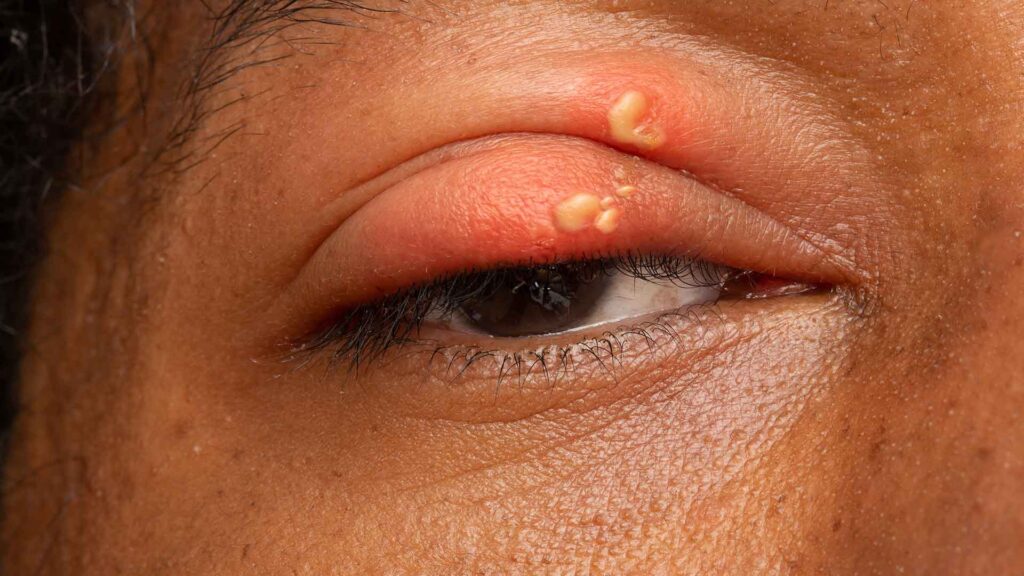
Eyelid herpes is herpes simplex virus infection of the lid skin and margin, usually caused by HSV-1.
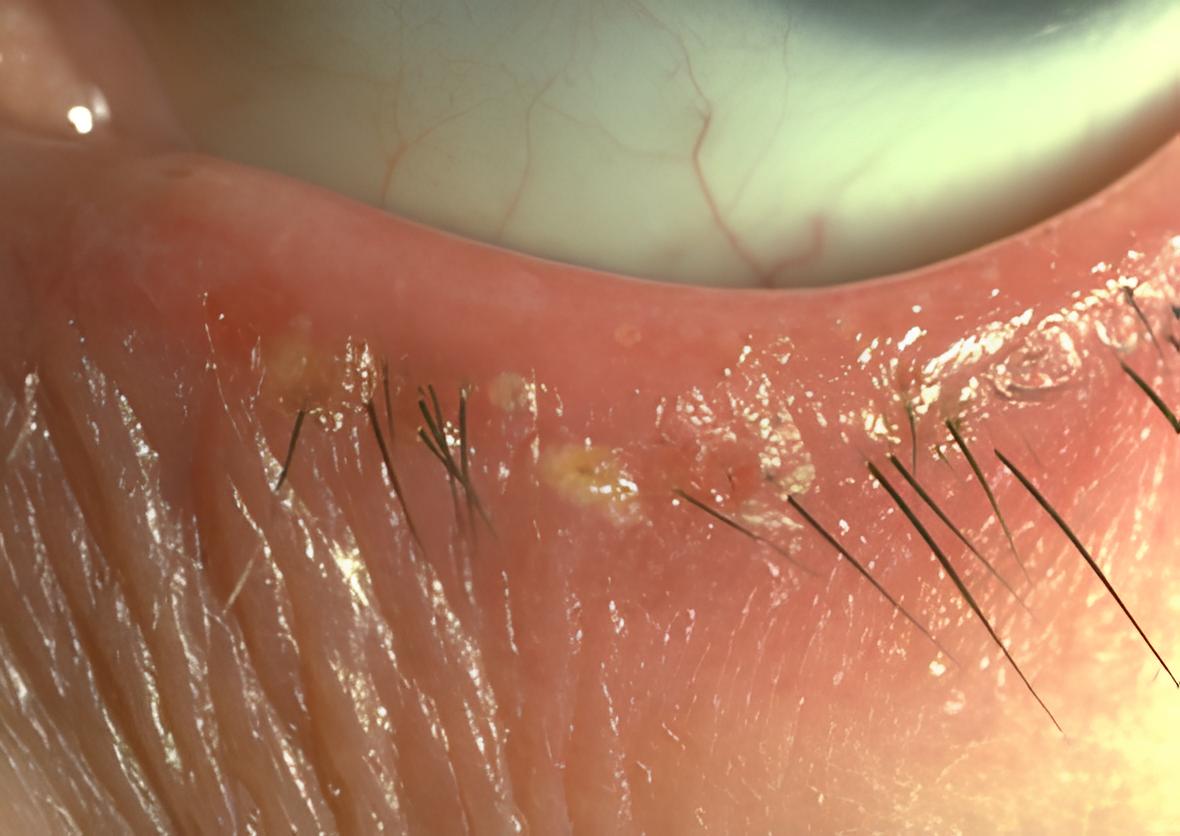
It appears as clustered vesicles on a red base, often with a mild follicular conjunctivitis, and most cases heal without scarring. However, margin lesions put the cornea at risk, so the examination must go beyond the skin.
What Causes Eyelid Herpes
HSV-1 reaches the lid through direct contact, often from saliva or another active lesion. The virus then travels along sensory nerves and becomes latent in the trigeminal ganglion. Later, stress, fever, sunlight or illness can reactivate it, and as a result the same lid may flare several times over a lifetime.
Primary Eyelid Herpes in Children
The first infection usually occurs in childhood or young adulthood. Children often present with a unilateral vesicular blepharoconjunctivitis and a tender preauricular node, and fever and malaise may also occur. Corneal involvement is less common in primary disease, although it can still develop.
All-fit Slit-Lamp Adapter
Record and share exactly what you see at the slit lamp. One adapter fits any slit lamp or surgical microscope — and any smartphone.
From Choroida — the team behind this siteRecurrent Lid Disease
Recurrences tend to be milder and more localized than the primary attack, and patients often describe burning or itching a day before the vesicles appear. The lesions then crust within several days and usually heal over one to two weeks. Repeated attacks at the same site strongly suggest HSV.
Clinical Signs of Eyelid Herpes
- Small clustered vesicles on an erythematous base
- Ulcerated or crusted lesions along the lash line
- Mild lid edema
- Follicular conjunctival reaction
- Palpable preauricular lymph node
- Usually unilateral involvement
The Lid Margin and the Cornea
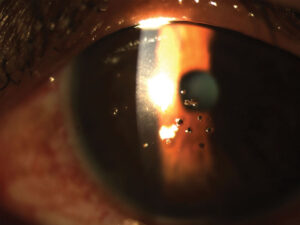
Vesicles at the lash line shed virus directly into the tear film. Therefore, margin lesions carry a higher risk of keratitis than lesions on the outer lid skin. Stain the cornea with fluorescein at every visit and look for punctate epithelial lesions and early dendrites (see dendritic ulcer).
Eyelid Herpes vs Zoster
Herpes zoster ophthalmicus follows the ophthalmic dermatome and stops at the midline, and it also brings severe prodromal pain and mostly affects older or immunosuppressed adults. HSV lesions, by contrast, are smaller and fewer, and they do not follow a dermatome strictly (for the full zoster picture, see herpes zoster ophthalmicus).
Eyelid Herpes vs Impetigo
Impetigo is a superficial bacterial infection, usually from Staphylococcus aureus or Streptococcus, and it forms honey-colored crusts, often around the nose and mouth. However, secondary bacterial infection can also cover an HSV lesion, so look for intact vesicles at the edge of the crust.
Other Differential Diagnoses
Contact dermatitis itches intensely and lacks true vesicle clusters, while molluscum contagiosum produces firm umbilicated papules. In children, varicella also causes lesions on the trunk and scalp, and finally, clinicians should consider mpox when the exposure history fits.
Atopic Skin and Eczema Herpeticum
Patients with atopic dermatitis can develop widespread HSV lesions across the face. This eczema herpeticum spreads quickly and may involve both lids. It needs systemic antiviral therapy and close follow-up, and you should involve dermatology early.
Confirming Eyelid Herpes
Diagnosis is usually clinical, but when the picture is atypical, unroof a vesicle and swab the base for HSV PCR, which is generally more sensitive than viral culture. A Tzanck smear shows multinucleated giant cells, but it cannot separate HSV from varicella zoster virus.
Treating Eyelid Herpes
Skin lesions alone often heal without treatment, but oral acyclovir, valacyclovir or famciclovir can shorten viral shedding and symptoms. Topical ganciclovir gel or trifluridine may protect the ocular surface when the margin is involved. Antivirals do not clear latent virus, so they cannot prevent attacks after the course ends, and clinicians should also adjust oral doses for reduced renal function.
When to Treat and When to Watch
Treat when vesicles involve the margin, when conjunctivitis is present, or when the patient is immunocompromised, and treat early if the patient has had herpetic keratitis before. A small isolated lesion on the outer skin of a healthy adult may simply be watched, and then you should review the cornea within a few days.
Steroids and Eyelid Herpes
Avoid topical steroids on active lid vesicles, because they can prolong viral replication and encourage corneal spread. If keratitis develops, follow corneal steroid principles (see herpes simplex keratitis).
Preventing Recurrences
In the Herpetic Eye Disease Study, long-term oral acyclovir reduced recurrent ocular HSV, and therefore clinicians usually reserve prophylaxis for frequent recurrences or prior stromal keratitis. Sunscreen on the face may also help patients whose attacks follow sun exposure.
Counseling Patients With Eyelid Herpes
Explain that the virus stays in the nerve and can return, and advise patients to avoid touching the lesions and to wash their hands often. They should not share towels, and contact lens wear should stop until healing. Finally, tell them to return at once for pain, light sensitivity or blurred vision.
Pitfalls to Avoid
- Do not skip fluorescein staining in lid disease
- Never prescribe steroid ointment for unexplained lid vesicles
- Do not label every crusted lesion as impetigo
- Remember eczema herpeticum in atopic children

Document what you see
Two smartphone imaging tools built for everyday clinic use — one for the slit lamp, one for the fundus.
From Choroida — the team behind this siteReferences
- White ML, Chodosh J. Herpes Simplex Virus Keratitis: A Treatment Guideline. San Francisco: American Academy of Ophthalmology; 2014.
- Herpetic Eye Disease Study Group. Acyclovir for the prevention of recurrent herpes simplex virus eye disease. N Engl J Med. 1998;339:300-306.
- Liesegang TJ. Herpes simplex virus epidemiology and ocular importance. Cornea. 2001;20:1-13.
- Darougar S, Wishart MS, Viswalingam ND. Epidemiological and clinical features of primary herpes simplex virus ocular infection. Br J Ophthalmol. 1985;69:2-6.
- Bowling B. Kanski’s Clinical Ophthalmology: A Systematic Approach. 8th ed. Elsevier; 2016.

Writes and reviews the clinical articles on Educate. Every post is checked against peer-reviewed sources before it goes live.