Sudden floaters are a common reason for urgent eye visits.
Most are benign, but some warn of retinal injury.
A careful history and dilated exam sort the cases.
What Floaters Are
Floaters are shadows cast by condensed vitreous or cells on the retina.
They appear as spots, threads or cobwebs.
They move with the eye and drift when it stops.
Therefore, they are more visible against bright backgrounds (see vitreous floaters).
Why Sudden Floaters Differ
Chronic floaters are usually stable.
A sudden onset means a change in the vitreous or retina.
New floaters with flashes or a shadow are more worrying.
So treat acute onset as a red flag.
Fundus Explorer Pro
Photograph the retinal findings described here with the phone already in your pocket — 22 D optics and built-in illumination in one handheld unit.
From Choroida — the team behind this sitePosterior Vitreous Detachment
This is the commonest cause of sudden floaters.
The vitreous separates from the retina and may leave a ring.
Most patients have no tear.
However, a dilated exam is still needed (see posterior vitreous detachment).
Retinal Tear
A tear causes sudden floaters in a minority of cases.
Blood or pigment in the vitreous increases the chance.
Flashes are often present.
Therefore, look carefully in the periphery.
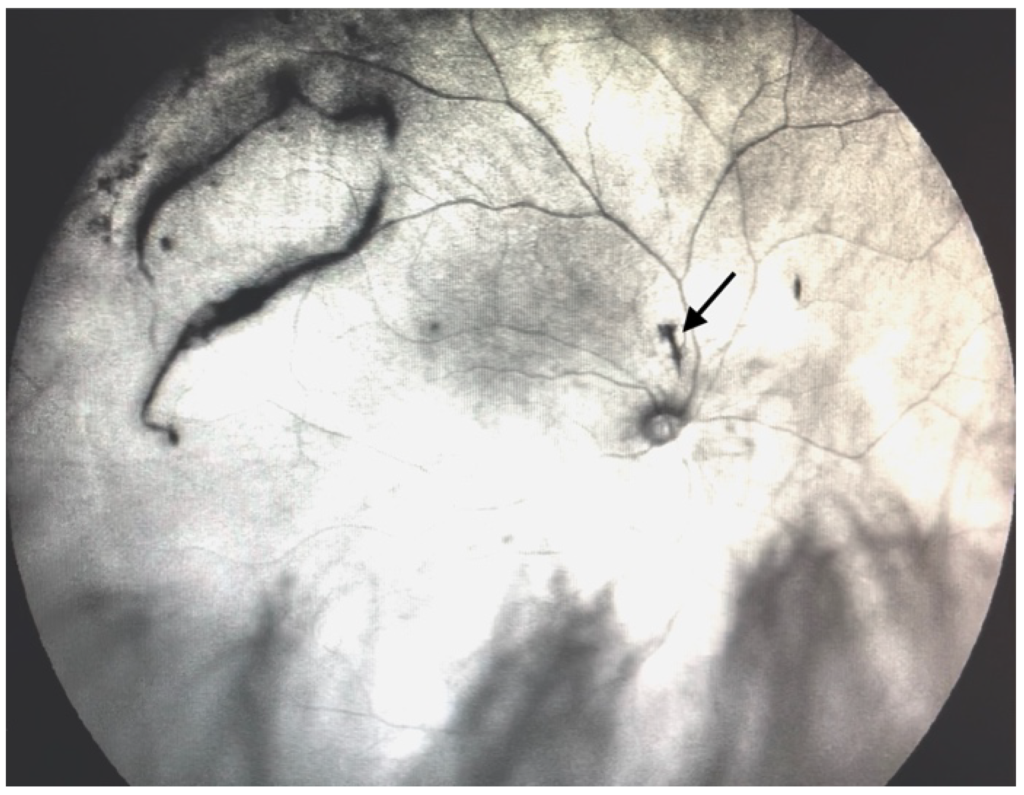
Vitreous Hemorrhage
Bleeding causes dark floaters or a red haze.
Causes include tears, diabetes and vein occlusion.
Ultrasound is needed if the view is blocked.
So find the source before reassuring the patient.
Uveitis
Inflammatory cells can cause floaters.
Eye redness, pain or light sensitivity may be present.
Posterior uveitis can be painless.
Also ask about systemic symptoms.
Retinal Detachment
Detachment presents with a shower of floaters and a shadow.
The shadow expands over time.
This is an emergency.
So refer the same day.
History to Take
Ask when the floaters began and whether flashes occurred.
Then ask about myopia, surgery and trauma.
Also review diabetes and blood thinners.
Also record the vision.
Examination Steps
Check vision and pupils.
Perform a dilated exam with scleral depression.
Use OCT or ultrasound when needed.
Therefore, plan enough time for the visit.
Timing of Examination
Examine sudden floaters within a day or two.
Examine at once if there is vision loss or a curtain.
Delay increases risk.
So triage carefully on the phone.
Reassurance and Follow-Up
If the exam is normal, reassure the patient.
Explain that floaters often fade.
Schedule a recheck in a few weeks.
Also give return advice.
Treatment of Troublesome Floaters
Most floaters need no treatment.
Vitrectomy and laser are options in rare cases.
Both carry risks.
Therefore, discuss benefits and limits.
Sudden Floaters: Practical Summary
Treat new floaters as urgent until a dilated exam is done.
Look for tears, bleeding and inflammation.
Because delayed tears occur, schedule a recheck.
Finally, teach the red flags.
Pitfalls to Avoid
- Do not reassure without dilating the pupil
- Never forget the fellow eye
- Avoid assuming floaters are harmless in diabetes
- Do not skip a recheck
Sudden Floaters in Diabetic Patients
Diabetic patients can bleed from new vessels.
A sudden shower of floaters may be vitreous hemorrhage.
Because the retina may be hidden, arrange ultrasound.
Therefore, treat sudden floaters in diabetes as urgent.
Sudden Floaters After Cataract Surgery
Vitreous detachment is common after surgery.
Flashes and floaters can follow within weeks.
Because tears are more likely, examine promptly.
So counsel patients before surgery.
Sudden Floaters in Young Patients
Young patients rarely have a vitreous detachment.
Think of uveitis, myopia or trauma.
Because causes differ, take a careful history.
Then dilate and examine the periphery.
Sudden Floaters and Eye Movements
Patients notice floaters when the eye stops moving.
They may see them against a bright screen.
Because the symptom is visual and benign in most, reassurance helps.
However, never skip the exam.
Sudden Floaters: Patient Questions
Patients ask whether floaters will go away.
Many fade as the brain adapts.
They also ask whether exercise is safe.
Normal activity is fine unless a tear is found.
Sudden Floaters: Red Flags
A curtain, shadow or loss of vision needs urgent care.
So does a shower of dark spots with flashes.
Because these signs may mean detachment, act at once.
Therefore, give patients clear written instructions.
Sudden Floaters: Triage by Phone
Ask about the timing, flashes and any shadow.
Book same-day visits for red-flag symptoms.
Because phone triage shapes outcomes, train staff.
Then audit missed cases.
Sudden Floaters: Documentation
Record the date of onset, the vision and the fundus findings.
If a tear is found, note its location and the treatment.
Because delayed tears occur, write the recheck date.
Finally, give patients a copy of the warning signs.
For the latest studies, see the PubMed results for sudden floaters.


Document what you see
Two smartphone imaging tools built for everyday clinic use — one for the slit lamp, one for the fundus.
From Choroida — the team behind this siteReferences
- Hollands H, Johnson D, Brox AC, Almeida D, Simel DL, Sharma S. Acute-onset floaters and flashes: is this patient at risk for retinal detachment? JAMA. 2009;302:2243-2249.
- Coffee RE, Westfall AC, Davis GH, Mieler WF, Holz ER. Symptomatic posterior vitreous detachment and the incidence of delayed retinal breaks. Am J Ophthalmol. 2007;144:409-413.
- Gariano RF, Kim CH. Evaluation and management of suspected retinal detachment. Am Fam Physician. 2004;69:1691-1698.
- Milston R, Madigan MC, Sebag J. Vitreous floaters: etiology, diagnostics, and management. Surv Ophthalmol. 2016;61:211-227.

Writes and reviews the clinical articles on Educate. Every post is checked against peer-reviewed sources before it goes live.