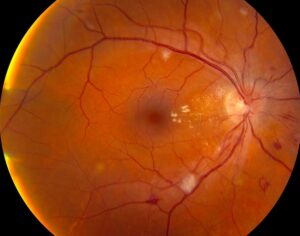
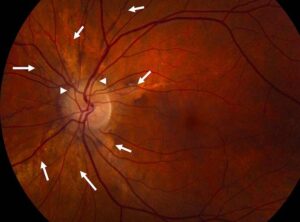
Retinal tear symptoms often begin with sudden flashes and new floaters.
Most patients have a harmless vitreous detachment.
A minority have a tear that can lead to detachment.
What Causes Retinal Tear Symptoms
The vitreous gel shrinks with age and pulls away from the retina.
This pull stimulates photoreceptors and causes flashes.
Strands in the gel cast shadows that appear as floaters.
Therefore, the symptoms come from traction on the retina.
Posterior Vitreous Detachment
Detachment of the vitreous is common after the age of 50.
Most cases cause no harm (see posterior vitreous detachment).
A small percentage of symptomatic cases produce a tear.
So every new symptom needs a dilated exam.
Fundus Explorer Pro
Photograph the retinal findings described here with the phone already in your pocket — 22 D optics and built-in illumination in one handheld unit.
From Choroida — the team behind this siteTypical Retinal Tear Symptoms
Patients describe lightning streaks, usually in the periphery.
A shower of new floaters often follows.
A curtain or shadow suggests detachment.
Also ask about the timing and the side.
Risk Factors
Myopia, previous cataract surgery and trauma raise the risk.
A family history of detachment also matters.
Lattice degeneration predisposes to tears (see lattice degeneration).
Therefore, ask about these factors.
How Urgent Is the Examination
New flashes and floaters need examination within a day or two.
A curtain or loss of vision needs same-day care.
Delay increases the chance of detachment.
So book urgent visits for new symptoms.
What the Clinician Looks For
Dilated examination with scleral depression checks the periphery.
The doctor looks for horseshoe tears, holes and pigment in the vitreous.
Vitreous hemorrhage raises suspicion of a tear.
Also check the fellow eye.
Symptomatic vs Asymptomatic Breaks
Symptomatic tears carry a higher risk of detachment.
Asymptomatic breaks are often observed.
Laser is advised for tears with traction.
Therefore, treatment depends on symptoms and findings.
Treatment: Laser Retinopexy
Laser burns create adhesion around the tear.
It takes effect in about two weeks.
Cryotherapy is an alternative.
So patients should avoid strenuous activity after treatment.
Follow-Up After Examination
If no tear is found, review the patient in four to six weeks.
A few cases develop delayed tears.
Give clear instructions about warning symptoms.
Also record the findings.
Retinal Tear Symptoms After Cataract Surgery
Detachment of the vitreous is common after surgery.
Flashes and floaters can follow.
Examine promptly.
Therefore, counsel patients before surgery.
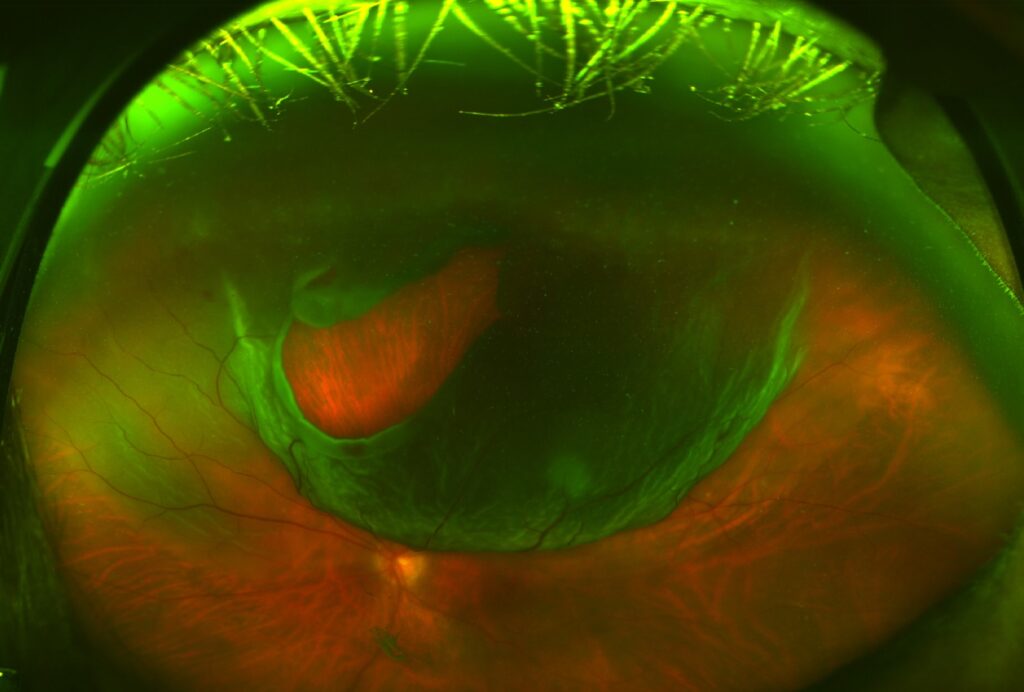
Retinal Tear Symptoms and Detachment
A tear can lead to detachment through fluid passing under the retina.
Vision loss starts in the periphery and moves inward (see retinal detachment symptoms and triage).
Surgery is needed to reattach the retina.
So early tear treatment prevents surgery.
Counseling Patients
Explain which symptoms need urgent care.
Give them a number to call.
Reassure those with normal findings.
Also encourage a follow-up visit.
Retinal Tear Symptoms: Practical Summary
Examine new symptoms promptly and use scleral depression.
Treat symptomatic tears with laser.
Because delayed tears occur, schedule a recheck.
Finally, teach the warning signs.
Pitfalls to Avoid
- Do not dismiss new floaters without a dilated exam
- Never skip scleral depression
- Avoid failing to recheck at four to six weeks
- Do not forget the fellow eye
Retinal Tear Symptoms in Highly Myopic Eyes
Myopic eyes have longer axes and thinner retinas.
Tears and lattice are more common.
Because detachment risk is higher, lower the threshold for examination.
Therefore, counsel myopic patients about warning signs.
Retinal Tear Symptoms After Trauma
Blunt injury can cause tears and dialyses.
Symptoms may appear weeks later.
Because the periphery is often affected, use scleral depression.
Then follow the patient closely.
Retinal Tear Symptoms and Anticoagulants
Patients on blood thinners can develop vitreous hemorrhage with a tear.
This blocks the view of the retina.
Because the tear may be hidden, use ultrasound.
Therefore, avoid false reassurance.
Retinal Tear Symptoms: Which Tears Need Laser
Horseshoe tears with traction need treatment.
Round holes without symptoms are often watched.
Because each eye differs, use judgment.
So document the reasoning.
Retinal Tear Symptoms After Laser
Mild discomfort and light sensitivity are common after laser.
Patients may resume normal activity within days.
Because the adhesion takes two weeks, avoid heavy straining.
Then review the retina.
Retinal Tear Symptoms and the Other Eye
A tear in one eye raises the chance in the other.
Examine both eyes at every visit.
Because symptoms may start in the second eye, teach patients.
In addition, document the baseline.


Document what you see
Two smartphone imaging tools built for everyday clinic use — one for the slit lamp, one for the fundus.
From Choroida — the team behind this siteReferences
- Hollands H, Johnson D, Brox AC, Almeida D, Simel DL, Sharma S. Acute-onset floaters and flashes: is this patient at risk for retinal detachment? JAMA. 2009;302:2243-2249.
- Coffee RE, Westfall AC, Davis GH, Mieler WF, Holz ER. Symptomatic posterior vitreous detachment and the incidence of delayed retinal breaks: case series and meta-analysis. Am J Ophthalmol. 2007;144:409-413.
- Gariano RF, Kim CH. Evaluation and management of suspected retinal detachment. Am Fam Physician. 2004;69:1691-1698.
- Blindbaek S, Grauslund J. Prophylactic treatment of retinal breaks: a systematic review. Acta Ophthalmol. 2015;93:3-8.
Test yourself
A few questions straight from this article.
-
What causes the flashes that accompany a posterior vitreous detachment or retinal tear?
The shrinking vitreous pulls away from the retina, and this pull stimulates photoreceptors to cause flashes, while strands in the gel cast floater shadows. -
After what age does posterior vitreous detachment become common?
Vitreous detachment is common after the age of 50; most cases cause no harm, but a small share of symptomatic cases produce a tear. -
How soon should a patient with new flashes and floaters be examined for a retinal tear?
New flashes and floaters need examination within a day or two, because delay increases the chance of detachment. -
Which symptom alongside flashes and floaters suggests a retinal detachment needing same-day care?
A curtain or shadow suggests detachment, and a curtain or loss of vision needs same-day care. -
Which examination technique is needed to check the retinal periphery in a patient with new flashes?
Dilated examination with scleral depression checks the periphery for horseshoe tears, holes and pigment in the vitreous, and the fellow eye is checked too. -
In a patient with new flashes and floaters, which vitreous finding raises suspicion of a retinal tear?
Vitreous hemorrhage raises suspicion of a tear, as does pigment in the vitreous, so the periphery must be searched carefully. -
How long does laser retinopexy take to create a firm adhesion around a retinal tear?
Laser burns create adhesion around the tear that takes effect in about two weeks, so heavy straining is avoided during that period. -
If no retinal tear is found in a patient with new flashes and floaters, when should they be reviewed?
A few patients develop delayed tears, so those with no tear are reviewed in four to six weeks and given clear warning-symptom instructions. -
Which retinal break typically needs laser treatment?
Horseshoe tears with traction need treatment, while round holes without symptoms are often watched, with the reasoning documented. -
In a patient on anticoagulants whose vitreous hemorrhage hides the retina, which test helps exclude a retinal tear?
Hemorrhage can hide the tear, so ultrasound is used and false reassurance avoided.

Writes and reviews the clinical articles on Educate. Every post is checked against peer-reviewed sources before it goes live.