
Accommodative esotropia is inward eye misalignment caused by the excess accommodative effort that a hyperopic child exerts to keep distance objects in focus, and unlike most forms of strabismus, it can often be substantially or fully corrected with glasses alone, without surgery.
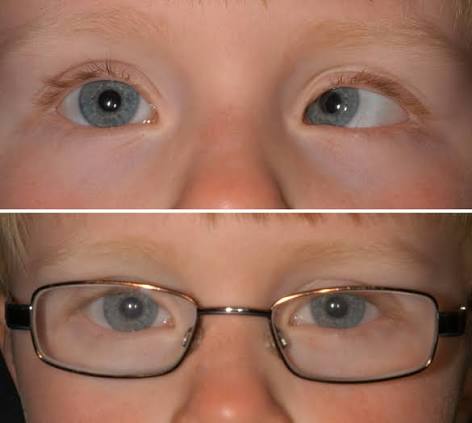
Getting the refractive correction right, and being patient with how the child responds to it, is the foundation of management before surgery is even considered.
The Mechanism
Accommodation and convergence are linked: the effort a hyperopic eye makes to accommodate for clear vision drives a proportional convergence response, and in a susceptible child this accommodative convergence exceeds what is needed for normal binocular fusion, producing an esodeviation.
The child essentially over-converges as a side effect of trying to see clearly, and correcting the underlying hyperopia removes the accommodative demand driving that convergence.
Types of Accommodative Esotropia
Refractive Accommodative Esotropia
The esodeviation is fully corrected by full-time wear of the appropriate hyperopic glasses correction, determined by cycloplegic refraction, with the deviation reappearing without glasses.
Non-Refractive (High AC/A) Accommodative Esotropia
The deviation is greater at near than at distance because of an abnormally high accommodative convergence to accommodation (AC/A) ratio, and distance glasses alone do not fully correct the near deviation, often requiring bifocals to address the near component separately.
Partially Accommodative Esotropia
Glasses reduce but do not fully eliminate the esodeviation, leaving a residual angle that needs additional treatment, sometimes including surgery for the nonaccommodative component.
Evaluation
- Cycloplegic refraction is essential, since accommodative esotropia can be masked or underestimated without full cycloplegia, which relaxes the child’s own accommodative effort during testing
- Measurement of the deviation both with and without the full hyperopic correction, and at both distance and near
- Calculation or clinical assessment of the AC/A ratio when the near deviation exceeds the distance deviation, to distinguish high AC/A esotropia from other patterns
- Assessment for amblyopia, which is common when the esotropia has been present for some time before diagnosis
Management
Full Hyperopic Correction
The first step is prescribing the full cycloplegic hyperopic correction and having the child wear it full-time, which can take weeks to show its full alignment effect as the child adapts to relying on the glasses rather than accommodative effort.
Many children show excellent, sometimes complete, resolution of the esodeviation with glasses alone.
Bifocals for High AC/A Esotropia
When near esotropia persists despite full distance correction, bifocals that reduce the accommodative demand for near work can control the near deviation, typically set to neutralize the near esodeviation as closely as possible.
Amblyopia Treatment
Amblyopia, when present, is treated with patching or optical penalization alongside the refractive correction, following standard amblyopia treatment principles (see amblyopia patching therapy).
Surgery
Surgery is reserved for the nonaccommodative residual deviation that remains despite optimal glasses correction, and it is not used to treat the accommodative component itself, since operating on an eye that is well aligned in glasses would overcorrect once the child puts the glasses back on.
Families sometimes ask about stopping glasses to avoid dependence; the deviation typically returns without correction, so glasses continue to be needed even after the eyes look straight, and stopping them prematurely undoes the benefit.
Long-Term Course
Some children can eventually reduce their hyperopic correction or discontinue bifocals as they get older, since the AC/A ratio and accommodative demand can change with age, though this should be done gradually and under monitoring rather than all at once.
Glasses dependence for alignment, not just for clarity of vision, is something families need to understand from the start.
Prognosis
The majority of children with accommodative esotropia achieve good alignment and reasonable binocular function with glasses, particularly when the diagnosis and correction are made promptly.
Outcomes are generally more favorable than in infantile esotropia, in part because the underlying mechanism is directly treatable with optical correction rather than requiring surgical alignment to restore binocular potential.
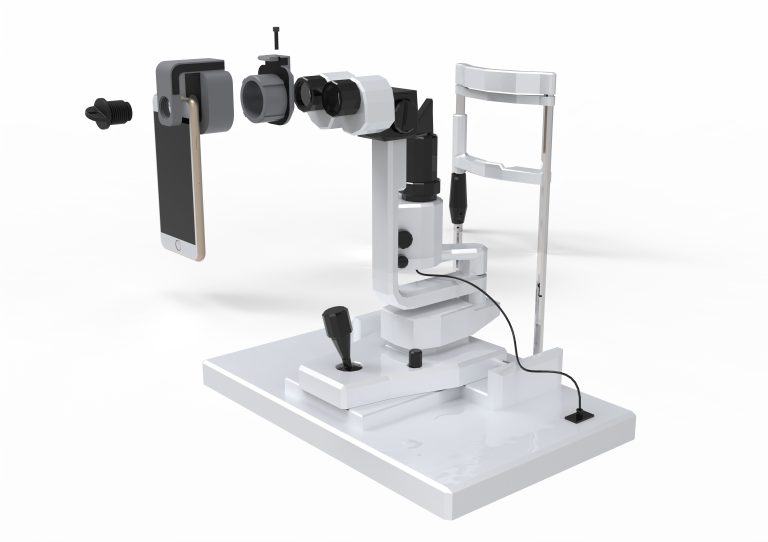
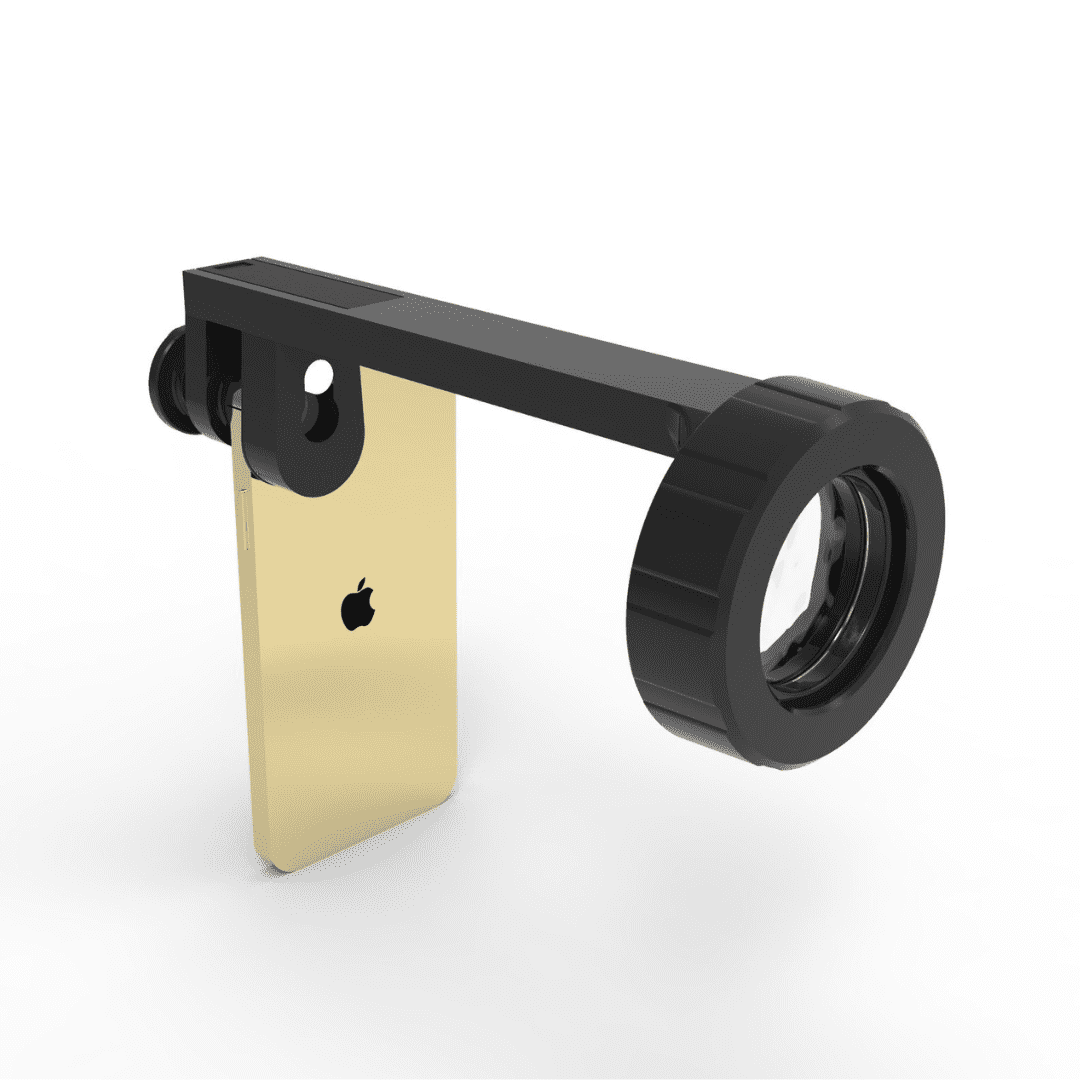
Document what you see
Two smartphone imaging tools built for everyday clinic use — one for the slit lamp, one for the fundus.
From Choroida — the team behind this siteReferences
- Ludwig IH, Parks MM, Getson PR, Kammerman LA. Rate of deterioration in accommodative esotropia correlated to the AC/A relationship. J Pediatr Ophthalmol Strabismus. 1988;25:8-12.
- Pediatric Eye Disease Investigator Group. A randomized trial comparing bifocal and single vision spectacles for children with accommodative esotropia. Arch Ophthalmol. 2009;127:255-263.
- von Noorden GK, Campos EC. Binocular Vision and Ocular Motility: Theory and Management of Strabismus. 6th ed. St Louis: Mosby; 2002.
- Ansons AM, Davis H. Diagnosis and Management of Ocular Motility Disorders. 4th ed. Chichester: Wiley-Blackwell; 2014.
