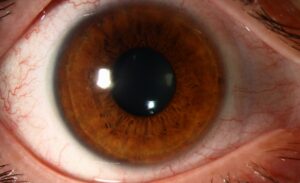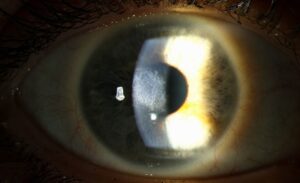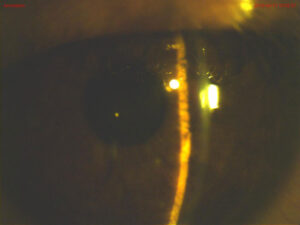
Few ophthalmic emergencies punish delay as directly as this one — every minute a chemical stays in contact with the eye adds to the damage.
Chemical eye injury is one of the few true ocular emergencies where treatment must begin before a full history or examination is even complete.
Alkali substances are generally more destructive than acids, because they continue penetrating tissue rather than being neutralized on contact.
The initial appearance of the eye can be deceptively mild even in severe injury, since the most damaged tissue can look pale and bloodless rather than obviously inflamed.
Long-term outcome is determined less by the chemical itself than by how much of the limbal stem cell population survives the initial injury.
Understanding immediate management, accurate severity grading, and the long-term risk of limbal stem cell deficiency is essential for anyone who might be first to see this injury.
What Is Chemical Eye Injury?
Chemical eye injury is tissue damage to the ocular surface and, in severe cases, deeper intraocular structures from exposure to an acidic or alkaline substance.
It is broadly divided by the offending agent:
- Alkali injuries — from substances such as ammonia, lye, and cement/lime — cause liquefactive necrosis and penetrate deeply and progressively into ocular tissue
- Acid injuries — from substances such as sulfuric or hydrochloric acid — cause coagulative necrosis, which tends to form a barrier that limits further penetration
- Severity ranges from mild epithelial injury that heals completely to severe limbal ischemia with a poor visual prognosis
This is why alkali exposures are generally treated as the more dangerous of the two — the injury keeps progressing after contact rather than being self-limited.
Epidemiology
Chemical eye injuries occur across occupational, household, and assault-related settings.
- Occupational exposure to industrial cleaning agents, cement, and manufacturing chemicals accounts for a large share of cases
- Household cleaning products are a common source, particularly ammonia- and lye-containing agents
- Young working-age men are disproportionately represented, reflecting occupational exposure patterns
- Chemical assault (deliberate acid or alkali attack) represents a smaller but especially severe subset of cases
Because so many cases are occupational, appropriate protective eyewear remains one of the most effective and underused prevention measures available.
All-fit Slit-Lamp Adapter
Record and share exactly what you see at the slit lamp. One adapter fits any slit lamp or surgical microscope — and any smartphone.
From Choroida — the team behind this sitePathophysiology
The mechanism of injury differs meaningfully between alkali and acid exposures.
- Alkali agents saponify cell membrane lipids, causing liquefactive necrosis that allows the chemical to keep penetrating deeper tissue over time
- This progressive penetration can damage the corneal stroma, anterior chamber structures, and even the lens with sufficient alkali exposure
- Acid agents denature and precipitate tissue protein on contact, forming a coagulum that generally limits further penetration
- Both mechanisms can damage the limbus, the ring of stem cells at the corneal-scleral junction responsible for regenerating corneal epithelium
- Loss of limbal stem cells prevents normal corneal epithelial healing, allowing conjunctival tissue to grow over the cornea instead
The degree of limbal damage — not the initial pain or redness — is what actually predicts whether the cornea will heal normally or scar permanently.
Risk Factors
Occupational and Environmental Risk Factors
- Work involving industrial cleaning agents, cement, plaster, or manufacturing chemicals
- Absent or inadequate protective eyewear in high-risk occupations
- Household use of concentrated cleaning agents without appropriate precautions
Other Considerations
- Young, working-age adults given occupational exposure patterns
- Deliberate chemical assault, which tends to produce more severe, often bilateral injury
Because so many exposures happen at home or work with common products, patient education about immediate irrigation is genuinely protective, not just a formality.
Clinical Presentation
Symptoms
- Immediate pain, tearing, and blepharospasm at the time of exposure
- Blurred vision, which can range from mild to severe depending on injury depth
- Photophobia from associated corneal epithelial damage
- A history of exposure to a specific chemical agent, which should be obtained without delaying treatment
Examination Findings
- Corneal epithelial defect, haze, or opacification depending on severity
- Conjunctival injection in milder injury — but a pale, blanched (ischemic) limbus in more severe injury, a critical and easily missed sign
- Chronic findings after severe injury include corneal scarring, persistent epithelial defects, and corneal neovascularization from limbal stem cell loss
- Elevated intraocular pressure can occur acutely from chemical effects on the trabecular meshwork
Limbal blanching is the single most important sign to look for and is easy to miss precisely because a bloodless, pale limbus can look deceptively unremarkable at first glance.
Diagnostic Evaluation
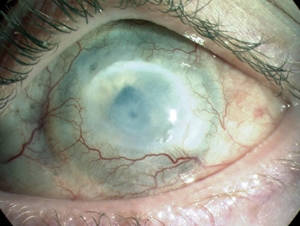
Immediate Assessment (After Irrigation)
- Visual acuity testing once the eye has been adequately irrigated and the patient can tolerate examination
- Fluorescein staining to assess the extent of the corneal epithelial defect
- Careful examination of limbal perfusion — the extent of limbal blanching is central to severity grading
Severity Grading
- Injuries are commonly graded using systems such as the Roper-Hall or Dua classification, based primarily on the degree of limbal involvement and corneal clarity
- Greater limbal ischemia predicts a substantially worse visual prognosis and higher risk of long-term complications
Intraocular Pressure Monitoring
- IOP measurement, since chemical injury can acutely elevate pressure through effects on aqueous outflow structures
Grading severity by limbal involvement, not just corneal appearance, is what actually predicts long-term outcome and guides how aggressively to treat.
Differential Diagnosis
The history of chemical exposure usually makes the diagnosis straightforward, but consider distinguishing from:
- Thermal burns — a heat rather than chemical exposure history, with a generally more localized injury pattern
- UV keratitis (photokeratitis) — diffuse superficial punctate epithelial changes from UV exposure without a caustic chemical history
- Mechanical or foreign-body corneal injury — a distinct trauma history without chemical contact
- Stevens-Johnson syndrome/toxic epidermal necrolysis — severe ocular surface disease from a drug or infectious trigger rather than direct chemical contact
Because the history of chemical exposure is usually clear and immediate, the differential diagnosis is rarely the challenge — accurately grading severity is.
Management
Immediate Emergency Treatment
- Copious irrigation with saline or any available clean water, started immediately, before any detailed history or examination
- Irrigation should continue until the ocular surface pH normalizes, checked with litmus paper where available
- Eversion of the eyelids and sweeping of the fornices to remove any retained particulate matter, particularly with lime or cement exposure
Acute Medical Management
- Topical antibiotics to prevent secondary infection of the damaged ocular surface
- Cycloplegic agents for comfort and to reduce the risk of posterior synechiae
- Topical corticosteroids in the early phase to reduce inflammation, used cautiously given their effect on corneal healing and melt risk
- Intraocular pressure-lowering therapy when elevated IOP is identified
- Ascorbate and citrate supplementation has been advocated in some protocols to support corneal healing after severe alkali injury
Long-Term and Reconstructive Management
- Management of persistent epithelial defects and ocular surface inflammation in the subacute phase
- Limbal stem cell transplantation for eyes with significant limbal stem cell deficiency and persistent surface failure
- Corneal transplantation, considered only after the ocular surface has been stabilized, since grafting onto an unstable surface fails at a high rate
Nothing else in management matters if irrigation is delayed — every other intervention addresses damage that continued accumulating during that delay.
Prognosis
Prognosis correlates closely with the degree of limbal involvement at presentation.
- Mild injuries with an intact limbus generally heal completely with little to no long-term visual impact
- Injuries with significant limbal ischemia carry a substantially worse prognosis, with risk of chronic epithelial defects, corneal scarring, and neovascularization
- Severe alkali injuries with extensive limbal stem cell loss can result in permanent visual impairment despite optimal management
The single biggest determinant of long-term vision is how quickly and thoroughly irrigation began — a fact worth repeating to anyone who might be the first responder to this injury.
Document what you see
Two smartphone imaging tools built for everyday clinic use — one for the slit lamp, one for the fundus.
From Choroida — the team behind this siteReferences
- Roper-Hall MJ. Thermal and chemical burns. Transactions of the Ophthalmological Societies of the United Kingdom. 1965.
- Dua HS, King AJ, Joseph A. A new classification of ocular surface burns. British Journal of Ophthalmology. 2001.
- Bizrah M, Yusuf A, Ahmad S. An update on chemical eye burns. Eye. 2019.
- Chemical Eye Injury. StatPearls, NCBI Bookshelf.
- Chemical Burns. EyeWiki, American Academy of Ophthalmology.
Test yourself
A few questions straight from this article.
-
Which mechanism explains why alkali chemical eye injury keeps penetrating ocular tissue?
Alkalis saponify cell membrane lipids and produce liquefactive necrosis, so the agent keeps moving deeper into stroma, anterior chamber and even lens rather than stopping at the surface. -
Why are acid burns in chemical eye injury generally more self-limited than alkali burns?
Acids denature and precipitate tissue protein on contact. The resulting coagulum acts as a barrier, so acid injuries tend not to progress the way alkali injuries do. -
What is the first action in managing a suspected chemical eye injury?
Chemical injury is one of the few emergencies where treatment precedes assessment: irrigate immediately with saline or any clean water, then take the history. -
In chemical eye injury, what endpoint should guide how long irrigation continues?
Irrigation continues until the ocular surface pH normalises, checked with litmus paper where available, not until a fixed time has elapsed or symptoms settle. -
Which examination finding is the key severity sign in acute chemical eye injury?
Limbal blanching is the single most important sign and is easily missed, because severely damaged tissue looks pale and bloodless rather than dramatically inflamed. -
What is the consequence of limbal stem cell loss after a severe chemical eye injury?
The limbus holds the stem cells that regenerate corneal epithelium. Once they are lost, normal healing fails and conjunctival tissue overgrows the cornea, with scarring and neovascularization. -
Which classification systems are commonly used to grade the severity of chemical eye injury?
Roper-Hall and Dua grading are both based mainly on the degree of limbal involvement and corneal clarity, and greater limbal ischemia predicts a worse visual prognosis. -
Why are the eyelids everted and the fornices swept in chemical eye injury?
Particulate matter trapped in the fornices keeps releasing chemical long after the initial exposure, so sweeping them is part of emergency treatment, particularly after lime or cement injury. -
Acutely raised intraocular pressure after chemical eye injury reflects chemical effects on which structure?
Chemical injury can acutely raise pressure through effects on the trabecular meshwork and aqueous outflow, so IOP measurement is part of the assessment after irrigation. -
When should corneal transplantation be considered after a severe chemical eye injury?
Grafting onto an unstable ocular surface fails at a high rate, so limbal stem cell transplantation and surface stabilization come first and keratoplasty is deferred.

Writes and reviews the clinical articles on Educate. Every post is checked against peer-reviewed sources before it goes live.