
Introduction
Night vision loss, or nyctalopia, is often associated with retinitis pigmentosa (RP), a hereditary retinal disorder that leads to progressive peripheral vision loss and difficulty seeing in low-light conditions.
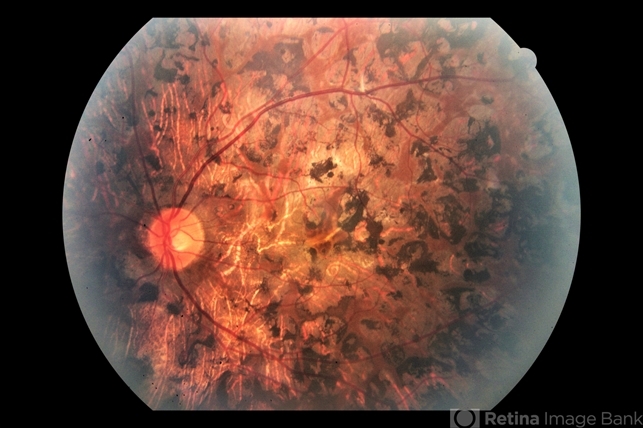
However, numerous other ocular and systemic conditions can impair night vision, sometimes mimicking RP. Understanding these alternative causes is crucial for accurate diagnosis and management.
This article explores various conditions beyond RP that can lead to night vision impairment, highlighting their clinical features, diagnostic approaches, and management options.
1. Vitamin A Deficiency
Key Features:
- Vitamin A is essential for rhodopsin, a pigment in rod cells necessary for low-light vision.
- Deficiency leads to progressive night blindness, xerophthalmia, and Bitot’s spots.
- Common in malnutrition, malabsorption disorders (e.g., Crohn’s disease, celiac disease), and post-bariatric surgery patients.
Diagnosis & Management:
- Serum vitamin A levels.
- Oral or intramuscular vitamin A supplementation often leads to improvement if detected early.

Fundus Explorer Pro
Photograph the retinal findings described here with the phone already in your pocket — 22 D optics and built-in illumination in one handheld unit.
From Choroida — the team behind this site2. Congenital Stationary Night Blindness (CSNB)
Key Features:
- A non-progressive inherited retinal disorder affecting rod function.
- Patients experience lifelong night blindness but retain normal or near-normal visual acuity.
- Common subtypes include X-linked, autosomal dominant, and autosomal recessive CSNB.
Diagnosis & Management:
- Electroretinography (ERG): Reduced or absent rod response.
- Fundus exam: Typically normal or subtle pigmentary changes.
- No specific treatment, but tinted lenses may help enhance contrast vision.
3. Choroideremia
Key Features:
- X-linked recessive disorder causing progressive choroidal and retinal atrophy.
- Begins with nyctalopia in childhood, followed by peripheral vision loss.
- Unlike RP, fundus examination shows diffuse choroidal atrophy.
Diagnosis & Management:
- Genetic testing confirms diagnosis.
- No cure, but gene therapy trials are ongoing.
- Low-vision aids and orientation training can improve quality of life.
4. Gyrate Atrophy
Key Features:
- Autosomal recessive metabolic disorder caused by ornithine aminotransferase deficiency.
- Night blindness in childhood, progressing to peripheral vision loss and central vision impairment.
- Fundus exam: Scalloped chorioretinal atrophy patches.
Diagnosis & Management:
- Plasma ornithine levels are markedly elevated.
- Treatment: Arginine-restricted diet and vitamin B6 supplementation may slow progression.
5. Cancer-Associated Retinopathy (CAR) and Autoimmune
Retinopathies
Key Features:
- Paraneoplastic or idiopathic autoimmune-mediated retinal degeneration.
- Symptoms include progressive nyctalopia, photopsias, and visual field loss.
- Retinal appearance may be normal initially but progresses to diffuse atrophy.
Diagnosis & Management:
- Anti-retinal antibody testing, ERG, and cancer screening (for CAR).
- Immunosuppressive therapy (e.g., corticosteroids, IVIG, rituximab) may stabilize vision.
6. Other Retinal and Systemic Disorders
Bietti Crystalline Dystrophy
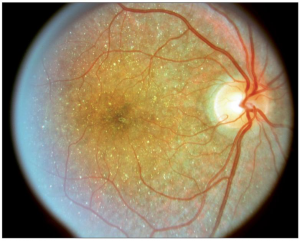
- Rare autosomal recessive disorder leading to nyctalopia and progressive vision loss.
- Fundus shows crystalline deposits in the retina and cornea.
Uncontrolled Glaucoma
- Rod dysfunction in advanced glaucoma can impair night vision before central vision loss becomes apparent.
Diabetic Retinopathy
- Retinal ischemia and microvascular changes can affect rod function, leading to nocturnal visual impairment.
Usher Syndrome
- A genetic condition combining hearing loss and progressive retinal degeneration.
- Three types exist, with varying degrees of severity and onset.
Oguchi Disease
- A rare form of stationary night blindness caused by mutations in the GRK1 or SAG gene.
- Characterized by prolonged adaptation to darkness, with fundus exhibiting a golden or grayish appearance.
Enhanced S-Cone Syndrome (ESCS)
- A genetic disorder where rods are dysfunctional but blue (S) cones are overrepresented.
- Patients experience night blindness, photophobia, and nummular pigmentary retinopathy.
Chronic Retinal Detachment
- Longstanding shallow retinal detachments can impair night vision due to photoreceptor degeneration.
- Patients often report progressive visual field defects before a full detachment occurs.
Medications That Affect Night Vision
- Isotretinoin (Accutane) can impair dark adaptation.
- Chloroquine and hydroxychloroquine cause retinal toxicity and nyctalopia.
- Sildenafil (Viagra) may lead to temporary night vision issues due to PDE6 inhibition.
Conclusion
While retinitis pigmentosa is the most recognized cause of night vision loss, many other disorders—from vitamin deficiencies to inherited retinal dystrophies and autoimmune conditions—can also contribute to nyctalopia.
A thorough history, comprehensive ophthalmic examination, and targeted investigations such as ERG, genetic testing, and serum analysis are essential for an accurate diagnosis and tailored management plan.
Document what you see
Two smartphone imaging tools built for everyday clinic use — one for the slit lamp, one for the fundus.
From Choroida — the team behind this siteReferences
- Saari JC. Vitamin A and Vision. Annu Rev Nutr. 2012;32:125-145.
- Zeitz C, Jacobson SG, Hamel CP. Congenital stationary night blindness: An analysis and update of genetic causes. Mol Vis. 2015;21:91-103.
- MacDonald IM, Russell L, Chan CC. Choroideremia: New findings from ocular pathology and review of recent literature. Surv Ophthalmol. 2009;54(4):401-407.
- Valle D, Simell O. Gyrate atrophy of the choroid and retina. In: Scriver CR, Beaudet AL, Sly WS, Valle D, eds. The Metabolic and Molecular Bases of Inherited Disease. McGraw-Hill; 2001.
- Ferreyra HA, Jayasundera T, Khan NW, et al. Autoimmune retinopathy: Clinical features, diagnostic testing, and treatment. Am J Ophthalmol. 2014;157(2):266-272.
- Li S, Guan L, Fang S, et al. Bietti crystalline dystrophy: Clinical and genetic research update. Ophthalmic Genet. 2018;39(6):647-654.
Test yourself
A few questions straight from this article.
-
Which visual pigment in rod cells depends on vitamin A, explaining the nyctalopia of deficiency?
Vitamin A is essential for rhodopsin, the rod pigment needed for low-light vision, so deficiency causes progressive night blindness. -
Which ocular signs accompany night blindness in vitamin A deficiency?
Vitamin A deficiency produces progressive night blindness together with xerophthalmia and Bitot's spots, often in malnutrition or malabsorption. -
Which feature distinguishes congenital stationary night blindness from retinitis pigmentosa?
CSNB is a non-progressive inherited rod disorder in which patients have lifelong night blindness but normal or near-normal visual acuity. -
Which test result supports congenital stationary night blindness in a patient with a normal fundus?
ERG in CSNB shows reduced or absent rod responses while the fundus is typically normal or shows only subtle pigmentary changes. -
Which fundus finding separates choroideremia from retinitis pigmentosa?
Choroideremia is an X-linked recessive disorder in which fundus examination shows diffuse choroidal atrophy rather than the RP pattern. -
Which enzyme deficiency causes gyrate atrophy with childhood night blindness?
Gyrate atrophy is an autosomal recessive metabolic disorder from ornithine aminotransferase deficiency, with scalloped chorioretinal atrophy on fundus exam. -
Which treatment is used to slow progression in gyrate atrophy?
Plasma ornithine is markedly elevated in gyrate atrophy, and an arginine-restricted diet plus vitamin B6 supplementation may slow progression. -
Which investigations are used when cancer-associated retinopathy is suspected as a cause of nyctalopia?
CAR presents with progressive nyctalopia, photopsias, and field loss, and is worked up with anti-retinal antibodies, ERG, and screening for malignancy. -
Which fundus appearance characterises Oguchi disease?
Oguchi disease is a stationary night blindness from GRK1 or SAG mutations, with prolonged dark adaptation and a golden or grayish fundus. -
Which medication impairs night vision through inhibition of PDE6?
Sildenafil may cause temporary night vision disturbance via PDE6 inhibition, whereas isotretinoin impairs dark adaptation and chloroquines cause retinal toxicity.
