
CASE REPORT
A 41-year-old female presented complaining of a darkening of her vision and progressive difficulty with reading and night vision.
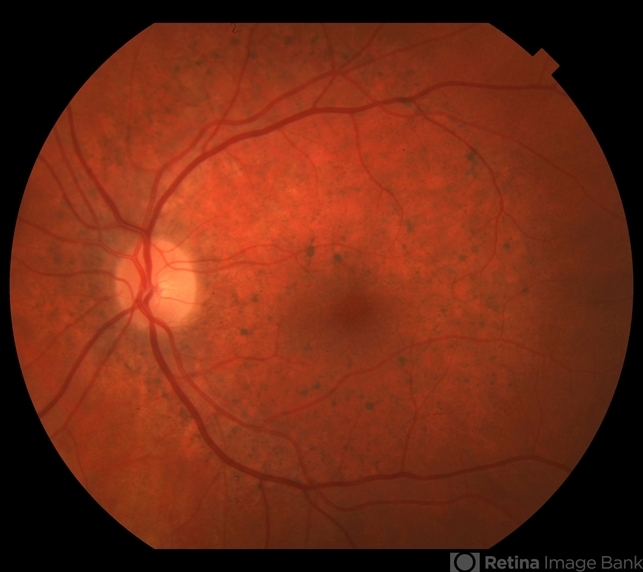
Her past medical history was positive for Crohn’s disease, hypothyroidism, chronic interstitial cystitis, irritable bowel syndrome, and bipolar disorder.
Relevant medications included adalimumab, methotrexate, gabapentin, quetiapine, naratriptan, oxcarbazepine, topiramate, and pentosan polysulfate (PPS).
Her best corrected visual acuity was 20/25 OD and 20/20 OS. The anterior segments were normal.
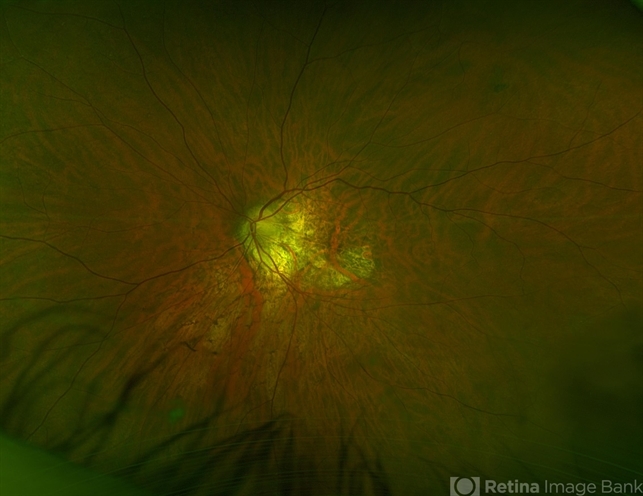
Dilated fundus exam demonstrated severe retinal pigment epithelial abnormalities (RPE) in both eyes, with clumps of hyper-pigmentation within larger areas of hypo-pigmentation that spanned the entire macula and circumferential peri-papillary area.
Near-infrared reflectance and optical coherence tomography (OCT) revealed scattered hyper-reflectance and RPE deposits that localized to the hyper-pigmented deposits on the fundus exam. The dark choroid was absent by fluorescein angiography (FA).
Full-field electroretinogram demonstrated normal amplitude rod and cone-mediated responses but with delayed timing. The electrooculogram was normal in both eyes.
Genetic testing was conducted on peripheral blood lymphocytes with retinitis pigmentosa multigene panel by massively parallel sequencing of coding regions and exon-intron boundaries including deletion/duplication analysis. A diagnosis of Pentosan Polysulfate Maculopathy was made.
Pentosan Polysulfate Maculopathy DISEASE entity
Pentosan polysulfate sodium is a semisynthetic sulfated polysaccharide that is the only FDA-approved oral therapy for interstitial cystitis (IC).
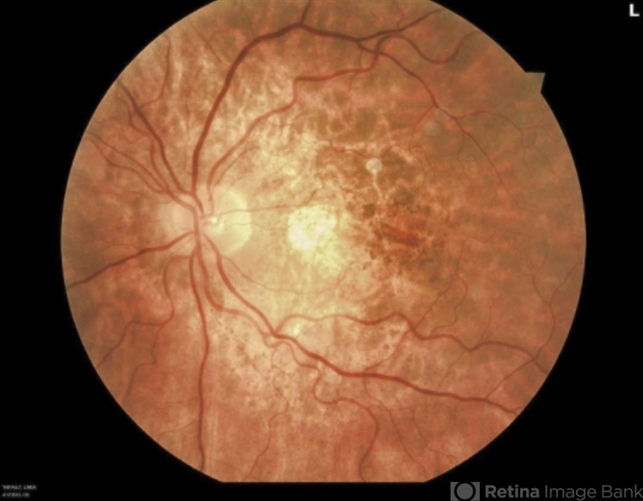
Interstitial cystitis, or bladder pain syndrome, is a syndrome of urinary frequency, urgency, and chronic pelvic discomfort, without an otherwise identifiable cause.
It is much more common in women and is estimated to impact over one million people in the United States.
Pentosan polysulfate has been prescribed widely for IC in the US since its FDA approval in 1996 and was used for many years prior in an off-label fashion.
The American Urological Association currently recommends PPS as a second-line therapy for IC after the failure of conservative management, and numerous international bodies recommend it as a first- or second-line agent.
Pentosan polysulfate is thought to protect the bladder lining from irritants by replacing disrupted glycosaminoglycans along the bladder urothelium.
A 2018 report first described a unique macular disease associated with long-term use of PPS in six patients. Numerous subsequent studies have further characterized the disease and strengthened its dose-dependent association with PPS use.
The totality of the evidence across many studies is strongly suggestive of a causal relationship between PPS use and this maculopathy.
Affected patients commonly experience difficulty reading, prolonged dark adaptation, and in some cases loss of visual acuity.
Retinal imaging findings suggest a primary insult to the retinal pigment epithelium (RPE), RPE-photoreceptor interface, and/or choriocapillaris.
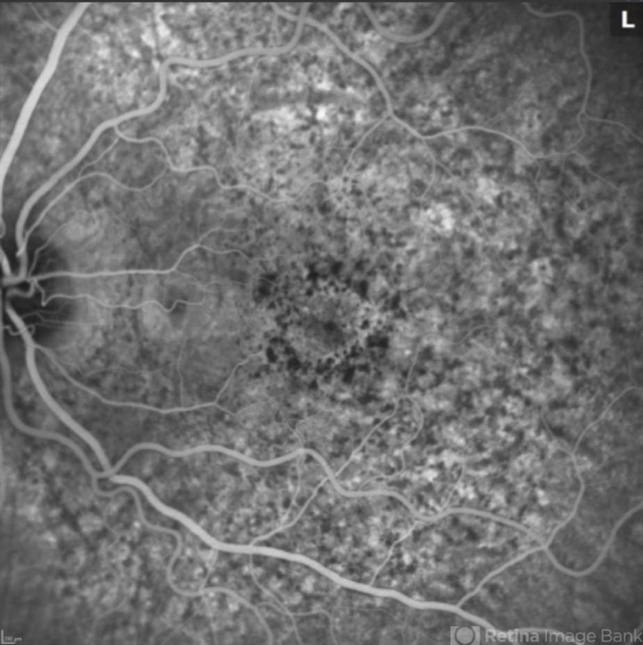
Although most cases manifest disease in the posterior pole, some eyes have involvement of the far peripheral retina.
Pentosan polysulfate maculopathy may result in RPE and outer retinal atrophy, cystoid macular edema (CME), vitelliform maculopathy, and macular neovascularization (MNV).
Fundus Explorer Pro
Photograph the retinal findings described here with the phone already in your pocket — 22 D optics and built-in illumination in one handheld unit.
From Choroida — the team behind this sitePentosan Polysulfate Maculopathy Diagnosis
While history and dilated fundus examination can be suggestive of Pentosan Polysulfate Maculopathy, multimodal retinal imaging, particularly fundus autofluorescence imaging, is helpful.
In some cases, the clinician must integrate findings from the examination, fundus autofluorescence imaging, near-infrared reflectance imaging, and optical coherence tomography to establish the diagnosis.
Screening:
Ophthalmologists at the Emory Eye Center, where this condition was initially described, monitor patients taking PPS or diagnosed with Pentosan Polysulfate Maculopathy annually with a comprehensive retinal evaluation including color fundus photography, FAF, OCT, and NIR imaging.
Exams are continued for the duration of treatment or beyond if there is suspicion of potential maculopathy development.
A study by The Macula Society suggested a similar screening approach. Most documented cases have occurred after 3 years of use or longer.
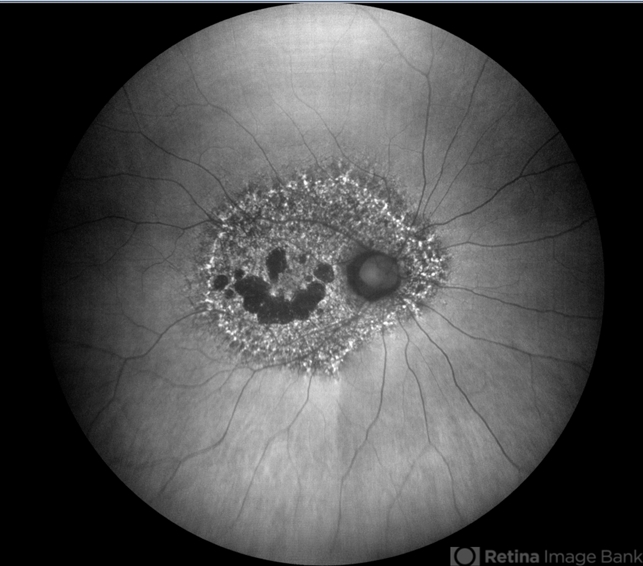
A drug labeling change issued in 2020 includes a warning about the increased risk for retinal pigmentary changes and recommends a detailed ophthalmologic evaluation prior to starting treatment.
Another group has recommended a baseline screening exam within 6 months of starting the drug and then annually as patients approach 500 g of cumulative exposure (approximately 4.6 years on the standard 300 mg daily dose).
History:
Providers should ask patients with suspected PPS maculopathy about the daily dose and duration of PPS intake. It may also be useful to ask about the history of or ongoing tobacco use, although no such link has been established to date.
To gauge the functional impact of Pentosan Polysulfate Maculopathy, it is useful to ask patients about difficulty adjusting to dim light, difficulty seeing at night, blurred vision, metamorphopsia, and difficulty reading.
Pentosan polysulfate maculopathy has also been identified in patients who are not reporting any visual symptoms. Thus, a negative history of visual symptoms does not rule out a mild manifestation of the disease.
In order to frame discussions regarding PPS cessation, it is helpful to inquire about IC disease status. Last, it is helpful to obtain contact information for the PPS prescriber to facilitate discussions regarding the discontinuation of PPS therapy.
Pentosan Polysulfate Maculopathy Physical examination
Although exam findings may be more subtle than those on fundus imaging, comprehensive evaluation with DFE should be performed for a patient suspected of having Pentosan Polysulfate Maculopathy.
Signs:
Examination may reveal hyperpigmented macular spots and yellowish subretinal deposits in early disease, and patchy parafoveal RPE atrophy, or more widespread atrophy, in severe disease.
Some eyes may manifest cystoid macular edema or CNV. A normal DFE does not rule out Pentosan Polysulfate Maculopathy since patients often have manifestations of disease on imaging that are not readily apparent on examination.
Symptoms:
Common symptoms of PPS maculopathy include prolonged dark adaptation, nyctalopia, and difficulty reading or blurred vision, often in the setting of normal BCVA.
Scotoma in the setting of RPE atrophy and distorted vision have also been reported. Severe vision loss can occur in the setting of CME, MNV, and/or RPE atrophy.
A comprehensive study of visual function in Pentosan Polysulfate Maculopathy demonstrated Low Luminance Questionnaire scores to be among the lowest ever reported with this tool.
Document what you see
Two smartphone imaging tools built for everyday clinic use — one for the slit lamp, one for the fundus.
From Choroida — the team behind this siteREFERENCES
- Hanno PM, Erickson D, Moldwin R, Faraday MM, American Urological Association. Diagnosis and treatment of interstitial cystitis/bladder pain syndrome: AUA guideline amendment. J Urol. 2015;193(5):1545-1553. doi:10.1016/j.juro.2015.01.086
- Parsons, C. L., Schmidt, J. D., & Pollen, J. J. (1983). Successful treatment of interstitial cystitis with sodium pentosan polysulfate. J. Urol., 130(1), 51–53. https://doi.org/10.1016/s0022-5347(17)50948-9
- Clemens, J. Q., Erickson, D. R., Varela, N. P., & Lai, H. H. (2022). Diagnosis and Treatment of Interstitial Cystitis/Bladder Pain Syndrome. Journal of Urology, 208(1), 34–42. https://doi.org/10.1097/JU.0000000000002756
- Janssen Pharmaceutical Companies. (2020). Elmiron (Pentosan Polysulfate Sodium) Capsules Prescribing Information.
- Malde, S., Palmisani, S., Al-Kaisy, A., & Sahai, A. (2018). Guideline of guidelines: bladder pain syndrome. BJU Int., 122(5), 729–743. https://doi.org/10.1111/bju.14399.
