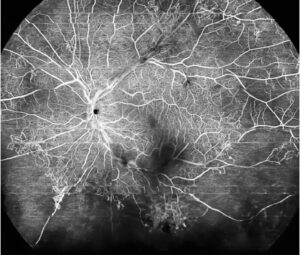
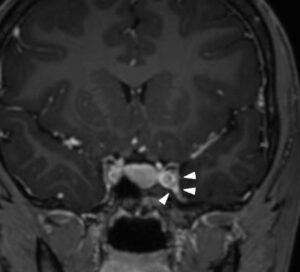
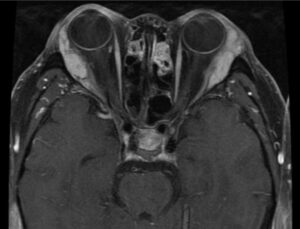
Airbag eye injury is ocular trauma caused by the deploying bag, its chemical byproducts, or both.
Airbags reduce deaths in frontal crashes, yet the bag inflates at high speed toward the face. As a result, the eye can absorb blunt, abrasive and chemical energy within milliseconds.
How Airbags Injure the Eye
Three mechanisms act together: first, the bag strikes the globe and orbit as a blunt object, and next, the fabric surface scrapes the cornea and lids. Finally, the propellant releases an aerosol that settles on the ocular surface, and because these forces overlap, one eye may show several injury types at once.
Risk Factors for Airbag Eye Injury
- Short stature or a seat close to the steering wheel
- Unbelted occupants who move forward before deployment
- Eyeglasses, which can break or press into the orbit
All-fit Slit-Lamp Adapter
Record and share exactly what you see at the slit lamp. One adapter fits any slit lamp or surgical microscope — and any smartphone.
From Choroida — the team behind this siteAlkaline Keratitis in Airbag Eye Injury
Older systems used sodium azide propellant, and combustion produced alkaline compounds such as sodium hydroxide. The patient reports burning, tearing and photophobia, often with white powder on the face. At the slit lamp, look for punctate epithelial erosions, chemosis and limbal blanching.
Therefore, check the tear pH and irrigate before the detailed examination. Continue irrigation until the pH is neutral, then recheck after several minutes.
Corneal Abrasions
Abrasions are among the most frequent findings in published case series, and they usually appear as broad, irregular epithelial defects that stain with fluorescein. Then evert the lids, because trapped powder or fibers can keep scraping the cornea, and management follows standard principles (see corneal abrasion care).
Lid and Periorbital Signs
Periorbital ecchymosis, lid edema and lid lacerations are common. These signs look dramatic, while the globe beneath may hide a worse injury. Therefore, open swollen lids gently with retractors and avoid pressure on the globe.
Hyphema After Airbag Eye Injury
Blunt compression stretches the iris root and ciliary body vessels, and as a result, blood collects in the anterior chamber. Grade the hyphema height, measure intraocular pressure and ask about sickle cell disease.
Clotted total hyphema needs urgent pressure control (see eight ball hyphema). In addition, plan gonioscopy after the blood clears to detect angle recession.
Iris, Angle and Lens Damage
- Traumatic mydriasis and sphincter tears
- Iridodialysis
- Angle recession with later glaucoma risk
- Lens subluxation or phacodonesis
- Traumatic cataract, which may appear weeks or months later
Commotio Retinae in Airbag Eye Injury
Contrecoup forces disrupt the photoreceptor outer segments, and the fundus shows gray-white retinal whitening, sometimes at the macula. OCT often shows increased outer retinal reflectivity in the acute phase. Many cases clear over weeks; however, foveal involvement can leave lasting loss (see commotio retinae).
Retinal Tears and Detachment
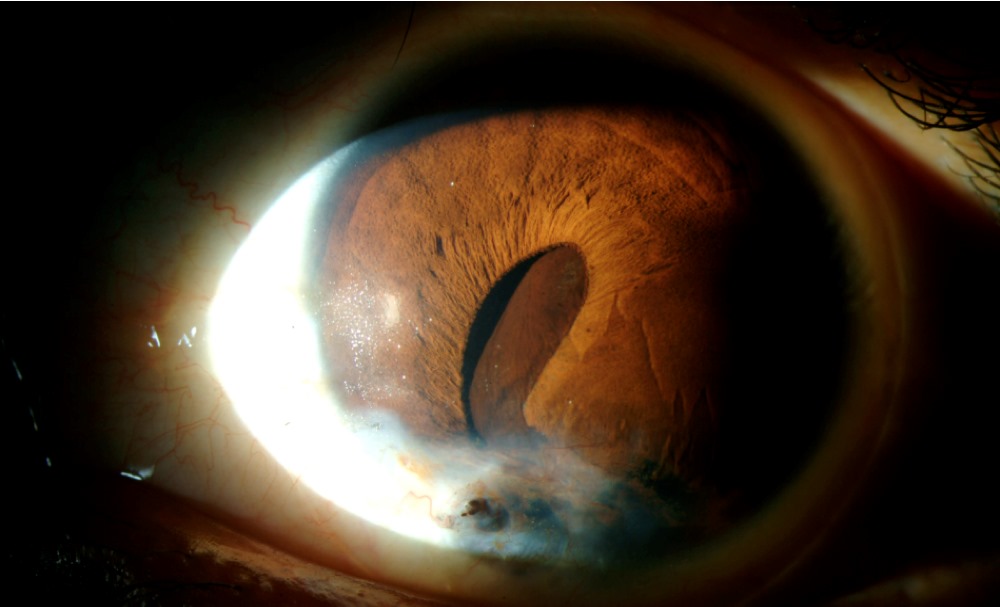
Rapid compression of the globe expands the equator and pulls on the vitreous base; for example, retinal dialysis is a typical traumatic break. Therefore, perform a dilated examination with scleral depression when the media allow. Detachment may present months later, so the first normal exam does not end follow-up.
Globe Rupture and Orbital Fracture
These injuries are uncommon but serious, so suspect rupture with extensive bullous subconjunctival hemorrhage, a peaked pupil, very low pressure or an abnormal chamber depth. In that case, stop the examination, place a rigid shield and arrange orbital CT and surgery. Also check ocular motility and infraorbital sensation for an orbital floor fracture.
Exam Checklist for Airbag Eye Injury
- Visual acuity in each eye, with pinhole
- Tear pH, with irrigation if alkaline
- Pupils, including a relative afferent pupillary defect
- Slit lamp with fluorescein and lid eversion
- Intraocular pressure, unless rupture is suspected
- Dilated fundus exam, with depression when safe
- Gonioscopy at a later visit
Follow-up After Airbag Eye Injury
Review chemical keratitis and abrasions within a day or two, while patients with hyphema need early pressure checks and activity limits. Next, repeat the depressed fundus exam and gonioscopy within the following weeks. Finally, eyes with angle recession need long-term pressure monitoring, because glaucoma can develop years later.
Counseling the Patient
Explain that most surface injuries heal well with treatment, then describe warning symptoms: new flashes, floaters, a curtain or falling vision. Also mention that cataract and glaucoma can appear late, and therefore, patients should keep scheduled visits even when the eye feels normal.
Prevention of Airbag Eye Injury
Seatbelts keep the occupant back from the inflating bag. Safety agencies advise about 25 cm between the breastbone and the steering wheel, and in addition, children belong in the rear seat.
Pitfalls to Avoid
- Do not delay irrigation while waiting for a full examination
- Never assume intact lids mean an intact globe
- Do not skip the dilated exam after a “minor” crash
- Avoid tonometry when rupture is suspected
- Do not discharge hyphema without a pressure plan


Document what you see
Two smartphone imaging tools built for everyday clinic use — one for the slit lamp, one for the fundus.
From Choroida — the team behind this siteReferences
- Duma SM, Kress TA, Porta DJ, et al. Airbag-induced eye injuries: a report of 25 cases. J Trauma. 1996;41:114-119.
- Pearlman JA, Au Eong KG, Kuhn F, Pieramici DJ. Airbags and eye injuries: epidemiology, spectrum of injury, and analysis of risk factors. Surv Ophthalmol. 2001;46:234-242.
- Stein JD, Jaeger EA, Jeffers JB. Air bags and ocular injuries. Trans Am Ophthalmol Soc. 1999;97:59-82.
- Smally AJ, Binzer A, Dolin S, Viano D. Alkaline chemical keratitis: eye injury from airbags. Ann Emerg Med. 1992;21:1400-1402.
- Bowling B. Kanski’s Clinical Ophthalmology: A Systematic Approach. 8th ed. Elsevier; 2016.
Test yourself
A few questions straight from this article.
-
What causes the chemical component of airbag eye injury in older airbag systems?
Older airbags used sodium azide propellant, whose combustion produced alkaline compounds such as sodium hydroxide that settle on the ocular surface as an aerosol. -
In suspected airbag alkaline keratitis, what should be done before the detailed eye examination?
Tear pH is checked and the eye irrigated before the detailed examination, continuing until the pH is neutral and rechecking after several minutes. -
Which slit-lamp findings point to alkaline keratitis after airbag deployment?
Patients report burning, tearing and photophobia, often with white powder on the face, and the slit lamp shows punctate epithelial erosions, chemosis and limbal blanching. -
Why should the lids be everted when examining a corneal abrasion after airbag deployment?
Airbag abrasions are broad, irregular fluorescein-staining defects, and lid eversion finds trapped powder or fibers that would otherwise keep scraping the cornea. -
After an airbag-related hyphema, why is gonioscopy planned once the blood clears?
Gonioscopy after the blood clears detects angle recession, and eyes with recession need long-term pressure monitoring because glaucoma can develop years later. -
What does OCT often show acutely in commotio retinae after an airbag injury?
Contrecoup forces disrupt photoreceptor outer segments, and OCT often shows increased outer retinal reflectivity in the acute phase; foveal involvement can leave lasting loss. -
Which retinal break is typical after blunt airbag compression of the globe?
Rapid globe compression expands the equator and pulls on the vitreous base, and retinal dialysis is a typical traumatic break, so a depressed fundus exam is needed. -
When globe rupture is suspected after an airbag injury, what is the correct next step?
With suspected rupture the examination stops, a rigid shield is placed and orbital CT and surgery are arranged; tonometry is avoided. -
What distance between the breastbone and steering wheel do safety agencies advise to prevent airbag eye injury?
Safety agencies advise about 25 cm between the breastbone and the steering wheel, alongside seatbelt use and seating children in the rear. -
Which occupant factor raises the risk of airbag eye injury?
Short stature or a seat close to the steering wheel, being unbelted and wearing eyeglasses all raise the risk of airbag eye injury.

Writes and reviews the clinical articles on Educate. Every post is checked against peer-reviewed sources before it goes live.