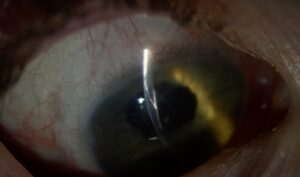
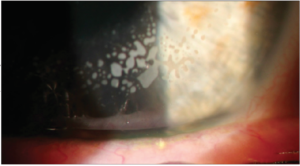
A gold weight implant is a small plate of gold placed in the upper eyelid to help it close by gravity.
It is also the most used surgical treatment for incomplete lid closure from facial nerve palsy, and it protects the cornea from drying and ulceration.
The result is good in most patients, and the implant can be removed if the nerve recovers.
Gold Weight Implant: Why the Eyelid Does Not Close
The orbicularis oculi muscle, supplied by the facial nerve, closes the eyelids.
In facial palsy, the muscle is weak, but the levator, supplied by the oculomotor nerve, keeps the lid open, so the eye cannot close fully (see exposure keratopathy and lagophthalmos).
The cornea dries out, and the patient has pain, redness, and sometimes ulcers.
When Is It Needed?
- Lagophthalmos with exposure keratopathy that does not respond to lubricants and taping
- Facial palsy that is not expected to recover soon, or is permanent
- Temporary use, in selected patients, while waiting for nerve recovery
- Patients who cannot close the eye during sleep, and who cannot manage drops at night
Doctors use conservative measures, such as ointment and taping, first and in the early phase of palsy.
All-fit Slit-Lamp Adapter
Record and share exactly what you see at the slit lamp. One adapter fits any slit lamp or surgical microscope — and any smartphone.
From Choroida — the team behind this siteHow a Gold Weight Implant Works
The weight adds mass to the upper lid, which works against the levator and helps the lid to close when the levator relaxes.
The effect is passive, so it works best in an upright position, and a gap may remain in the supine position at night.
Choosing the Weight
- Weights come in sizes from about 0.8 to 1.6 grams
- Surgeons choose the correct size by taping trial weights to the lid, in the upright position, and finding the lightest weight that gives closure without ptosis (see the references)
- Heavier weights close better but increase ptosis, and thin lids show the implant more
Platinum chain implants are lighter and have a lower profile.
The Operation
- Done under local anesthesia, in a short procedure
- An incision in the upper lid crease exposes the tarsus
- Surgeons place the weight over the lower part of the tarsal plate and suture it
- Surgeons close the orbicularis and skin over it
Placing it below the tarsal border gives a better effect, and a pretarsal position reduces extrusion.
Results of Gold Weight Implant
In series, most patients get good closure and relief of symptoms, with a reduction in exposure keratopathy (see the references).
Some residual lagophthalmos at night may remain, and lubricants may still be needed.
Patients with lower lid laxity often need a lower lid procedure at the same time.
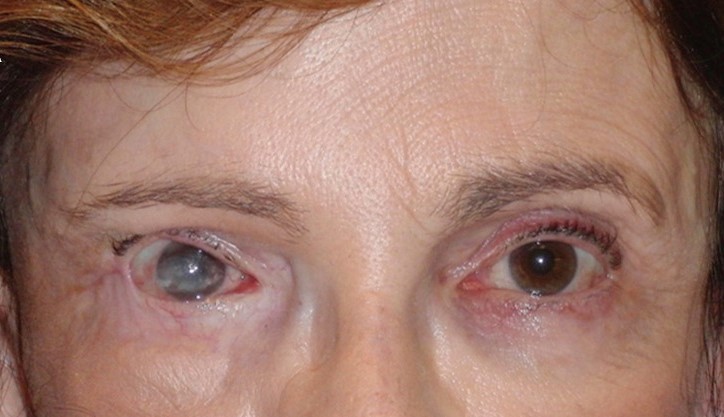
Complications of Gold Weight Implant
- Extrusion and migration of the implant, especially in thin lids
- Ptosis, from excess weight, which may be corrected by changing the weight
- Visible implant and astigmatism
- Infection and granuloma
- Allergy to gold, which is rare
- Reduced effect over time, as the levator strengthens or the lid changes
Surgeons can remove or replace the implant if necessary.
Combined Procedures
- Lateral tarsal strip or lower lid tightening: to correct ectropion and lid laxity (see lateral tarsal strip)
- Brow lift, if a brow ptosis blocks vision
- Static slings and dynamic reanimation, for facial support
These combine with eye care, such as tear substitutes and ointment.
Counselling
Explain the aim, which is to protect the eye and not to restore the blink, and the possibility of changing the weight.
Discuss the risks, and the need for follow-up.
Gold Weight Implant: Follow-Up and Adjustment
- Review at one week and one month for lid position, closure, and wound healing
- Check the cornea with fluorescein, and continue ointment at night until the closure is good
- If ptosis is troublesome, exchange the implant for a lighter one, and if closure is poor, for a heavier one
- Watch for thinning of the skin over the implant, which may announce extrusion
Alternatives and Temporary Options
Temporary measures include hyaluronic acid fillers or an external weight stuck to the lid, which doctors use while waiting for the nerve to recover.
Botulinum toxin can induce a temporary ptosis in the levator and protect the cornea for weeks, in selected patients.
Tarsorrhaphy is an option when the cornea is at risk and other measures fail, though it limits the field of vision (see exposure keratopathy).
Quality of Life
Patients with facial palsy also have social and emotional problems, and referral to a facial nerve team improves the overall result.
Photographs before and after surgery, with the eyes open and closed, help to record the result, to guide changes in weight, and to show the patient the improvement over time.
For the latest studies, see the PubMed results for gold weight implant.


Document what you see
Two smartphone imaging tools built for everyday clinic use — one for the slit lamp, one for the fundus.
From Choroida — the team behind this siteReferences
- Jobe RP. A technique for lid loading in the management of the lagophthalmos of facial palsy. Plast Reconstr Surg. 1974;53:29-32.
- Seiff SR, Boerner M, Carter SR. Treatment of facial palsies with external eyelid weights. Am J Ophthalmol. 1995;120:652-657.
- Bergeron CM, Moe KS. The evaluation and treatment of upper eyelid paralysis. Facial Plast Surg. 2008;24:220-230.
- American Academy of Ophthalmology. Basic and Clinical Science Course, Section 7: Oculofacial Plastic and Orbital Surgery. AAO; current edition.

Writes and reviews the clinical articles on Educate. Every post is checked against peer-reviewed sources before it goes live.