Aphakia correction is the replacement of the focusing power of the lens after removal or loss.
Also, without correction, an aphakic eye is highly hyperopic, with a loss of near and distance vision.
The choice of method depends on age, laterality, the state of the eye, and the patient’s needs.
Each approach has its own optical effects and risks.
Why Aphakia Correction Is Needed
The lens provides about 20 diopters of the eye’s power, so its absence makes the eye strongly hyperopic and abolishes accommodation.
Other issues may accompany aphakia, such as iris tremor, a deep anterior chamber, and loss of vitreous support.
The optical solution must restore focus while keeping the image size and the field of view as close to normal as possible.
Aphakia may be congenital, traumatic, or due to surgery, and in children the correction is also needed to protect against amblyopia.
Aphakia Correction: Spectacle Correction
Aphakic spectacles typically need a power of about plus 10 to plus 12 diopters.
- They are inexpensive, safe, and noninvasive
- They magnify the image by 25 to 30 percent, which causes problems of fusion if the other eye is phakic
- These produce a ring scotoma and a “jack-in-the-box” phenomenon at the lens edge, and distortion in the periphery
- They are heavy and cosmetically unattractive
They are practical for bilateral aphakia in adults, but they are not suitable for unilateral aphakia, because of the difference in image size between the eyes.
All-fit Slit-Lamp Adapter
Record and share exactly what you see at the slit lamp. One adapter fits any slit lamp or surgical microscope — and any smartphone.
From Choroida — the team behind this siteContact Lenses
Contact lenses give a much smaller image magnification, about 7 to 10 percent, and a more natural field of vision.
- Clinicians use soft lenses, extended-wear lenses, and rigid gas-permeable lenses
- They are the method of choice for infants and young children with congenital cataract, in whom early optical correction is essential
- They require care, handling, and regular replacement, and they carry the risk of infection and lens loss
In older patients with limited dexterity, handling the lens may also be difficult.
Clinicians use silicone elastomer lenses in infants in some centers because of their high oxygen permeability.
Aphakia Correction: Intraocular Lenses
Placing a lens in the eye provides near-normal image size and a normal visual field, without the burden of handling lenses.
- Primary IOL, placed at the time of cataract surgery, is the usual approach in adults
- Secondary IOL, placed later, is an option in aphakic patients who cannot tolerate other forms of correction
- Fixation methods depend on the capsular support, with in-the-bag, sulcus, iris-claw, scleral-fixated, or anterior chamber lenses (see sulcus-fixated IOL, iris-claw IOL, and scleral-fixated intraocular lens)
Secondary implantation carries the risks of intraocular surgery, and the choice depends on ocular health.
Aphakia in Children
The Infant Aphakia Treatment Study randomized infants with unilateral congenital cataract to an IOL or to contact lens correction after surgery.
At 4.5 years, there was no significant difference in visual acuity between the groups, but the IOL group had more adverse events and more additional surgeries.
For this reason, many surgeons still prefer contact lenses in infants.
They implant lenses later, when the eye is larger and more stable (see pediatric cataract surgery IOL timing).
Amblyopia treatment, including patching of the better eye, is essential for the outcome.
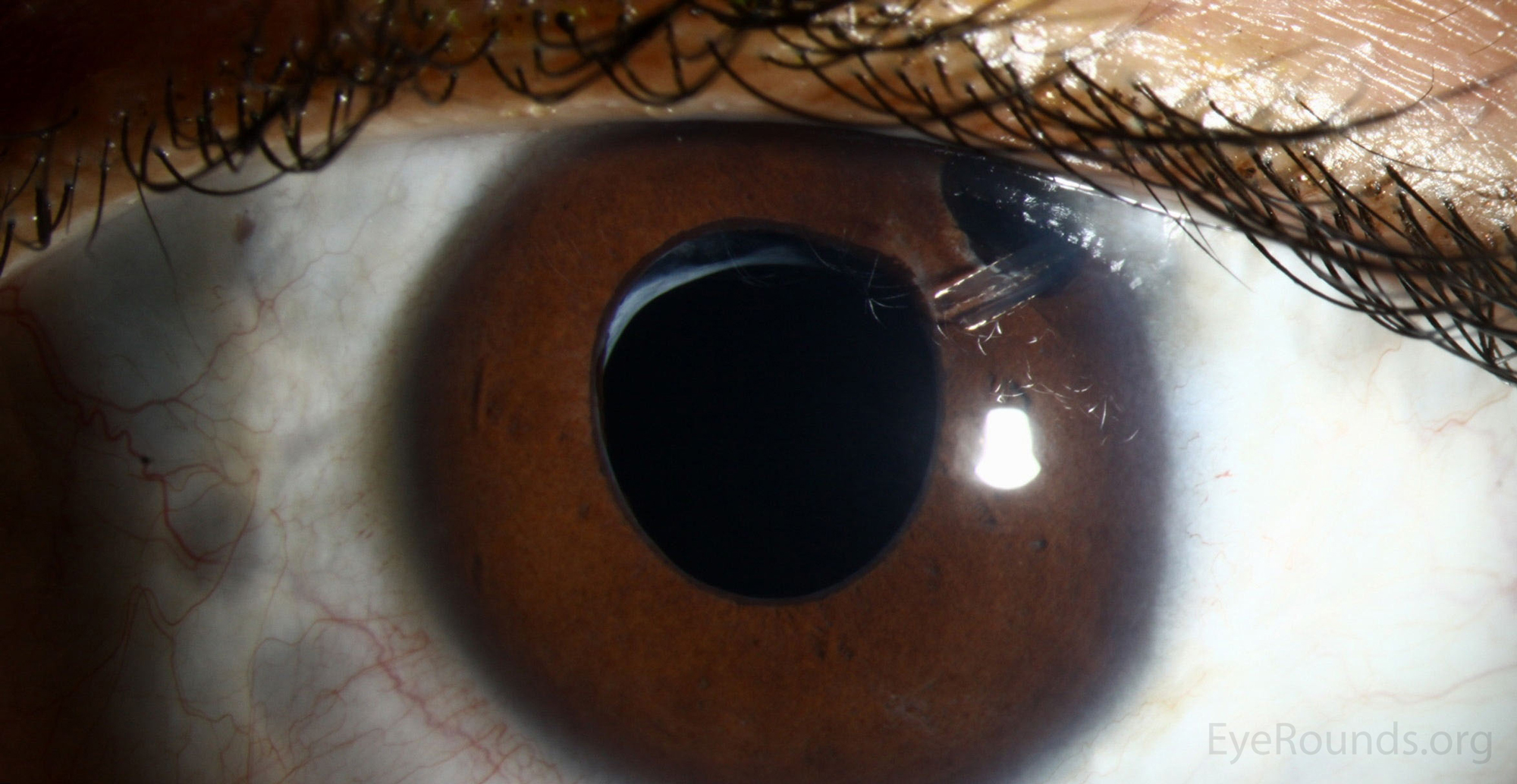
Choosing a Method
Consider the age, the laterality, the dexterity and motivation of the patient, the condition of the cornea and the capsule, and the risks.
Discuss the options, including the trade-offs, with the patient or the parents.
Follow up regularly, since the needs and the refraction change, especially in children.
Practical Tips for Contact Lens Fitting in Aphakia
High-plus lenses are thick, and the center of gravity matters, so experienced practitioners should do the fitting.
Extended-wear lenses may reduce the burden of handling but raise the risk of infection, and patients need regular follow-up.
In young children, parents must be trained, and clinicians change the lens power as the eye grows.
Optical Details Worth Knowing
Spectacles correct aphakia at a distance of about 12 to 14 millimeters in front of the eye.
The power needed rises when the lens sits farther away.
The difference in image size between a spectacle-corrected aphakic eye and a normal fellow eye is called aniseikonia.
It is the reason why fusion fails in unilateral cases.
Contact lenses sit close to the cornea and reduce the problem, and an IOL nearly eliminates it.
Aphakia Correction: Follow-Up and Rehabilitation
After the choice is made, the follow-up should include refraction, a check of the lens position or fit, and attention to amblyopia in children.
Teach patients with unilateral aphakia and poor vision in the aphakic eye how to protect the better eye.
Low-vision services help those with lasting visual loss.
Document what you see
Two smartphone imaging tools built for everyday clinic use — one for the slit lamp, one for the fundus.
From Choroida — the team behind this siteReferences
- Lambert SR, Lynn MJ, Hartmann EE, et al. Comparison of contact lens and intraocular lens correction of monocular aphakia during infancy: a randomized clinical trial of HOTV optotype acuity at age 4.5 years and clinical findings at age 5 years. JAMA Ophthalmol. 2014;132:676-682.
- Wagoner MD, Cox TA, Ariyasu RG, Jacobs DS, Karp CL. Intraocular lens implantation in the absence of capsular support: a report by the American Academy of Ophthalmology. Ophthalmology. 2003;110:840-859.
- Lambert SR, Lyons CJ, eds. Taylor and Hoyt’s Pediatric Ophthalmology and Strabismus. 5th ed. Elsevier; 2017.
- American Academy of Ophthalmology. Basic and Clinical Science Course, Section 11: Lens and Cataract. AAO; current edition.

Writes and reviews the clinical articles on Educate. Every post is checked against peer-reviewed sources before it goes live.