
Alström syndrome is a rare autosomal recessive ciliopathy that shares enough overlapping features with Bardet-Biedl syndrome, discussed in its own dedicated article on this site, that the two are frequently compared and sometimes initially confused — both cause cone-rod dystrophy, obesity, and sensorineural hearing loss — but Alström syndrome is distinguished by the notable absence of the polydactyly and intellectual disability common in Bardet-Biedl syndrome, and by its own distinctive, and more immediately life-threatening, pattern of early-onset cardiomyopathy and progressive multi-organ fibrotic disease.
Genetics
Alström syndrome results from mutations in ALMS1, a gene involved in ciliary and centrosomal function, placing the condition within the broader family of ciliopathies that also includes Bardet-Biedl syndrome and several other multisystem genetic disorders affecting cilia-dependent cellular processes across multiple organ systems.
This shared underlying biology of ciliary dysfunction is part of why these otherwise distinct genetic syndromes present with overlapping features (retinal dystrophy, obesity, renal disease) despite arising from entirely different genes.
Because ALMS1 is expressed broadly across ciliated tissues throughout the body, the wide range of organs affected in Alström syndrome — retina, heart, ear, kidney, liver, and metabolic tissue — reflects the near-ubiquitous distribution of cilia-dependent cellular processes rather than a series of unrelated, coincidental findings.
Ocular Findings
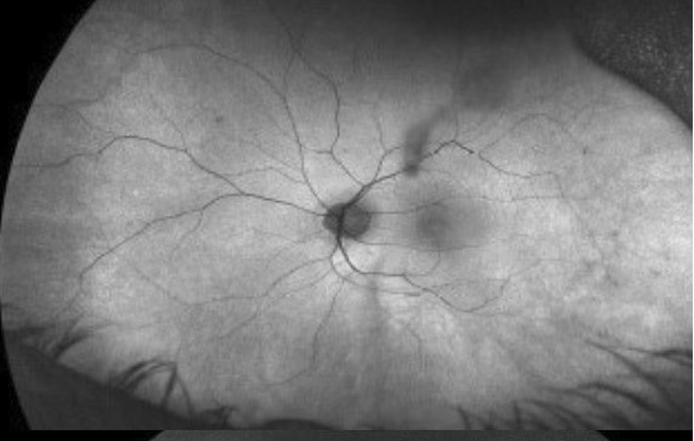
- Cone-rod dystrophy, typically presenting very early — often in infancy, earlier than the more classically described onset of Bardet-Biedl-associated retinal disease — with photophobia, nystagmus, and progressive vision loss following the cone-predominant pattern discussed in more detail in this site’s dedicated article on cone-rod dystrophy generally
- Progressive visual field constriction and eventual severe visual impairment, typically by the second or third decade of life
- Nystagmus, often present from early infancy given how early and severely the retinal dystrophy affects visual development
Because the retinal dystrophy is often the earliest and most obvious manifestation of the syndrome, ophthalmologists are frequently the first specialists to encounter an affected infant, well before the cardiac and other systemic findings have become apparent — a genuine responsibility to recognize the broader syndromic pattern rather than treating the retinal findings in isolation.
Fundus Explorer Pro
Photograph the retinal findings described here with the phone already in your pocket — 22 D optics and built-in illumination in one handheld unit.
From Choroida — the team behind this siteSystemic Findings
- Dilated cardiomyopathy — a genuinely important and distinguishing feature of Alström syndrome, sometimes presenting acutely in infancy and requiring urgent cardiac evaluation and management; this cardiac involvement is a key clinical differentiator from Bardet-Biedl syndrome and one of the more medically consequential aspects of the diagnosis
- Sensorineural hearing loss, typically progressive, developing in childhood
- Obesity, developing in early childhood, often accompanied by insulin resistance and type 2 diabetes mellitus at an unusually young age
- Progressive renal disease and, in some patients, hepatic fibrosis, reflecting the broader multi-organ fibrotic tendency associated with the underlying ciliary dysfunction
- Notably, normal cognitive development in the great majority of affected individuals — a genuinely important distinguishing feature from Bardet-Biedl syndrome, where intellectual disability is common
- Absence of polydactyly — another key distinguishing feature from Bardet-Biedl syndrome, where extra digits are a classic associated finding
Differential Diagnosis
- Bardet-Biedl syndrome — shares retinal dystrophy, obesity, and hearing loss, but is distinguished by the presence of polydactyly, intellectual disability, and hypogonadism, along with the general absence of Alström syndrome’s characteristic early dilated cardiomyopathy, discussed in its own dedicated article on this site
- Isolated cone-rod dystrophy without systemic features — the absence of the characteristic systemic findings (obesity, cardiomyopathy, hearing loss) distinguishes an isolated retinal dystrophy from the syndromic Alström phenotype
- Other ciliopathies with overlapping features — distinguished ultimately through the specific combination of systemic findings and, when needed, genetic testing for ALMS1 mutations
Diagnostic Evaluation
Diagnosis relies on recognizing the characteristic combination of early-onset cone-rod dystrophy, obesity, sensorineural hearing loss, and, most distinctively, cardiomyopathy, supported by genetic testing for ALMS1 mutations.
Given the cardiac risk, echocardiography is an essential and urgent part of the initial evaluation once the diagnosis is suspected, and this cardiac assessment should not be deferred behind the ophthalmic and other systemic workup, given how acutely dangerous unrecognized cardiomyopathy can be in infancy.
Baseline hearing assessment, renal function testing, and metabolic screening (fasting glucose and lipid panel) round out the initial evaluation once Alström syndrome is suspected, establishing a baseline against which future changes in each of these systems can be tracked.
Management
Management is multidisciplinary and addresses each system involved: low vision services and educational support for the progressive visual impairment, cardiology follow-up and treatment for cardiomyopathy (which can be life-threatening if unrecognized and untreated), audiology and hearing amplification for the sensorineural hearing loss, and endocrinology involvement for obesity-related insulin resistance and diabetes management.
Regular monitoring for renal and hepatic involvement is part of long-term, comprehensive care, with the frequency and specific tests used guided by the severity of organ involvement already documented in each individual patient.
Genetic counseling addresses recurrence risk for the family given the autosomal recessive inheritance pattern.
Given the number of organ systems involved and the potential severity of the cardiac and renal manifestations specifically, coordinated, multidisciplinary care — rather than ophthalmology managing the retinal findings in isolation — is essential for these patients, with the eye findings representing an important but far from the only significant aspect of the overall disease, and lifelong follow-up across all of these specialties remains necessary as the child grows into adulthood.
Document what you see
Two smartphone imaging tools built for everyday clinic use — one for the slit lamp, one for the fundus.
From Choroida — the team behind this siteReferences
- Marshall JD, Maffei P, Collin GB, Naggert JK. Alström syndrome: genetics and clinical overview. Current Genomics.
- Marshall JD, Bronson RT, Collin GB, et al. New Alström syndrome phenotypes based on the evaluation of 182 cases. Archives of Internal Medicine.
- American Academy of Ophthalmology. Basic and Clinical Science Course, Section 12: Retina and Vitreous.
Test yourself
A few questions straight from this article.
-
Mutations in which gene cause Alström syndrome?
Alström syndrome results from mutations in ALMS1, a gene involved in ciliary and centrosomal function, placing it within the family of ciliopathies. -
Why does Alström syndrome affect so many different organ systems?
ALMS1 is expressed widely across ciliated tissues, so retina, heart, ear, kidney, liver and metabolic tissue are all affected rather than these being unrelated coincidental findings. -
Which systemic feature is characteristic of Alström syndrome and generally absent in Bardet-Biedl syndrome?
Retinal dystrophy, obesity and hearing loss are shared by both syndromes. Early dilated cardiomyopathy, which can present acutely in infancy, is the key differentiator favouring Alström syndrome. -
Which features are typical of Bardet-Biedl syndrome but characteristically absent in Alström syndrome?
Bardet-Biedl syndrome classically includes polydactyly and intellectual disability, whereas Alström syndrome lacks extra digits and cognitive development is normal in the great majority of patients. -
When does the retinal dystrophy of Alström syndrome typically first present?
The cone-rod dystrophy typically presents very early, often in infancy, earlier than the more classically described onset of Bardet-Biedl-associated retinal disease. -
By when does severe visual impairment typically develop in Alström syndrome?
Progressive visual field constriction and eventual severe visual impairment typically occur by the second or third decade of life. -
Which investigation should not be deferred once Alström syndrome is suspected?
Echocardiography is an essential and urgent part of the initial evaluation and should not wait behind the ophthalmic workup, because unrecognised cardiomyopathy is acutely dangerous in infancy. -
Which metabolic problem commonly accompanies the obesity of Alström syndrome?
Obesity develops in early childhood and is often accompanied by insulin resistance and type 2 diabetes mellitus at an unusually young age. -
What is the inheritance pattern of Alström syndrome?
Alström syndrome is a rare autosomal recessive ciliopathy, and genetic counselling addresses recurrence risk on that basis. -
What does appropriate long-term care for a patient with Alström syndrome require?
Because several organ systems are involved and the cardiac and renal manifestations can be severe, coordinated multidisciplinary care is essential rather than managing the retinal findings in isolation.
