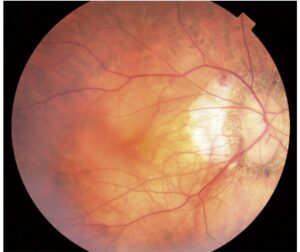
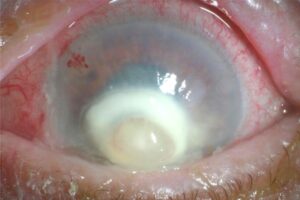
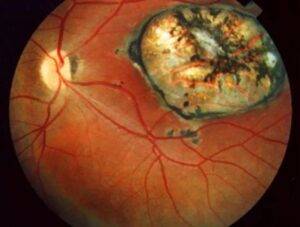
TASS vs endophthalmitis is a frequent dilemma when an eye looks inflamed after cataract surgery.
Both conditions can show fibrin, hypopyon and reduced vision. However, one is a sterile chemical injury and the other is a sight-threatening infection. Therefore, the first examination must sort them quickly, because treatment differs sharply.
Why the Distinction Is Urgent
Toxic anterior segment syndrome (TASS) responds to intensive topical steroids, while infectious endophthalmitis needs intravitreal antibiotics, often within hours. As a result, a wrong label can delay antibiotics or expose a sterile eye to an unnecessary injection, so when doubt remains, treat the eye as infected.
Onset Timing in TASS vs Endophthalmitis
Timing is the first clue, because TASS usually appears within 12 to 48 hours of surgery, often on the first postoperative day. Acute bacterial endophthalmitis typically declares itself later, most often during the first week. However, virulent organisms such as streptococci can present early, so early onset never excludes infection.
All-fit Slit-Lamp Adapter
Record and share exactly what you see at the slit lamp. One adapter fits any slit lamp or surgical microscope — and any smartphone.
From Choroida — the team behind this sitePain and Symptoms
Patients with TASS often report blurred vision with mild discomfort. In contrast, endophthalmitis usually brings increasing pain, redness and falling vision, while lid swelling and chemosis also point toward infection. Still, some infected eyes are nearly painless, so a quiet history does not settle the question.
Corneal Edema in TASS vs Endophthalmitis
TASS damages the corneal endothelium directly, so it typically produces diffuse limbus-to-limbus corneal edema, out of proportion to the surgery. Endophthalmitis can also cause edema, although it is often less uniform early on. Localized edema with a visible separated membrane suggests another cause (see Descemet membrane detachment).
Anterior Chamber Findings
Both conditions can show heavy cells, fibrin and hypopyon, so the anterior chamber alone rarely separates them. However, TASS often leaves a dilated, poorly reactive or irregular pupil from iris toxicity, and intraocular pressure may rise after trabecular damage.
Vitreous Involvement in TASS vs Endophthalmitis
The vitreous offers the most useful dividing line, because TASS stays in the anterior segment and the vitreous remains clear, while endophthalmitis spreads into the vitreous and dulls the red reflex. Therefore, a clear reflex with visible fundus detail favors TASS. When the view is poor, B-scan ultrasound can show vitreous opacities and membranes.
Course Over 24 Hours in TASS vs Endophthalmitis
Progression often settles the diagnosis, because TASS usually improves steadily with intensive topical steroids. Endophthalmitis worsens despite steroids, with more pain, denser vitritis and lower vision, so the plan must change the same day.
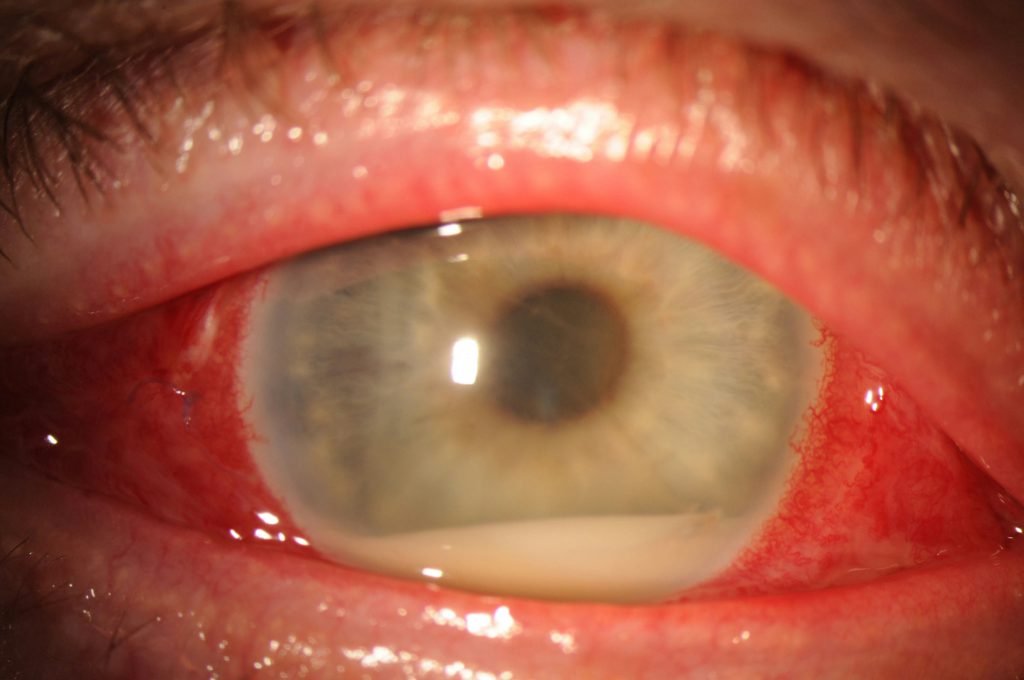
Steroid Response in TASS vs Endophthalmitis
A clear response to topical steroids supports a sterile process, for example when fibrin clears and the chamber quiets over several days. However, steroids can briefly blunt the signs of early infection, so an apparent response never replaces close review.
Clustered Cases and Instrument Clues
TASS often occurs in clusters on the same operating list or within one unit, and reported triggers include detergent residue, endotoxin, preservatives and incorrect solution concentrations. Therefore, several inflamed eyes after one session should prompt a review of cleaning and sterilization, although infection clusters also occur, so cultures stay essential.
When to Tap and Inject
Sample aqueous and vitreous when infection cannot be excluded, then inject intravitreal antibiotics at the same visit, commonly vancomycin with a gram-negative agent. The Endophthalmitis Vitrectomy Study supported immediate vitrectomy for eyes with light perception vision only, while eyes with better vision did well with tap and inject.
TASS Management Steps
First, start intensive topical steroids, often hourly, and then control intraocular pressure and monitor corneal clarity. Severe endothelial loss may leave permanent edema that needs keratoplasty, and iris and trabecular damage can cause chronic glaucoma (see TASS overview).
Lessons From Injection Practice
Similar reasoning applies after intravitreal injections, where sterile inflammation and infection also overlap in the first days (see post-injection endophthalmitis). Again, pain, vitritis and progression favor infection.
Counseling the Patient
Explain that inflammation after surgery has several possible causes, then describe the plan and the next review time clearly. Ask the patient to return at once if pain or blurring worsens, and honest uncertainty builds trust when a tap becomes necessary.
Pitfalls to Avoid
- Do not rely on onset timing alone
- Never assume a painless eye is sterile
- Do not delay a tap when the vitreous is hazy
- Avoid labeling TASS without a clear fundus view
- Check other eyes from the same operating list
- Keep close review even when steroids seem to work


Document what you see
Two smartphone imaging tools built for everyday clinic use — one for the slit lamp, one for the fundus.
From Choroida — the team behind this siteReferences
- Mamalis N, Edelhauser HF, Dawson DG, et al. Toxic anterior segment syndrome. J Cataract Refract Surg. 2006;32:324-333.
- Cutler Peck CM, Brubaker J, Clouser S, et al. Toxic anterior segment syndrome: common causes. J Cataract Refract Surg. 2010;36:1073-1080.
- Endophthalmitis Vitrectomy Study Group. Results of the Endophthalmitis Vitrectomy Study. Arch Ophthalmol. 1995;113:1479-1496.
- ESCRS Endophthalmitis Study Group. Prophylaxis of postoperative endophthalmitis following cataract surgery: results of the ESCRS multicenter study and identification of risk factors. J Cataract Refract Surg. 2007;33:978-988.
- Bowling B. Kanski’s Clinical Ophthalmology: A Systematic Approach. 8th ed. Elsevier; 2016.
Test yourself
A few questions straight from this article.
-
What is the fundamental nature of toxic anterior segment syndrome (TASS) after cataract surgery?
TASS is a sterile chemical injury, whereas infectious endophthalmitis is a sight-threatening infection, even though both can show fibrin, hypopyon and reduced vision. -
What is the first-line treatment for toxic anterior segment syndrome (TASS)?
TASS responds to intensive topical steroids, often hourly, with pressure control and monitoring of corneal clarity. -
Within what time after cataract surgery does toxic anterior segment syndrome (TASS) usually appear?
TASS usually appears within 12 to 48 hours, often on the first postoperative day, while acute bacterial endophthalmitis usually declares itself later in the first week. -
What pattern of corneal edema is typical of toxic anterior segment syndrome (TASS)?
TASS damages the corneal endothelium directly, producing diffuse limbus-to-limbus edema out of proportion to the surgery. -
Which pupil finding in post-cataract inflammation points toward toxic anterior segment syndrome (TASS)?
TASS often leaves a dilated, poorly reactive or irregular pupil from iris toxicity, and pressure may rise after trabecular damage. -
Which finding most usefully separates toxic anterior segment syndrome (TASS) from endophthalmitis?
TASS stays in the anterior segment with a clear vitreous, while endophthalmitis spreads into the vitreous and dulls the red reflex; hypopyon and fibrin occur in both. -
How should an inflamed eye after cataract surgery be managed when infection cannot be excluded?
When doubt remains the eye is treated as infected: aqueous and vitreous are sampled and intravitreal antibiotics injected at the same visit. -
According to the Endophthalmitis Vitrectomy Study, which eyes benefited from immediate vitrectomy?
The Endophthalmitis Vitrectomy Study supported immediate vitrectomy for eyes with light perception vision only; eyes with better vision did well with tap and inject. -
Which is a reported trigger of toxic anterior segment syndrome (TASS) clusters?
TASS often clusters on one operating list; reported triggers include detergent residue, endotoxin, preservatives and incorrect solution concentrations, prompting review of cleaning and sterilization. -
Which long-term complication can follow severe toxic anterior segment syndrome (TASS)?
Severe endothelial loss in TASS may leave permanent corneal edema needing keratoplasty, and iris and trabecular damage can cause chronic glaucoma.

Writes and reviews the clinical articles on Educate. Every post is checked against peer-reviewed sources before it goes live.