Red eye in children is a daily problem in primary care and clinics.
Most cases are mild conjunctivitis.
A few signal danger that is easy to miss.
Red Eye in Children: History First
Ask about duration, discharge, pain, vision and contact with sick children.
Ask about trauma, allergy and recent illness.
A newborn needs separate thought.
Therefore, age shapes the differential.
Common Causes of Red Eye in Children
Viral conjunctivitis is the commonest cause.
Allergic and bacterial forms follow.
Blepharitis and styes also redden the eye.
So most cases are benign.
All-fit Slit-Lamp Adapter
Record and share exactly what you see at the slit lamp. One adapter fits any slit lamp or surgical microscope — and any smartphone.
From Choroida — the team behind this siteViral Conjunctivitis in Children
Watery discharge, follicles and a recent cold are typical.
The infection spreads in schools.
Supportive care is enough (see epidemic keratoconjunctivitis).
Therefore, avoid unneeded antibiotics.
Bacterial Conjunctivitis
Thick purulent discharge and sticky lids point to bacteria.
Haemophilus and Streptococcus species are common in children.
Topical antibiotics shorten the illness.
However, many cases settle on their own.
Allergic Causes of Red Eye in Children
Itching, tearing and bilateral involvement point to allergy.
Children often have eczema or asthma.
Vernal disease can threaten the cornea (see vernal keratoconjunctivitis).
So watch for photophobia and corneal signs.
Red Eye in Children With Pain
Pain and light sensitivity suggest corneal or uveal disease.
Look for corneal ulcers, abrasions and foreign bodies.
Uveitis can present with a quiet pain in juvenile arthritis.
Therefore, examine every painful red eye with a slit lamp.
Trauma Causing Red Eye in Children
Children rub the eye after a scratch or after sand exposure.
Check under the upper lid.
Consider intraocular foreign body after high-speed injury.
Also suspect child abuse if the story does not fit.
Preseptal and Orbital Cellulitis
Swollen lids with fever need urgent care.
Pain with eye movement and proptosis suggest orbital spread.
Imaging and admission are required.
So never delay referral (see orbital cellulitis).
Red Eye in Newborns
Newborn conjunctivitis within the first month needs urgent assessment.
Chlamydia, gonococcus and herpes simplex are causes.
Tests and systemic therapy may be needed.
Therefore, refer the baby the same day.
Congenital Glaucoma
Large corneas, tearing and light sensitivity suggest glaucoma.
Red eye is not typical but may occur.
Early surgery protects vision.
Also remember it when tearing persists.
Examining Red Eye in Children
Use a bright toy and gentle restraint.
Check vision by fixation and following.
Use fluorescein when the child tolerates it.
So plan the examination with the parents.
Red Flags in Red Eye in Children
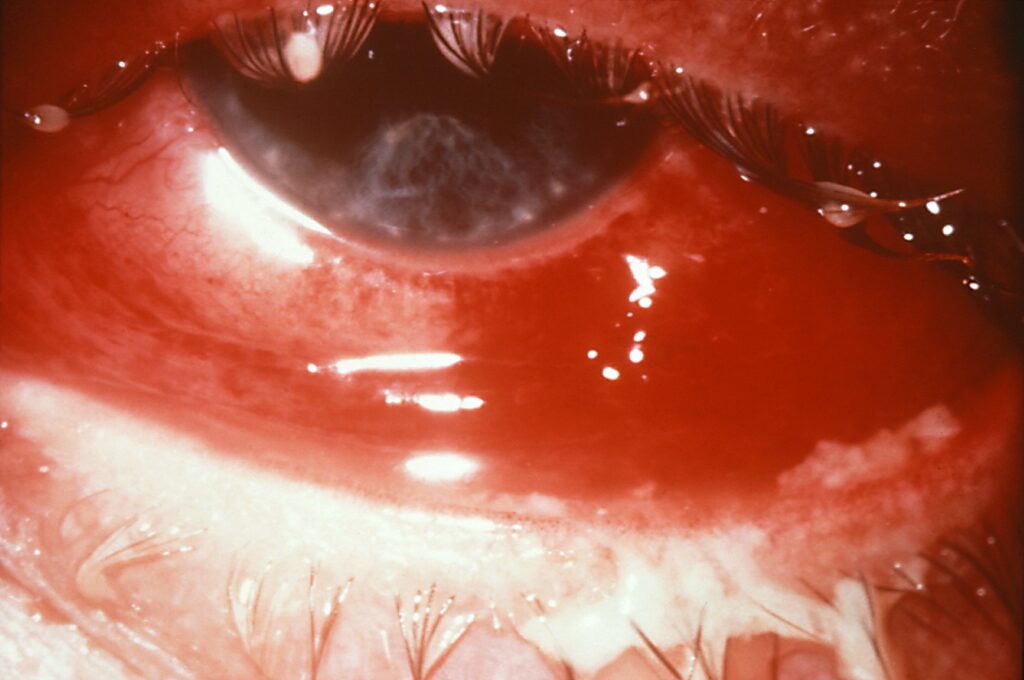
Reduced vision, photophobia, corneal opacity and hypopyon need referral.
Fever, proptosis and limited movement also need it.
Chemical injury is an emergency.
Therefore, teach parents the warning signs.
Advice for Parents
Explain hand washing and avoiding towel sharing.
Give return instructions in writing.
Note the school policy for exclusion.
Also offer reassurance.
Pitfalls to Avoid
- Do not treat every red eye with antibiotics
- Never miss a corneal ulcer
- Avoid delaying imaging in suspected orbital cellulitis
- Do not forget the newborn pathway
Red Eye in Children and Juvenile Arthritis
Chronic anterior uveitis in juvenile arthritis can be white and painless.
Because it is silent, screening examinations are essential.
If ANA is positive, follow the screening schedule closely.
Therefore, ask the rheumatologist about eye review.
Red Eye in Children and Blocked Tear Ducts
Babies with blocked ducts have watery, sticky eyes.
When mucus builds up, the eye may look red.
Because most ducts open by one year, massage and observation help.
Then refer if tearing continues (see congenital nasolacrimal duct obstruction).
Red Eye in Children After Swimming
Chlorine and bacteria irritate the eyes after swimming.
If the redness persists, consider infection.
Because goggles reduce exposure, advise them.
Therefore, rinse with clean water after swimming.
Red Eye in Children and Contact Lenses
Teenagers who wear lenses can develop serious ulcers.
When pain develops, they must remove the lenses.
Because they delay seeking help, teach early warning signs.
Then arrange same-day review.
Red Eye in Children: Medication Choices
Avoid redness-relieving drops in children.
Because many cases are viral, antibiotics seldom help.
If treatment is needed, choose age-appropriate drugs.
In addition, follow local guidelines.
Red Eye in Children: School Policy
Many schools exclude children with conjunctivitis.
However, evidence supports attendance once treated or improving.
Therefore, discuss local rules with parents.
Also give a note if needed.
Red Eye in Children: Practical Summary
Most children with a red eye have a mild, self-limited illness.
However, pain, photophobia or reduced vision change the plan.
Because early referral protects sight, keep the threshold low.
Finally, give parents clear return advice.
For the latest studies, see the PubMed results for red eye in children.


Document what you see
Two smartphone imaging tools built for everyday clinic use — one for the slit lamp, one for the fundus.
From Choroida — the team behind this siteReferences
- Azari AA, Barney NP. Conjunctivitis: a systematic review of diagnosis and treatment. JAMA. 2013;310:1721-1729.
- Varu DM, Rhee MK, Akpek EK, et al. Conjunctivitis preferred practice pattern. Ophthalmology. 2019;126:P1-P55.
- Wallace DK, Christiansen SP, Sprunger DT, et al. Pediatric eye evaluations preferred practice pattern. Ophthalmology. 2018;125:P184-P227.
- Visscher KL, Hutnik CML, Thomas M. Evidence-based treatment of acute infective conjunctivitis: breaking the cycle of antibiotic prescribing. Can Fam Physician. 2009;55:1071-1075.
Test yourself
A few questions straight from this article.
-
What is the commonest cause of red eye in children?
Viral conjunctivitis is the commonest cause of red eye in children, followed by allergic and bacterial forms, so most cases are benign. -
In a child with conjunctivitis, which feature points to a bacterial cause?
Thick purulent discharge and sticky lids point to bacteria, whereas watery discharge, follicles and a recent cold are typical of viral disease. -
Which presentation of red eye in a child points to an allergic cause?
Itching, tearing and bilateral involvement point to allergy, often in children with eczema or asthma; vernal disease can threaten the cornea. -
A child's red eye is painful and light-sensitive. Which disease category does this suggest?
Pain and light sensitivity suggest corneal or uveal disease, so every painful red eye in a child is examined with a slit lamp. -
In a child with swollen lids and fever, which signs suggest orbital rather than preseptal cellulitis?
Pain with eye movement and proptosis suggest orbital spread, which requires imaging and admission without delay. -
Which organisms cause conjunctivitis in the first month of life, needing same-day referral?
Newborn conjunctivitis within the first month is caused by chlamydia, gonococcus and herpes simplex, may need tests and systemic therapy, and is referred the same day. -
Which triad of signs in a young child suggests congenital glaucoma?
Large corneas, tearing and light sensitivity suggest congenital glaucoma; red eye is not typical, and early surgery protects vision. -
How is a baby with a watery, sticky eye from a blocked tear duct first managed?
Most blocked ducts open by one year, so massage and observation help, with referral if tearing continues. -
After a high-speed injury in a child with a red eye, what must be considered?
An intraocular foreign body is considered after high-speed injury; the upper lid should also be checked, and abuse suspected if the story does not fit. -
Which finding in a child's red eye is a red flag requiring referral?
Reduced vision, photophobia, corneal opacity and hypopyon all need referral, as do fever, proptosis and limited eye movement.

Writes and reviews the clinical articles on Educate. Every post is checked against peer-reviewed sources before it goes live.