
Corticosteroids are among the most effective drugs in medicine, and the eye pays a price for them.
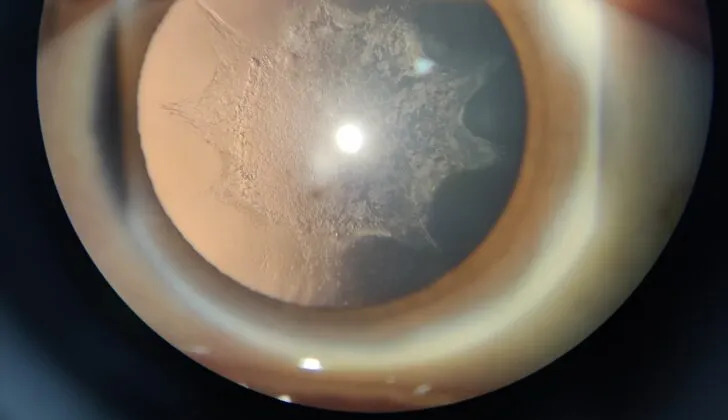
Posterior subcapsular cataract, a plaque of opacity at the back of the lens, is one of the best-known ocular side effects, and it can develop with oral, inhaled, nasal, topical, and injected steroids.
What the cataract looks like
The opacity starts as a small group of granules and vacuoles just beneath the posterior capsule, near the visual axis.
As it enlarges, it forms a saucer-shaped plaque, with a hazy, iridescent appearance on retroillumination.
Because it sits at the nodal point of the eye, even a small plaque produces disproportionate visual symptoms (see posterior subcapsular cataract).
Typical complaints are glare, halos around lights, poor vision in bright light, and trouble with reading, while distance vision in dim light may remain reasonably good.
The pupil constricts in bright light, which pushes light through the opacity, and the patient notices that vision is worse in sunshine than in the evening.
Who is at risk
- Patients on long-term oral prednisone or its equivalents, with risk rising with dose and duration
- Children, who appear to be more susceptible to steroid cataract than adults
- Patients with asthma or COPD using high doses of inhaled corticosteroids over years
- Those who receive repeated periocular or intravitreal steroid injections, including triamcinolone and dexamethasone implants
- Patients with uveitis on long-term topical steroids, in whom the inflammation itself also promotes cataract
- Individuals with a genetic predisposition, since only some develop cataract at a given dose
No dose is entirely safe.
Studies have found an association with doses as low as 5 to 10 mg of prednisone per day over a period of years, but the response varies from patient to patient.
All-fit Slit-Lamp Adapter
Record and share exactly what you see at the slit lamp. One adapter fits any slit lamp or surgical microscope — and any smartphone.
From Choroida — the team behind this siteHow steroids damage the lens
The mechanism is not fully understood.
Steroids may bind to lens proteins and form covalent adducts, alter lens epithelial cell function and cation transport, and induce oxidative stress, which leads to protein aggregation.
The cells at the posterior pole are the most vulnerable because they migrate posteriorly and differentiate there.
Evaluation
- Take a careful drug history, including inhalers, nasal sprays, creams and injections that patients tend not to mention
- Examine the lens with retroillumination and the slit lamp, with the pupil dilated
- Measure intraocular pressure and examine the optic nerve, since steroid-induced glaucoma often accompanies steroid cataract (see steroid-induced glaucoma)
- Document visual function, including glare testing when available
Management
Early on, the cataract can be observed.
If the underlying condition allows, the steroid dose can be reduced, or a steroid-sparing drug can be substituted, though established opacities do not usually regress, and in children some do improve when steroids are stopped.
When the cataract interferes with daily activity, surgery is effective.
Patients on long-term steroids have a higher risk of postoperative inflammation, delayed wound healing, and raised pressure, and the steroid regimen around surgery should be coordinated with the prescribing physician.
Prevention
Use the lowest effective dose for the shortest time, favor steroid-sparing therapy for chronic conditions, rinse the mouth after inhaled steroid use, and schedule regular eye examinations for patients on long-term treatment.
For patients on chronic steroids, an annual dilated examination is reasonable.
Discussing the risk with the prescriber
The ophthalmologist is often the first to see the lens changes of long-term steroid therapy, and the finding needs to be communicated to the physician who prescribes the drug. A short letter that explains the changes, the visual symptoms, and the options for dose reduction helps the physician weigh the benefit of the drug against the damage to the eye. In some conditions, a steroid-sparing agent is a practical alternative.
Monitoring
Patients on prolonged corticosteroids benefit from a dilated examination at least once a year, with measurement of intraocular pressure and examination of the optic nerve, because steroid cataract and steroid glaucoma often occur together. Children on long-term treatment for nephrotic syndrome, asthma, or rheumatic disease need particular attention, since a posterior subcapsular opacity in the visual axis can cause amblyopia if the child is young.
Record the dose and duration in the notes, so that future changes can be interpreted.
How soon can changes appear
In susceptible patients, early opacities can appear within a few months of starting high-dose treatment. In others, years of low-dose treatment pass before any change is visible. This variability means that a normal lens at one visit gives limited reassurance, and a regular schedule of examination is the safest course.
Prognosis
Cataract surgery gives excellent results.
The visual outcome depends more on the underlying disease, such as uveitis or macular edema, than on the cataract itself.

Document what you see
Two smartphone imaging tools built for everyday clinic use — one for the slit lamp, one for the fundus.
From Choroida — the team behind this siteReferences
- Black RL, Oglesby RB, von Sallmann L, Bunim JJ. Posterior subcapsular cataracts induced by corticosteroids in patients with rheumatoid arthritis. JAMA. 1960;174:166-171.
- Jobling AI, Augusteyn RC. What causes steroid cataracts? A review of steroid-induced posterior subcapsular cataracts. Clin Exp Optom. 2002;85:61-75.
- Urban RC Jr, Cotlier E. Corticosteroid-induced cataracts. Surv Ophthalmol. 1986;31:102-110.
- Cumming RG, Mitchell P, Leeder SR. Use of inhaled corticosteroids and the risk of cataracts. N Engl J Med. 1997;337:8-14.
Test yourself
A few questions straight from this article.
-
Which type of lens opacity is characteristically caused by corticosteroid therapy?
Posterior subcapsular cataract, a plaque of opacity at the back of the lens, is the best-known lens side effect of corticosteroids and can follow oral, inhaled, nasal, topical or injected use. -
What is the classic slit-lamp appearance of an established steroid-induced cataract?
The opacity begins as granules and vacuoles just under the posterior capsule and enlarges into a saucer-shaped plaque with a hazy, iridescent look on retroillumination. -
Why does even a small steroid-induced posterior subcapsular plaque cause marked visual symptoms?
Because the plaque sits at the nodal point of the eye, even a small opacity produces visual symptoms out of proportion to its size. -
Why is vision worse in bright sunshine than in the evening with a posterior subcapsular cataract?
In bright light the pupil constricts, forcing light through the central opacity, so patients report glare and halos by day while distance vision in dim light stays reasonably good. -
Steroid cataract has been linked to daily prednisone doses as low as which range when taken for years?
Studies have found an association with doses as low as 5 to 10 mg of prednisone daily over a period of years, and no dose is entirely safe, although susceptibility varies between patients. -
Which mechanism is proposed for corticosteroid damage to the lens?
Steroids may form covalent adducts with lens proteins, alter lens epithelial cell function and cation transport, and induce oxidative stress that leads to protein aggregation. -
How often should a patient on chronic corticosteroid therapy have a dilated eye examination?
An annual dilated examination with intraocular pressure measurement and optic nerve assessment is reasonable, since steroid cataract and steroid glaucoma often occur together. -
Which part of the drug history do patients with steroid cataract most often fail to mention?
A careful drug history must specifically cover inhalers, nasal sprays, creams and injections, which patients tend not to think of as steroid treatment. -
Which operative risk is increased when cataract surgery is done in a patient on long-term steroids?
Long-term steroid use raises the risk of postoperative inflammation, delayed wound healing and raised pressure, so the steroid regimen around surgery should be coordinated with the prescribing physician. -
What chiefly determines the visual outcome after surgery for a steroid-induced cataract?
Cataract surgery gives excellent results, and the visual outcome depends more on the underlying condition, such as uveitis or macular oedema, than on the cataract itself.
