
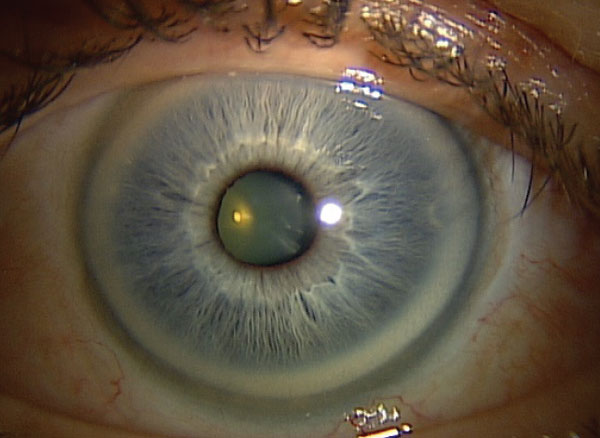
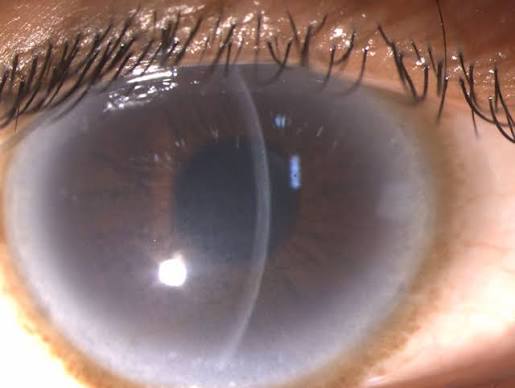
Arcus juvenilis looks identical to the common, entirely benign arcus senilis seen in the vast majority of older adults, a gray-white ring of lipid deposition at the corneal periphery, but the same finding in a young patient carries a meaningfully different significance, since it should prompt a lipid panel rather than being dismissed as an incidental aging change that simply arrived early.
The Same Appearance, a Different Story
Arcus senilis, the peripheral corneal lipid deposit seen with increasing prevalence as patients age, is generally considered a benign, expected finding of no particular clinical significance in an older individual, related to gradually increasing lipid deposition in the peripheral cornea over a lifetime.
When this same ring appears in a younger patient, generally considered under age 40 to 50 depending on the specific reference used, it is termed arcus juvenilis, and its early appearance raises a specific concern: an underlying lipid metabolism disorder, most importantly familial hypercholesterolemia, may be driving accelerated lipid deposition well before the age at which this would typically be expected.
Clinical Appearance
- A gray-white to yellowish ring or partial ring at the peripheral cornea, typically with a clear zone separating it from the limbus
- Usually bilateral and roughly symmetric
- Composed of lipid deposition (predominantly cholesterol and phospholipids) within the peripheral corneal stroma
- Visually asymptomatic, not affecting vision even when well developed, since the deposition remains confined to the far periphery, outside the visual axis
All-fit Slit-Lamp Adapter
Record and share exactly what you see at the slit lamp. One adapter fits any slit lamp or surgical microscope — and any smartphone.
From Choroida — the team behind this siteWhy Screening Matters
Familial hypercholesterolemia is a genetic lipid disorder causing significantly elevated LDL cholesterol from birth, and affected individuals carry a substantially increased lifetime risk of premature cardiovascular disease, including myocardial infarction at a young age, if the condition remains undiagnosed and untreated.
Arcus juvenilis can be one of the earliest visible clues to this underlying, otherwise silent condition, and recognizing its significance in a young patient, rather than assuming it is simply an early but benign variant of the common age-related finding, can lead to a diagnosis with genuinely important, potentially life-saving implications for cardiovascular risk reduction.
Other Causes of Early Arcus
- Familial hypercholesterolemia and other primary lipid metabolism disorders are the most important causes to identify given their treatable cardiovascular implications
- Some cases of arcus juvenilis occur without any identifiable lipid abnormality, representing an isolated corneal finding without broader systemic significance, though this determination can only be made after appropriate lipid screening has been performed and found normal
Diagnostic Approach
- Any patient found to have arcus at an unexpectedly young age should have a fasting lipid panel, assessing total cholesterol, LDL, HDL, and triglycerides
- A family history specifically asking about early cardiovascular events (heart attack or stroke at a young age) in parents or siblings, and a family history of similarly early arcus, supports suspicion for a familial lipid disorder
- Referral to primary care or a lipid specialist for further evaluation and management is appropriate when screening reveals significant lipid abnormality, particularly when familial hypercholesterolemia is suspected based on the degree of elevation or family history
Distinguishing From Other Peripheral Corneal Findings
- Arcus is distinguished from limbal girdle of Vogt, another common peripheral corneal finding, by its lipid composition, grayish color, and the typical clear zone separating it from the limbus, versus the chalky, crescentic appearance of limbal girdle changes closer to the limbus itself
- Unlike some inflammatory or infectious peripheral corneal conditions, arcus causes no associated redness, pain, or epithelial irregularity, supporting its identification as a purely deposition-related, non-inflammatory finding
Management
Arcus juvenilis itself requires no ocular treatment, since it does not threaten vision or corneal health; the entire clinical value of recognizing it lies in the systemic lipid screening it should prompt.
When an underlying lipid disorder, particularly familial hypercholesterolemia, is identified, management is directed at the systemic condition itself, including dietary modification, lipid-lowering medication, and cardiovascular risk reduction, coordinated with primary care or a lipid specialist, rather than any ocular-specific intervention.
Prognosis
The corneal finding itself carries an excellent prognosis and never requires treatment or monitoring in its own right.
The broader prognosis depends entirely on whether an underlying lipid disorder is identified and appropriately treated, which is precisely why an ophthalmologist noticing arcus in a young patient, and following through with the recommendation for lipid screening, can meaningfully change that patient’s long-term cardiovascular health trajectory.
Document what you see
Two smartphone imaging tools built for everyday clinic use — one for the slit lamp, one for the fundus.
From Choroida — the team behind this siteReferences
- Segal P, Insull W Jr, Chambless LE, et al. The association of dyslipoproteinemia with corneal arcus and xanthelasma. The Lipid Research Clinics Program Prevalence Study. Circulation. 1986;73:I108-I118.
- Zech LA Jr, Hoeg JM. Correlating corneal arcus with atherosclerosis in familial hypercholesterolemia. Lipids Health Dis. 2008;7:7.
- Chua BE, Mitchell P, Cumming RG. Corneal arcus and hypercholesterolaemia: baseline and five-year findings from the Blue Mountains Eye Study. Clin Exp Ophthalmol. 2004;32:24-30.
- Nemet AY, Vinker S, Kaiserman I. Associated morbidity of corneal arcus. Cornea. 2010;29:1044-1048.
