
CASE REPORT
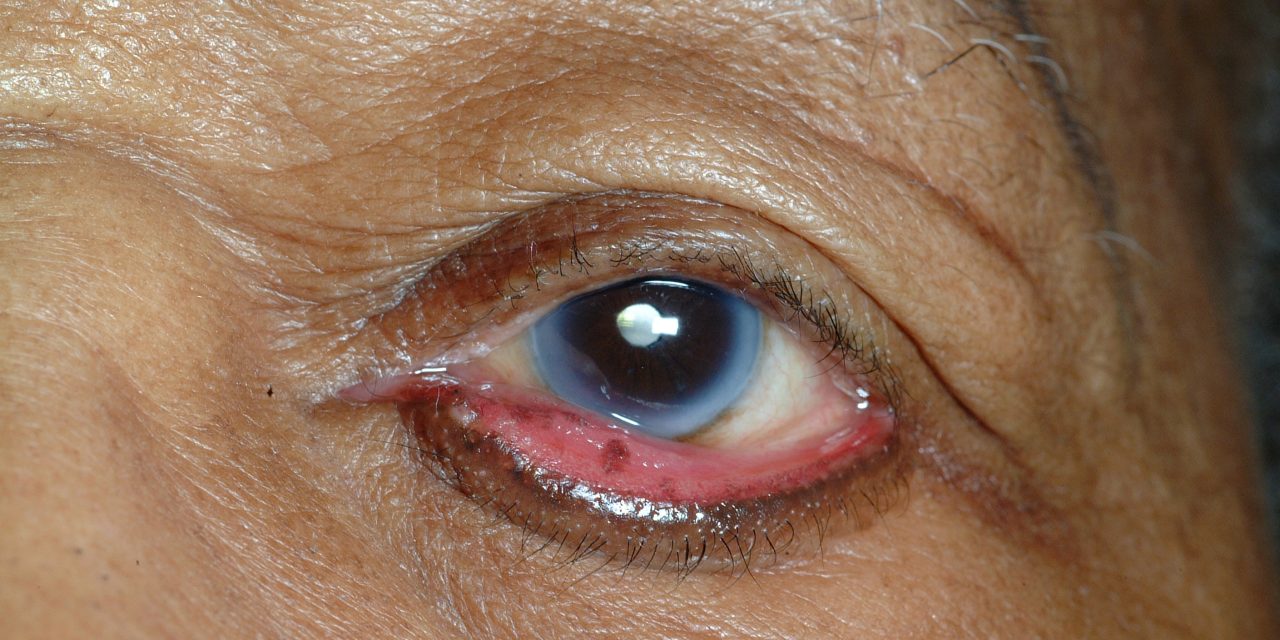
A 62-year-old male patient presented with a 3-month history of ocular irritation, tearing, and redness in the left eye.

The clinical examination revealed an outwardly turned lower eyelid margin and conjunctival exposure in the left eye, while the right eye had normal findings.
The evaluation process included a detailed medical history, assessment of eyelid laxity, tear film evaluation, and ruling out facial nerve palsy or previous trauma. The diagnosis was determined as involutional ectropion of the left lower eyelid.
Ectropion DISEASE entity
Ectropion is an outward turning of the eyelid margin. Patients may experience symptoms due to ocular exposure and inadequate lubrication. Definitive management is surgical. Medical management is temporary but can improve symptoms while waiting for surgery.

There are four main types of ectropion: involutional, cicatricial, mechanical, and paralytic.
- Involutional ectropion is caused by increased horizontal laxity of the lower eyelid and disinsertion of the lower eyelid retractors.
- Cicatricial ectropion is caused by the shortening of the anterior lamella, which is comprised of the skin and orbicularis muscle.
- Paralytic ectropion is caused by decreased orbicularis muscle tone supporting the lower eyelid.
- Additionally, mechanical ectropion can occur when a mass, such as a tumor, displaces the lower eyelid margin.
Congenital ectropion can occur rarely and may be seen in association with other congenital defects such as blepharophimosis syndrome or euryblepharon.
In involutional ectropion, the tarsoligamentous sling supporting the eyelid by attachment to the orbital rim via the medial and lateral canthal tendons becomes lax. In paralytic ectropion, orbicularis muscle tone is weak or absent due to facial nerve palsy.
In cicatricial ectropion, the anterior or middle lamellae are shortened due to scarring. Midfacial hypoplasia, where the inferior orbital rim is located relatively posterior to the eyeball, results in both decreased lower eyelid support and an increased propensity for lower eyelid retraction.
All-fit Slit-Lamp Adapter
Record and share exactly what you see at the slit lamp. One adapter fits any slit lamp or surgical microscope — and any smartphone.
From Choroida — the team behind this siteEctropion MANAGEMENT
Definitive management is surgical. Medical management is temporary but can improve symptoms while awaiting surgery.

Deferral of surgery should be considered in 2 groups of patients. It is induced by the long-term use of eye drops such as dorzolamide and brimonidine and may resolve with discontinuation, if feasible.
Patients suffering from inflammatory skin conditions involving the eyelid may have improvement or reversal of ectropion with improved control of inflammation.
Medical therapy
- Lubrication of the ocular surface
- Horizontal taping of the eyelid
Surgery
- Lower eyelid laxity: the lower eyelid is horizontally tightened by a lateral tarsal strip or similar procedure.
- Lower eyelid retractor disinsertion: the Jones procedure
ofreattaching retractors to the tarsus.
- Punctal ectropion: the medial spindle procedure reapposes the everted punctum.
- Cicatricial ectropion often requires lengthening of the anterior lamella by a skin graft.
- Paralytic ectropion requires horizontal tightening and correction of punctal ectropion. With facial nerve paralysis, corneal exposure and brow ptosis may also need to be addressed.
- Mechanical ectropion from facial ptosis may often require surgical elevation of the mid-face (such as a suborbicular oculi fat lift), or a facelift in conjunction with lower lid tightening.
- In some cases of heavy facial tissues or recurrence, periosteal fixation may not be successful and therefore require additional fixation using bone plates or bone tunnels to which the lower lid can be suspended.

Complications
Ectropion surgery is considered safe and effective. Recurrence does occur occasionally after several years requiring a repeat surgery.
Like any eyelid surgery, there is always a possibility of local post-operative bleeding or infection but these are generally minor. Injury to the cornea is possible but uncommon with careful technique.
Document what you see
Two smartphone imaging tools built for everyday clinic use — one for the slit lamp, one for the fundus.
From Choroida — the team behind this siteREFERENCES
- Orbit, Eyelids, and Lacrimal System, Section 7. Basic and Clinical Science Course. San Francisco: American Academy of Ophthalmology; 2009.
- American Academy of Ophthalmology Focal Points: Ectropion and Entropion, Volume 12, Number 10, 1994.
- Hegde V, Robinson R, Dean F, et al. Drug-induced ectropion: what is best practice? Ophthalmology 2007;114:362-366.
- Durairaj VD, Horsley MB. Resolution of pityriasis rubra pilaris-induced cicatricial ectropion with systemic low-dose methotrexate. Am J Ophthalmol 2007;143:709-710.
- Nerad JA. Techniques in Ophthalmic Plastic Surgery: A Personal Tutorial. Philadelphia: Saunders, 2010. Print.
Test yourself
A few questions straight from this article.
-
Ectropion is best defined as which eyelid abnormality?
Ectropion is an outward turning of the eyelid margin, which exposes the ocular surface and leaves it inadequately lubricated. -
Which mechanism underlies involutional ectropion of the lower eyelid?
Involutional ectropion follows increased horizontal laxity of the lower lid together with disinsertion of the lower eyelid retractors; the tarsoligamentous sling becomes lax. -
Cicatricial ectropion results from shortening of which eyelid structure?
The anterior lamella comprises skin and orbicularis muscle, and its shortening by scarring pulls the lid margin outward. -
Paralytic ectropion of the lower eyelid is caused by which abnormality?
In paralytic ectropion the orbicularis tone supporting the lower lid is weak or absent because of facial nerve palsy. -
What causes mechanical ectropion of the lower eyelid?
Mechanical ectropion occurs when a mass, for example a tumour, physically displaces the lower eyelid margin outward. -
Congenital ectropion may be seen in association with which condition?
Congenital ectropion is rare and is described in association with other congenital defects such as blepharophimosis syndrome or euryblepharon. -
Which measures give temporary relief in ectropion while awaiting definitive treatment?
Medical management of ectropion is temporary. Lubricating the ocular surface and taping the eyelid horizontally can ease symptoms until definitive repair. -
Which technique addresses horizontal lower eyelid laxity in involutional ectropion?
Lower eyelid laxity is corrected by tightening the lid horizontally, typically with a lateral tarsal strip or a similar approach. -
Which technique reapposes an everted punctum in punctal ectropion?
The medial spindle reapposes the everted punctum to the globe; the Jones procedure instead reattaches disinserted lower lid retractors to the tarsus. -
What is the recognised long-term outcome after repair of ectropion?
Repair is regarded as safe and effective; recurrence occasionally occurs after several years and calls for a repeat operation, while bleeding, infection and corneal injury are uncommon or minor.
