Miller Fisher syndrome is an acute immune neuropathy defined by ophthalmoplegia, ataxia and areflexia.
Charles Miller Fisher described the triad in 1956 as a variant of Guillain-Barré syndrome, and eye signs often appear first, so patients may present to an eye clinic with sudden double vision.
Why Miller Fisher Syndrome Reaches the Eye Clinic
Most patients report binocular diplopia that worsens over a few days, and symptoms typically follow a respiratory or diarrheal illness by one to three weeks. Many also notice unsteady walking, although they may not mention it unprompted, so ask directly about gait, tingling and recent infection.
The Antibody Behind Miller Fisher Syndrome
Most patients carry serum anti-GQ1b IgG antibodies during the acute phase, and Campylobacter jejuni infection can trigger these antibodies through molecular mimicry with nerve gangliosides. GQ1b is concentrated in the paranodal regions of the oculomotor, trochlear and abducens nerves, and as a result the attack targets the eye muscles early and selectively.
All-fit Slit-Lamp Adapter
Record and share exactly what you see at the slit lamp. One adapter fits any slit lamp or surgical microscope — and any smartphone.
From Choroida — the team behind this siteOphthalmoplegia Pattern
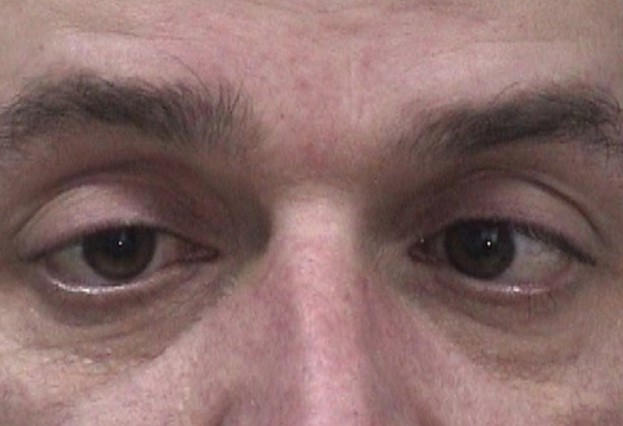
External ophthalmoplegia is usually bilateral and often fairly symmetric, and abduction deficits often appear early, while vertical gaze may fail later. However, onset can mimic an isolated sixth or third nerve palsy, and within days, some patients develop near-complete ophthalmoplegia.
Ptosis in Miller Fisher Syndrome
Ptosis is frequent and usually bilateral, and it reflects third nerve involvement of the levator and often parallels the gaze deficit. Because fatigability is usually absent, it helps separate the condition from myasthenia (see the general ptosis workup).
Pupil Involvement in Miller Fisher Syndrome
Some patients show dilated pupils that react poorly to light, and light-near dissociation and tonic features have also appeared in reports, which suggests ciliary ganglion involvement. Therefore, a large pupil with ophthalmoplegia does not always mean compression, but exclude an aneurysmal cause first (see third nerve palsy and blown pupil).
Ataxia and Areflexia
Gait ataxia is often out of proportion to any sensory loss, and tendon reflexes are reduced or absent in the limbs. Therefore, check reflexes in every patient with acute bilateral ophthalmoplegia, because this simple step reframes the case.
Miller Fisher Syndrome Versus Its Overlaps
Facial and bulbar weakness also occur in some patients, and limb weakness suggests overlap with Guillain-Barré syndrome. However, drowsiness or brisk reflexes point toward Bickerstaff brainstem encephalitis, and Odaka and colleagues grouped these disorders as the anti-GQ1b antibody syndrome.
Differential Diagnosis
- Myasthenia gravis, with fatigable ptosis and variable diplopia
- Brainstem stroke, with abrupt onset and long tract signs
- Wernicke encephalopathy, with nystagmus and confusion
- Botulism, with early pupil and bulbar involvement
- Pituitary apoplexy, with headache and visual field loss
- Tick paralysis or diphtheria when exposure fits
Testing for Miller Fisher Syndrome
First, send serum anti-GQ1b IgG early, before any immunotherapy, and next, arrange urgent neuroimaging to exclude a structural or compressive lesion. Cerebrospinal fluid may show raised protein with normal cells, although it is often normal in the first week.
Nerve conduction studies may also show reduced sensory nerve action potentials. However, a negative antibody result does not exclude the diagnosis, because titers fall quickly after onset.
Treatment of Miller Fisher Syndrome
Pure Miller Fisher syndrome is usually self-limited, and in a retrospective study, Mori and colleagues found that intravenous immunoglobulin slightly hastened recovery of ophthalmoplegia and ataxia. However, final outcomes were similar with or without treatment, and plasma exchange showed no clear benefit.
Clinicians therefore treat overlap cases with limb or respiratory weakness as Guillain-Barré syndrome. Meanwhile, watch swallowing, limb strength and breathing, because some cases progress over days, and also involve neurology early for shared care.
Managing Diplopia
Occluding one eye or fogging a spectacle lens relieves diplopia during the acute weeks. Later, Fresnel prisms help once the deviation stabilizes, but avoid strabismus surgery while recovery continues. Facial weakness may also limit lid closure, so lubricate the eye and check the cornea with fluorescein.
Recovery Course in Miller Fisher Syndrome
Recovery usually begins within weeks of the clinical nadir, and in Mori’s series, ataxia improved before ophthalmoplegia. Most patients had recovered from both by about six months, while mild residual diplopia or ptosis can persist in a few patients, although lasting disability is uncommon.
Counseling the Patient
Explain that the attack is immune-mediated and usually reversible, and also warn that double vision may last several months. Then advise urgent review for breathing difficulty, swallowing problems or new limb weakness, and finally, driving should wait until single vision returns.
Pitfalls to Avoid
- Do not label bilateral sixth nerve palsy as microvascular before checking reflexes
- Never attribute a dilated pupil to the syndrome before excluding compression
- Avoid relying on a single negative antibody test
- Do not miss corneal exposure when facial weakness coexists
- Avoid early strabismus surgery


Document what you see
Two smartphone imaging tools built for everyday clinic use — one for the slit lamp, one for the fundus.
From Choroida — the team behind this siteReferences
- Fisher M. An unusual variant of acute idiopathic polyneuritis (syndrome of ophthalmoplegia, ataxia and areflexia). N Engl J Med. 1956;255:57-65.
- Chiba A, Kusunoki S, Shimizu T, Kanazawa I. Serum IgG antibody to ganglioside GQ1b is a possible marker of Miller Fisher syndrome. Ann Neurol. 1992;31:677-679.
- Chiba A, Kusunoki S, Obata H, Machinami R, Kanazawa I. Serum anti-GQ1b IgG antibody is associated with ophthalmoplegia in Miller Fisher syndrome and Guillain-Barré syndrome: clinical and immunohistochemical studies. Neurology. 1993;43:1911-1917.
- Mori M, Kuwabara S, Fukutake T, Yuki N, Hattori T. Clinical features and prognosis of Miller Fisher syndrome. Neurology. 2001;56:1104-1106.
- Mori M, Kuwabara S, Fukutake T, Hattori T. Intravenous immunoglobulin therapy for Miller Fisher syndrome. Neurology. 2007;68:1144-1146.
- Odaka M, Yuki N, Hirata K. Anti-GQ1b IgG antibody syndrome: clinical and immunological range. J Neurol Neurosurg Psychiatry. 2001;70:50-55.

Writes and reviews the clinical articles on Educate. Every post is checked against peer-reviewed sources before it goes live.