Keratitis steroid taper planning starts only after the clinician identifies and controls the infection.
Topical corticosteroids reduce stromal inflammation, scarring and neovascularization. However, they also slow epithelial healing and can let organisms spread, so timing, dose and withdrawal need the same care as the antimicrobial plan.
Why Use Steroids in Keratitis
Stromal damage comes partly from the host immune response, because neutrophils release collagenases that thin the cornea and leave dense scars.
As a result, a cleared infection can still end with poor vision. Steroids dampen this response, while antimicrobials handle the organism.
Before Starting a Keratitis Steroid Taper
First, confirm the diagnosis with scraping and culture whenever the ulcer is significant. Then exclude fungal and Acanthamoeba infection, because steroids worsen both (see fungal versus bacterial clues). Also record the epithelial defect, infiltrate size and stromal thickness at baseline.
All-fit Slit-Lamp Adapter
Record and share exactly what you see at the slit lamp. One adapter fits any slit lamp or surgical microscope — and any smartphone.
From Choroida — the team behind this siteBacterial Keratitis: Evidence From SCUT
The Steroids for Corneal Ulcers Trial compared prednisolone phosphate 1% with placebo in culture-positive bacterial ulcers, and all patients first received topical moxifloxacin for 48 hours. Overall, steroids did not improve best-corrected acuity at three months.
However, subgroup analyzes suggested benefit in severe, central ulcers with poor baseline vision. The trial also found no clear increase in perforation with steroids.
Timing the Keratitis Steroid Taper in Bacterial Ulcers
Start only after culture identifies a bacterium and the eye shows a clinical response. A secondary SCUT analysis suggested better outcomes when steroids began early in antibiotic therapy.
Therefore, avoid long delays once the ulcer is clearly improving. On the other hand, never start while the infiltrate is still expanding.
Organisms That Argue Against Steroids
- Fungal keratitis, including suspected filamentous fungi
- Acanthamoeba before amoebicidal therapy is well established
- Nocardia, which showed larger scars with steroids in SCUT data
- Atypical mycobacteria
- Any ulcer with marked thinning or a descemetocele
A Typical Bacterial Keratitis Steroid Taper
SCUT used prednisolone phosphate 1% four times daily for one week. The dose then dropped to twice daily for one week, then once daily for a third week.
Antibiotic coverage continues throughout this period, and many specialists adjust the schedule to the response while keeping the course short to limit steroid risks.
Herpetic Stromal Keratitis: HEDS Evidence
The Herpetic Eye Disease Study tested topical prednisolone in stromal keratitis without epithelial ulceration. Steroids produced faster resolution and fewer treatment failures than placebo.
Patients followed a slow taper over about ten weeks with antiviral prophylaxis. However, delaying steroids did not worsen visual outcome at six months (see herpetic disciform keratitis).
Keratitis Steroid Taper in Herpetic Disease
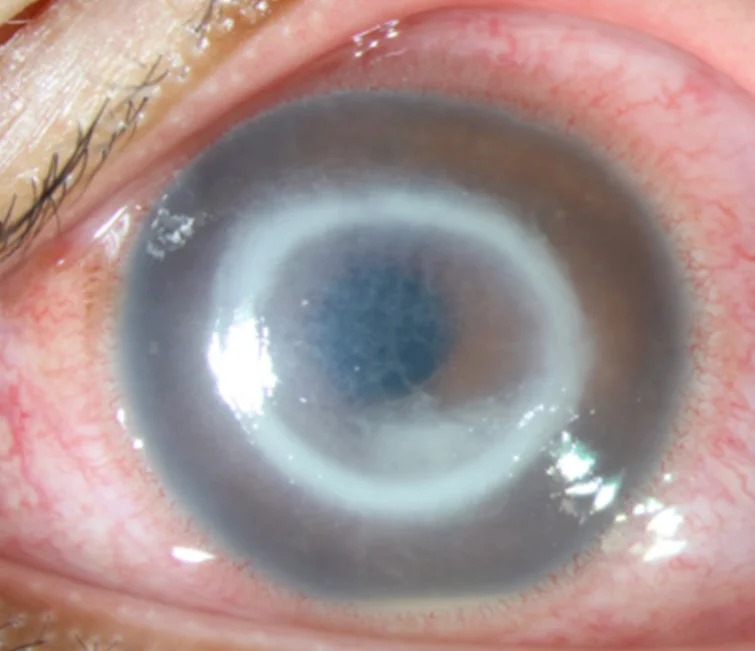
First, confirm an intact epithelium, because active epithelial keratitis is a contraindication. Then add an oral antiviral for the whole course (see acyclovir prophylaxis). Necrotizing stromal keratitis needs closer control, because active viral replication drives the damage.
The Low-Dose Tail
Some herpetic patients flare each time the dose falls below a certain level, so in these eyes a very low maintenance dose may be needed for months.
For example, a weak steroid once daily or on alternate days can keep the cornea quiet. Next, attempt further reduction slowly while antiviral cover continues.
What to Check at Each Keratitis Steroid Taper Visit
- Epithelial defect size and staining pattern
- Infiltrate density, margins and satellite lesions
- Stromal thickness and new thinning
- Anterior chamber cells and hypopyon
- Intraocular pressure
- New dendrites in herpetic eyes
Warning Signs During the Keratitis Steroid Taper
A growing infiltrate or new satellite lesions suggest uncontrolled or missed infection. Similarly, a persistent epithelial defect can signal steroid toxicity or neurotrophic disease.
In that case, reduce or hold the steroid and reassess the cause, and re-culture when the course does not fit the expected organism.
Pressure and Lens Risks
Steroid response can raise intraocular pressure within weeks. Therefore, measure pressure at every visit with a method suited to an irregular cornea.
Long herpetic courses also increase the risk of posterior subcapsular cataract. A lower-potency agent such as loteprednol may reduce pressure risk during maintenance.
When to Stop the Keratitis Steroid Taper
Stop when the epithelium is closed and the stroma stays quiet at the lowest dose. Avoid abrupt withdrawal, because rebound stromal inflammation can follow, and herpetic eyes often need the slowest final steps.
Counseling the Patient
Explain that the steroid limits scarring, while the antimicrobial treats the infection. Then give a written schedule, since tapers confuse many patients. Finally, stress that worsening pain, discharge or blur needs same-day review.
Pitfalls to Avoid
- Starting steroids before culture results or a clinical response
- Using steroids with an open herpetic epithelial defect
- Stopping antiviral cover during a herpetic taper
- Ignoring intraocular pressure on long courses
- Tapering faster than the stroma allows


Document what you see
Two smartphone imaging tools built for everyday clinic use — one for the slit lamp, one for the fundus.
From Choroida — the team behind this siteReferences
- Srinivasan M, Mascarenhas J, Rajaraman R, et al. Corticosteroids for bacterial keratitis: the Steroids for Corneal Ulcers Trial (SCUT). Arch Ophthalmol. 2012;130:143-150.
- Wilhelmus KR, Gee L, Hauck WW, et al. Herpetic Eye Disease Study. A controlled trial of topical corticosteroids for herpes simplex stromal keratitis. Ophthalmology. 1994;101:1883-1896.
- Lalitha P, Srinivasan M, Rajaraman R, et al. Nocardia keratitis: clinical course and effect of corticosteroids. Am J Ophthalmol. 2012;154:934-939.
- Ray KJ, Srinivasan M, Mascarenhas J, et al. Early addition of topical corticosteroids in the treatment of bacterial keratitis. JAMA Ophthalmol. 2014;132:737-741.
Test yourself
A few questions straight from this article.
-
In infectious keratitis, which host process do topical steroids aim to dampen?
Stromal damage comes partly from neutrophils releasing collagenases that thin and scar the cornea; steroids dampen this while antimicrobials handle the organism. -
Which infections must be excluded before starting topical steroids for keratitis, because steroids worsen both?
Confirm the diagnosis with scraping and culture, then exclude fungal and Acanthamoeba infection, because steroids worsen both. -
Long steroid courses for herpetic keratitis increase the risk of which lens change?
Long herpetic courses raise the risk of posterior subcapsular cataract, alongside steroid-induced pressure rise. -
In the Steroids for Corneal Ulcers Trial, which bacterial ulcers appeared to benefit from steroids on subgroup analysis?
Overall, steroids did not improve best-corrected acuity at three months, but subgroup analyses suggested benefit in severe central ulcers with poor baseline vision. -
When should a topical steroid be started in bacterial keratitis?
Start only after culture identifies a bacterium and the eye responds, avoid long delays once it improves, and never start while the infiltrate is expanding. -
Which keratitis organism showed larger scars with steroids in SCUT data?
Nocardia showed larger scars with steroids in SCUT data, so it sits with fungi, Acanthamoeba and atypical mycobacteria among organisms arguing against steroids. -
What prednisolone phosphate 1% schedule did SCUT use for bacterial keratitis?
SCUT used four-times-daily dosing for one week, twice daily for a second week and once daily for a third, with antibiotic cover throughout. -
Before a steroid taper for herpetic stromal keratitis, which finding must be confirmed?
Active epithelial keratitis is a contraindication, so confirm an intact epithelium and add an oral antiviral for the whole course. -
How is a herpetic eye managed that flares whenever its steroid dose falls below a certain level?
A weak steroid once daily or on alternate days can keep the cornea quiet, with further reduction attempted slowly under antiviral cover. -
During a keratitis steroid taper, what do a growing infiltrate or new satellite lesions suggest?
These signs suggest uncontrolled or missed infection, so reduce or hold the steroid, reassess the cause and re-culture if the course does not fit.

Writes and reviews the clinical articles on Educate. Every post is checked against peer-reviewed sources before it goes live.