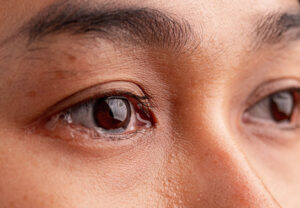
Adult strabismus is more common than many people think.
It may be new or a childhood problem that returns.
Treatment improves both function and quality of life.
What Causes Adult Strabismus
Cranial nerve palsy, thyroid eye disease and trauma are common causes.
Decompensation of childhood strabismus also occurs.
Surgery and sensory loss add to the list.
Therefore, take a thorough history.
New Onset Double Vision in Adult Strabismus
New diplopia needs a careful work-up.
Look for neurological signs and vascular risk factors (see diplopia differential approach).
Imaging is needed in some cases.
So do not delay assessment.
Childhood Strabismus Returning
Many adults had childhood surgery or patching.
Misalignment can drift back.
Fusion may fail with age.
Also ask about prior treatment.
Sensory Strabismus
Poor vision in one eye leads to drift (see sensory strabismus).
Esotropia and exotropia are common results.
Surgery can improve appearance.
Therefore, explain that vision may not improve.
Examining Adult Strabismus
Measure alignment with prisms.
Test eye movements in all gaze positions.
Check for restriction and palsy.
Also test stereopsis.
Prisms for Adult Strabismus
Prism glasses correct small deviations and diplopia.
They are useful for temporary relief.
Large angles need surgery.
So consider prisms first.
Botulinum Toxin
Injection weakens a muscle temporarily.
It helps in acute palsies and as a trial of surgery (see botulinum toxin for strabismus).
Effects last weeks to months.
Therefore, counsel about repeat injections.
Surgery for Adult Strabismus
Muscle surgery realigns the eyes.
Adjustable sutures allow fine tuning.
Results are good in most patients.
Also discuss the risk of overcorrection and double vision.
Quality of Life in Adult Strabismus
Strabismus affects self-image and job prospects.
Studies show improved wellbeing after surgery.
Surgery is not merely cosmetic.
So encourage patients to seek care.
Thyroid Eye Disease
Restrictive myopathy causes vertical and horizontal misalignment (see thyroid eye disease).
Wait until the disease is stable before surgery.
Prisms and botulinum toxin help meanwhile.
Therefore, coordinate with the endocrine team.
Cranial Nerve Palsy
Sixth, fourth and third nerve palsies cause typical patterns.
Many resolve in months.
Observation and prisms are used first.
So reserve surgery for stable cases.
Risks and Complications
Risks include overcorrection, undercorrection, double vision and rare infection.
Most are manageable.
Reoperation is needed in some patients.
Also warn about the postoperative redness.

Recovery
Eyes feel gritty and look red for weeks.
Most return to work in a week.
Vision may fluctuate briefly.
Therefore, give clear instructions.
Adult Strabismus: Practical Summary
Find the cause, measure the deviation and offer prisms or toxin before surgery.
If the angle is stable and symptoms persist, operate.
Because quality of life improves, support patients.
Finally, review for late drift.
Pitfalls to Avoid
- Do not treat new diplopia as benign
- Never operate on unstable palsy
- Avoid ignoring thyroid disease
- Do not forget to counsel on double vision risk
Adult Strabismus and Diabetes
Diabetes can cause cranial nerve palsy.
The palsy often recovers in months.
Because control of glucose is essential, coordinate care.
Therefore, treat double vision with prisms or patching meanwhile.
Adult Strabismus After Cataract Surgery
Anesthetic myotoxicity and altered fusion can cause diplopia.
Most cases settle.
Because persistent cases need care, refer promptly.
So review the history of surgery.
Adult Strabismus and Myasthenia
Variable double vision and ptosis suggest myasthenia.
Tests include an ice pack test and antibody assays.
Because treatment is available, consider it early.
Therefore, ask about fatigability.
Adult Strabismus and Head Posture
Patients may tilt the head to avoid diplopia.
Old photos can reveal long-standing palsy.
Because chronic tilt strains the neck, treat the cause.
So look at the posture.
Adult Strabismus and Prisms Over Time
Prisms help while the deviation changes.
They can be fixed to glasses or applied as stick-on lenses.
Because the angle may shift, update them.
Therefore, review at regular intervals.
Adult Strabismus: Practical Summary
Determine the cause, measure the angle and choose prisms, toxin or surgery.
If the deviation is stable, operate.
Because function improves, support patients.
Finally, discuss the risk of double vision.
Adult Strabismus: Patient Questions
Patients ask whether surgery will cure double vision.
It often does, but not always.
They also ask whether the eyes can drift again.
Late drift can occur, so follow-up is wise.
Adult Strabismus: Referral Pathway
Patients with new double vision should see an eye doctor quickly.
If neurological signs exist, arrange urgent imaging.
Because causes differ, avoid delays.
Finally, share results with the primary physician.
For the latest studies, see the PubMed results for adult strabismus.


Document what you see
Two smartphone imaging tools built for everyday clinic use — one for the slit lamp, one for the fundus.
From Choroida — the team behind this siteReferences
- Mills MD, Coats DK, Donahue SP, Wheeler DT. Strabismus surgery for adults: a report by the American Academy of Ophthalmology. Ophthalmology. 2004;111:1255-1262.
- Beauchamp CL, Beauchamp GR, Stager DR Sr, Brown MM, Brown GC, Felius J. The cost utility of strabismus surgery in adults. J AAPOS. 2006;10:394-399.
- Jackson S, Harrad RA, Morris M, Rumsey N. The psychosocial benefits of corrective surgery for adults with strabismus. Br J Ophthalmol. 2006;90:883-888.
- Wallace DK, Christiansen SP, Sprunger DT, et al. Esotropia and exotropia preferred practice pattern. Ophthalmology. 2018;125:P143-P183.

Writes and reviews the clinical articles on Educate. Every post is checked against peer-reviewed sources before it goes live.