Demodex blepharitis is an inflammation of the eyelid margin that follows an overgrowth of Demodex mites in the lash follicles and meibomian glands.
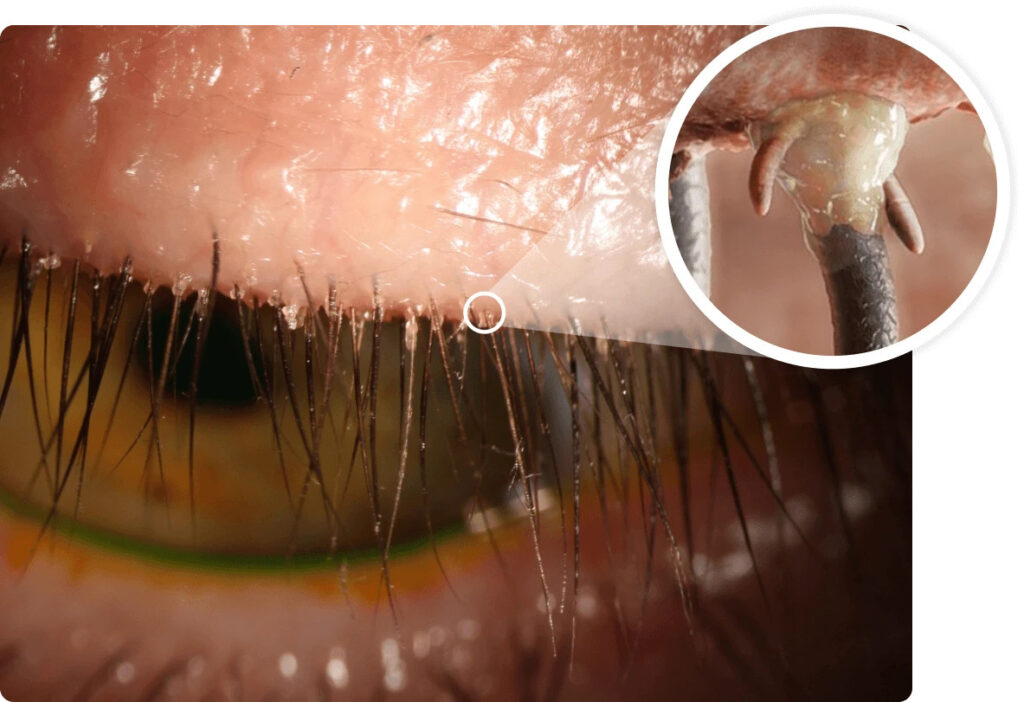
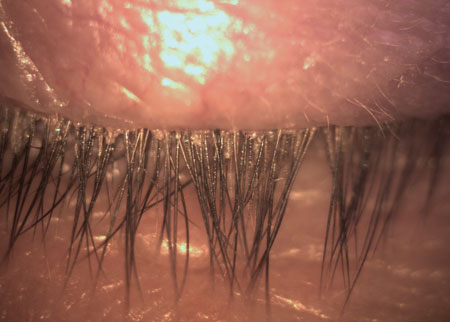
Its hallmark is the collarette, a ring of waxy debris at the base of the lash.
Therefore, you can make the diagnosis at the slit lamp in about a minute.
Demodex Mites on the Lid
Two species live on the human lid.
Demodex folliculorum lives in the lash follicle, and Demodex brevis lives in the sebaceous and meibomian glands.
The mites feed on epithelial cells, and their waste can irritate the lid margin.
Also, bacteria carried by the mites may add to the inflammation.
Mite load rises with age, so the condition is common in older adults.
Clinical Signs of Demodex Blepharitis
Patients complain of itching, burning and a foreign body sensation, often worse in the morning.
On examination, collarettes appear at the base of many lashes, and the lashes may be misdirected or sparse.
Because the mites also affect the meibomian glands, many patients have meibomian gland dysfunction and chalazia (see meibomian gland dysfunction).
All-fit Slit-Lamp Adapter
Record and share exactly what you see at the slit lamp. One adapter fits any slit lamp or surgical microscope — and any smartphone.
From Choroida — the team behind this siteDiagnosing Demodex Blepharitis
Look for collarettes with the patient looking down while you lift the upper lid.
Epilate a lash, place it on a slide with a drop of saline or fluorescein, and count the mites under a microscope.
Several mites on a single lash is regarded as abnormal.
Also, rotate the lash gently, because the movement may bring a mite out of the follicle.
Treating Demodex Blepharitis
Tea tree oil is the traditional treatment.
Typical regimens use a higher concentration in the office and a diluted product at home, and irritation is common.
Lotilaner 0.25% twice daily for six weeks is a newer option that paralyzes the mites, and the FDA approved it in 2023.
Treat associated blepharitis and ocular rosacea at the same time (see blepharitis and ocular rosacea).
Lash Examination Pearls
Examine the lashes before you instill drops, because fluorescein can mask collarettes.
Also, run a slit beam along the base of the upper lashes while the patient looks down.
Because collarettes are most obvious on the upper lid, start there.
Associations With Rosacea and Meibomian Gland Disease
Demodex overgrowth is more frequent in ocular rosacea and in meibomian gland dysfunction.
Therefore, treat the whole lid margin disease, and look at the facial skin for rosacea.
Counselling on Lid Hygiene
Explain that mites live on most older adults, so the goal is control and not eradication.
Also, advise washing pillow cases and removing eye makeup nightly.
Because recurrence is common, ask patients to keep up lid hygiene in the long term.
Side Effects of Treatment
Tea tree oil can burn and cause allergic contact dermatitis, especially in pure form.
Lotilaner may cause stinging after instillation.
Therefore, review tolerance after the first week of treatment.
Timing Around Surgery
Treat active blepharitis before elective cataract or refractive surgery.
Lid disease can destabilize the tear film and affect keratometry and healing.
Also, contact lens wearers may need a break from lenses during treatment.
A Pitfall to Avoid
Do not miss sebaceous carcinoma in a unilateral, chronic blepharitis with lash loss (see sebaceous carcinoma of the eyelid).
Biopsy any lid that fails to respond to treatment.
Natural History
Demodex blepharitis tends to be chronic and relapsing.
Symptoms often improve with treatment, but mite counts rise again when care stops.
Therefore, plan long-term maintenance with the patient.
Evidence for Treatments
Randomised trials of lotilaner showed higher rates of collarette cure and mite eradication than vehicle.
Tea tree oil studies are smaller and use different regimens.
Because trial designs vary, interpret the data with care.
Differential Diagnosis
Staphylococcal blepharitis produces hard scales and ulcerated margins.
Seborrheic blepharitis shows greasy scales, and allergic lid disease shows itch with edema.
Collarettes point to Demodex, so look for them in every case.
Demodex Blepharitis in Special Groups
Patients with rosacea, older adults and people with weak immunity show higher mite loads.
Also, contact lens wearers with chronic discomfort may have unrecognized lid disease.
Therefore, examine the lashes of every patient with persistent lens intolerance.
Follow-Up After Treating Demodex Blepharitis
Review the patient after four to six weeks.
Check collarettes, lid margin redness and symptoms, and adjust the plan.
Because symptoms can return, agree on a maintenance routine that fits the patient’s daily habits.


Document what you see
Two smartphone imaging tools built for everyday clinic use — one for the slit lamp, one for the fundus.
From Choroida — the team behind this siteReferences
- Gao YY, Di Pascuale MA, Li W, et al. High prevalence of Demodex in eyelashes with cylindrical dandruff. Invest Ophthalmol Vis Sci. 2005;46:3089-3094.
- Gao YY, Di Pascuale MA, Elizondo A, Tseng SC. Clinical treatment of ocular demodecosis by lid scrub with tea tree oil. Cornea. 2007;26:136-143.
- Zhang AC, Muntz A, Wang MTM, Craig JP, Downie LE. Ocular Demodex: a systematic review of the clinical literature. Ophthalmic Physiol Opt. 2020;40:389-432.
- Yeu E, Wirta DL, Karpecki P, Baba SN, Holdbrook M. Lotilaner ophthalmic solution, 0.25%, for the treatment of Demodex blepharitis: results of a prospective, randomized, vehicle-controlled, double-masked trial (Saturn-1). Cornea. 2023;42:435-443.

Writes and reviews the clinical articles on Educate. Every post is checked against peer-reviewed sources before it goes live.