Multifocal IOL designs split light between distance and near foci to reduce the need for glasses after cataract surgery.
The trade-off is lower contrast and more halos and glare, especially at night. Therefore, patient selection decides satisfaction more than the lens itself.
How a Multifocal IOL Works
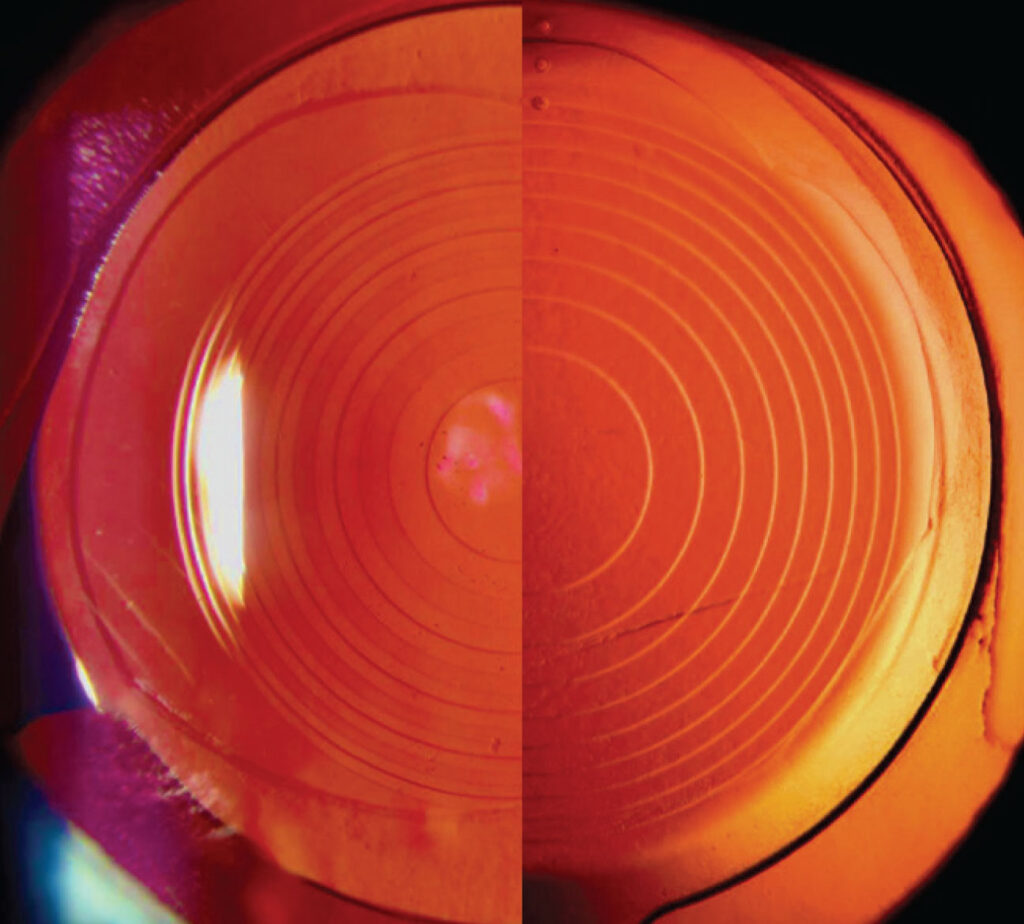
Diffractive designs divide light between foci with concentric steps, while refractive designs use zones of different power. Bifocal lenses give distance and near, and trifocal lenses add an intermediate focus, while the brain must learn to ignore the out-of-focus image, which takes time.
Benefits of a Multifocal IOL
Systematic reviews found that patients with multifocal lenses need glasses less often than those with monofocal lenses, and their near vision is better without correction. Therefore, motivated patients who want freedom from glasses may be well served.
All-fit Slit-Lamp Adapter
Record and share exactly what you see at the slit lamp. One adapter fits any slit lamp or surgical microscope — and any smartphone.
From Choroida — the team behind this sitePhotic Phenomena With a Multifocal IOL
Halos and glare around lights are common, and they are most bothersome at night, while contrast sensitivity falls slightly, even when acuity is good. Most patients adapt with time through neuroadaptation, but a minority stay bothered. Because the effect is part of the design, explain it before surgery.
Choosing the Right Multifocal IOL Candidate
Good candidates have healthy eyes, realistic expectations and a wish for spectacle independence. Check the ocular surface, the macula, the optic nerve and the cornea carefully (see dry eye disease). Patients with macular disease, glaucoma or irregular corneas are poor candidates, and you should also think twice for night drivers and for patients with demanding visual tasks.
Counselling Before Surgery
Describe the halos in clear terms and show a simulation if you can. Explain that a small residual error may need glasses or laser enhancement, and discuss the chance of a lens exchange if the patient cannot adapt. Because surprise causes dissatisfaction, give the same message in writing.
Causes of Dissatisfaction With a Multifocal IOL
Residual refractive error is the most common cause and the easiest to fix. Dry eye, posterior capsule opacification and decentration also reduce quality (see YAG laser capsulotomy), and negative dysphotopsia and other lens-related effects may add (see negative dysphotopsia). Therefore, look for the cause before you blame the lens.
Managing the Unhappy Patient
Treat the surface and refine the refraction first, then wait for neuroadaptation over several months. If symptoms persist, an IOL exchange is possible but carries risk (lens exchange is possible but carries risk).
Alternatives
Monovision, extended depth of focus and enhanced monofocal lenses suit some patients, and each has its own trade-offs. A monofocal lens with spectacles also remains a safe option.
Types of Multifocal IOL
Diffractive lenses split light by steps on the optic, refractive lenses use annular zones with different powers, and hybrid designs combine the two approaches. Because designs differ in distance and near performance, pick one that fits the patient’s needs.
Neuroadaptation
The brain learns to suppress unwanted images over weeks to months, and most patients notice fewer halos with time. A stable ocular surface and a clear capsule speed the process, so advise patience and avoid early lens exchange.
Ocular Surface and Multifocal IOL Outcomes
Dry eye reduces the quality of the image, and multifocal optics make this more obvious. Treat blepharitis and meibomian gland disease before surgery, and check the tear film with staining and tear breakup time. Because the surface limits quality, optimize it first.
Biometry and Astigmatism
Accurate biometry is essential, since multifocal lenses tolerate little residual error. Correct corneal astigmatism above half a diopter with a toric design or a relaxing incision, and plan laser enhancement if a small error remains. Therefore, expect a more careful workflow than for a monofocal lens.
Posterior Capsule Opacification
Even mild opacity reduces contrast and increases halos, and a laser capsulotomy often restores quality. Because opacity is common, include it in counseling, and schedule the laser early in patients who complain of blur.
Alternatives for Spectacle Independence
Extended depth of focus lenses give less near vision but fewer halos, and monovision uses one eye for distance and one for near. Enhanced monofocal lenses also offer a modest range without added halos. Therefore, match the option to the patient’s priorities.
Practical Screening Questions
Ask what the patient does all day and how much they dislike glasses. Ask about night driving, reading in dim light and fine work, and ask how they feel about halos around lights. Because the answers show priorities, they help you decide between lens types, and you then record the discussion in the chart.


Document what you see
Two smartphone imaging tools built for everyday clinic use — one for the slit lamp, one for the fundus.
From Choroida — the team behind this siteReferences
- de Vries NE, Nuijts RMMA. Multifocal intraocular lenses in cataract surgery: literature review of benefits and side effects. J Cataract Refract Surg. 2013;39:268-278.
- Calladine D, Evans JR, Shah S, Leyland M. Multifocal versus monofocal intraocular lenses after cataract extraction. Cochrane Database Syst Rev. 2012;(9):CD003169.
- Woodward MA, Randleman JB, Stulting RD. Dissatisfaction after multifocal intraocular lens implantation. J Cataract Refract Surg. 2009;35:992-997.
- Alio JL, Plaza-Puche AB, Fernandez-Buenaga R, Pikkel J, Maldonado M. Multifocal intraocular lenses: an overview. Surv Ophthalmol. 2017;62:611-634.
Test yourself
A few questions straight from this article.
-
How do diffractive multifocal IOL designs divide light between distance and near foci?
Diffractive designs divide light between foci with concentric steps, whereas refractive designs use zones of different power. -
Compared with monofocal lenses, what benefit did systematic reviews find for multifocal IOLs?
Systematic reviews found that multifocal lens patients need glasses less often than monofocal patients, and their uncorrected near vision is better. -
Which visual trade-off of a multifocal IOL persists even when visual acuity is good?
Halos and glare are common and worst at night, and contrast sensitivity falls slightly even when acuity is good, because the effect is part of the design. -
Which patient is a poor candidate for a multifocal IOL?
Good candidates have healthy eyes and realistic expectations; macular disease, glaucoma or irregular corneas make a patient a poor candidate. -
What is the most common cause of dissatisfaction after multifocal IOL implantation?
Residual refractive error is the most common cause of dissatisfaction and the easiest to fix, so the cause should be sought before blaming the lens. -
What should be done first for an unhappy patient after multifocal IOL surgery?
Management starts by treating the surface and refining the refraction, then waiting for neuroadaptation; exchange is possible but carries risk. -
Over what time course does neuroadaptation to multifocal IOL halos usually occur?
The brain learns to suppress unwanted images over weeks to months, so patience is advised and early lens exchange avoided. -
Above what level should corneal astigmatism be corrected when implanting a multifocal IOL?
Multifocal lenses tolerate little residual error, so corneal astigmatism above half a diopter is corrected with a toric design or a relaxing incision. -
How does even mild posterior capsule opacification affect a multifocal IOL patient?
Even mild opacity reduces contrast and increases halos; a laser capsulotomy often restores quality and can be scheduled early in patients complaining of blur. -
Compared with a multifocal IOL, what do extended depth of focus lenses offer?
Extended depth of focus lenses give less near vision but fewer halos, an alternative matched to patients who prioritise night quality.

Writes and reviews the clinical articles on Educate. Every post is checked against peer-reviewed sources before it goes live.