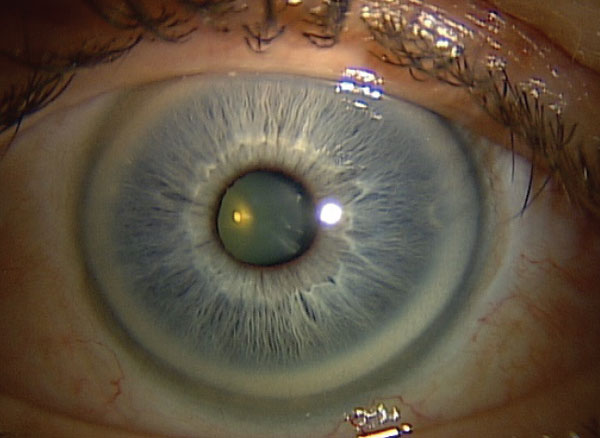
Arcus juvenilis is a gray-white ring of lipid at the corneal periphery in a patient younger than about 40 to 50 years. It looks identical to the arcus senilis of older adults, but in a young person it calls for a lipid panel, because familial hypercholesterolemia is the main cause to exclude.
The ring causes no symptoms and needs no eye treatment. It is also called juvenile arcus, arcus lipoides, or arcus lipidus, and the term is sometimes misspelled arcus juvenalis.
Arcus Juvenilis vs Arcus Senilis
The two differ in the age of the patient, not in appearance or histology. Arcus senilis becomes more common with each decade and affects most people past age 80, so it means little in an older adult. The same ring in a younger patient suggests accelerated lipid deposition.
Cutoffs vary by source: many references use age 40, others use 50, and the Dutch Lipid Clinic Network score for familial hypercholesterolemia counts corneal arcus before age 45. Our practical rule is that arcus in a patient in their 20s, 30s, or early 40s deserves lipid testing. For the aging form, see our article on arcus senilis.
What Arcus Juvenilis Looks Like in the Eye
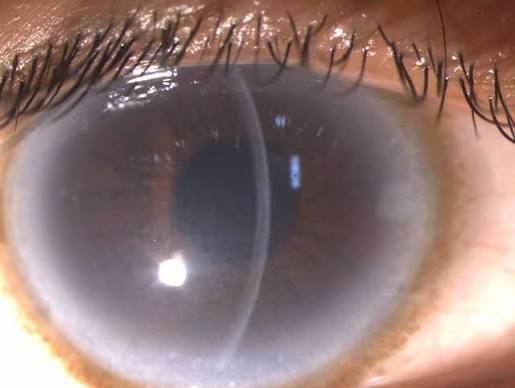
On slit-lamp examination, the ring has a consistent pattern. Most patients never notice it, and it is usually found on routine examination or pointed out by a family member. The findings below help separate it from other peripheral corneal changes.
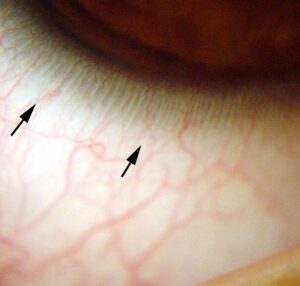
- A gray-white to yellow band that starts superiorly and inferiorly, then joins into a partial or complete ring
- A clear zone of normal cornea, the lucid interval, between the ring and the limbus
- Usually bilateral and roughly symmetric
- Lipid (cholesterol, cholesterol esters, and phospholipids) in the peripheral stroma, with a sharp outer border and a more diffuse inner border
- No redness, pain, epithelial defect, or vision loss, because the deposit stays outside the visual axis
All-fit Slit-Lamp Adapter
Record and share exactly what you see at the slit lamp. One adapter fits any slit lamp or surgical microscope — and any smartphone.
From Choroida — the team behind this siteWhy the Ring Forms
Lipoproteins leak from the limbal capillaries into the avascular peripheral cornea and bind to stromal tissue. Cholesterol and its esters then accumulate in the stroma, Bowman layer, and Descemet membrane. Higher circulating LDL cholesterol speeds this process, which explains why the ring appears early when LDL is high.
Arcus Juvenilis Causes
The main cause is a primary lipid disorder, most often familial hypercholesterolemia. Heterozygous familial hypercholesterolemia affects roughly 1 in 250 people and raises LDL cholesterol from birth, so arterial disease starts early. Arcus can be one of the first visible signs in a patient who feels entirely well.
- Other primary dyslipidemias, such as familial combined hyperlipidemia and dysbetalipoproteinemia
- Secondary lipid elevation from hypothyroidism, nephrotic syndrome, poorly controlled diabetes, or cholestatic liver disease
- Normal lipid levels in some patients, a benign isolated finding that you can accept only after testing confirms a normal panel
How to Evaluate Early Arcus Juvenilis
Order a lipid panel for every patient with early arcus juvenilis, measuring total cholesterol, LDL, HDL, and triglycerides. A fasting sample is preferred when triglycerides matter. In adults, an LDL cholesterol of 190 mg/dL or higher without a secondary cause strongly suggests familial hypercholesterolemia.
- Ask about heart attack or stroke at a young age in parents and siblings, and about early arcus in relatives
- Look for xanthelasma and examine the Achilles tendons for xanthomas when you suspect a familial disorder
- Check thyroid, glucose, kidney, and liver tests when lipids are high, to find secondary causes
- Refer to primary care or a lipid specialist, and advise testing of first-degree relatives when familial hypercholesterolemia is confirmed
Familial hypercholesterolemia is usually autosomal dominant, so each child of an affected parent has a 50 percent chance of inheriting it. That is why one young patient’s corneal ring can lead to the diagnosis of parents, siblings, and children, many of whom feel well and have never had their lipids checked.
Homozygous familial hypercholesterolemia is rare but severe. A child or teenager with arcus, markedly high cholesterol, and skin or tendon xanthomas needs urgent specialist referral, because untreated disease can cause coronary events in childhood or young adulthood.
Arcus Juvenilis Treatment
Arcus juvenilis treatment targets the cholesterol, not the cornea. The ring does not threaten vision or corneal health, so it needs no drops, laser, or surgery. Patients rarely find it cosmetically bothersome, and reassurance usually suffices.
When testing confirms familial hypercholesterolemia or another dyslipidemia, management includes diet, statins, and often ezetimibe or a PCSK9 inhibitor, coordinated with primary care or a lipid specialist. Lipid lowering reduces cardiovascular risk, but an established arcus often persists. A lasting ring does not mean treatment is failing.
Does Arcus Juvenilis Affect Vision?
No, arcus juvenilis does not affect vision or corneal health. The deposit sits in the far periphery, outside the visual axis, and does not cause glare or pain. Patients can be reassured that the ring is harmless, and that its meaning lies in what it may reveal about their blood lipids.
Conditions That Mimic Arcus Juvenilis
- Limbal girdle of Vogt: a chalky, crescentic white opacity in the interpalpebral zone at the nasal and temporal limbus, without a lucid interval
- Anterior embryotoxon: a congenital arcus-like ring present from birth, often isolated and unrelated to acquired lipid disease
- Kayser-Fleischer ring: a golden-brown copper deposit in Descemet membrane in Wilson disease, important to recognize in a young patient
- Lipid keratopathy: lipid within a scarred or vascularized cornea, not a ring in an otherwise clear periphery; see our article on lipid keratopathy
- Peripheral corneal inflammation or thinning, such as peripheral ulcerative keratitis or Terrien marginal degeneration, which causes redness, pain, or epithelial change that arcus never does
When arcus is clearly unilateral, the arcus-free eye may be the abnormal one. Reduced blood flow from carotid occlusive disease or ocular hypoperfusion can limit lipid deposition on that side. Examine both eyes and consider vascular evaluation when the asymmetry is striking.
Counseling the Patient
Explain the finding plainly: the ring is harmless to the eye, but it may signal high cholesterol that is silent. Give patients a written note for their primary care physician stating the age, the finding, and the request for a lipid panel. Document the referral, and confirm at the next visit that testing occurred.
Younger patients often ask whether diet alone will remove the ring. It will not, though healthy eating helps the underlying cholesterol.
Prognosis
The corneal finding has an excellent prognosis and needs no monitoring. The patient’s outlook depends on whether a lipid disorder is found and treated. Early diagnosis of familial hypercholesterolemia, followed by lifelong lipid lowering, reduces the risk of premature heart disease, so a lipid panel prompted by a corneal ring can change a patient’s health.


Document what you see
Two smartphone imaging tools built for everyday clinic use — one for the slit lamp, one for the fundus.
From Choroida — the team behind this siteReferences
- Segal P, Insull W Jr, Chambless LE, et al. The association of dyslipoproteinemia with corneal arcus and xanthelasma. The Lipid Research Clinics Program Prevalence Study. Circulation. 1986;73:I108-I118.
- Zech LA Jr, Hoeg JM. Correlating corneal arcus with atherosclerosis in familial hypercholesterolemia. Lipids Health Dis. 2008;7:7.
- Chua BE, Mitchell P, Cumming RG. Corneal arcus and hypercholesterolaemia: baseline and five-year findings from the Blue Mountains Eye Study. Clin Exp Ophthalmol. 2004;32:24-30.
- Nemet AY, Vinker S, Kaiserman I. Associated morbidity of corneal arcus. Cornea. 2010;29:1044-1048.
Test yourself
A few questions straight from this article.
-
What is the term for a peripheral corneal lipid ring appearing in a young patient?
The identical gray-white peripheral lipid ring is called arcus senilis in older adults, but in a young patient it is arcus juvenilis and should prompt lipid screening rather than be dismissed. -
Below roughly what age is peripheral corneal arcus considered arcus juvenilis?
Arcus appearing under roughly age 40 to 50, depending on the reference used, is termed juvenilis and raises concern for an underlying lipid metabolism disorder. -
Arcus juvenilis is composed of which material within the peripheral corneal stroma?
The ring represents lipid deposition in the peripheral corneal stroma, predominantly cholesterol and phospholipids, not an inflammatory or mineral deposit. -
Which systemic disorder is most important to identify in a young patient with corneal arcus?
Familial hypercholesterolemia is the most important cause to find, because it is treatable and carries major cardiovascular implications if it stays undiagnosed. -
Which slit-lamp description matches the corneal ring of arcus juvenilis?
Arcus is a gray-white to yellowish peripheral ring, usually bilateral and roughly symmetric, with a clear zone of cornea separating it from the limbus. -
Which feature distinguishes limbal girdle of Vogt from corneal arcus?
Limbal girdle of Vogt is chalky and crescentic and sits closer to the limbus itself, whereas arcus is lipid, grayish, and separated from the limbus by a clear zone. -
Which investigation should a young patient found to have corneal arcus undergo?
Arcus at an unexpectedly young age warrants a fasting lipid panel measuring total cholesterol, LDL, HDL, and triglycerides. -
Which family history supports a familial lipid disorder in a young patient with corneal arcus?
Early cardiovascular events in parents or siblings, and a family history of similarly early arcus, both raise suspicion for a familial lipid disorder. -
Why does identifying familial hypercholesterolemia in a young patient matter so much?
Familial hypercholesterolemia elevates LDL cholesterol from birth and substantially increases lifetime risk of premature cardiovascular disease, including myocardial infarction at a young age, if untreated. -
Once a lipid disorder is confirmed in arcus juvenilis, treatment is directed at what?
Arcus juvenilis needs no ocular treatment; care is aimed at the systemic disorder through dietary change, lipid-lowering medication, and cardiovascular risk reduction with primary care or a lipid specialist.

Writes and reviews the clinical articles on Educate. Every post is checked against peer-reviewed sources before it goes live.