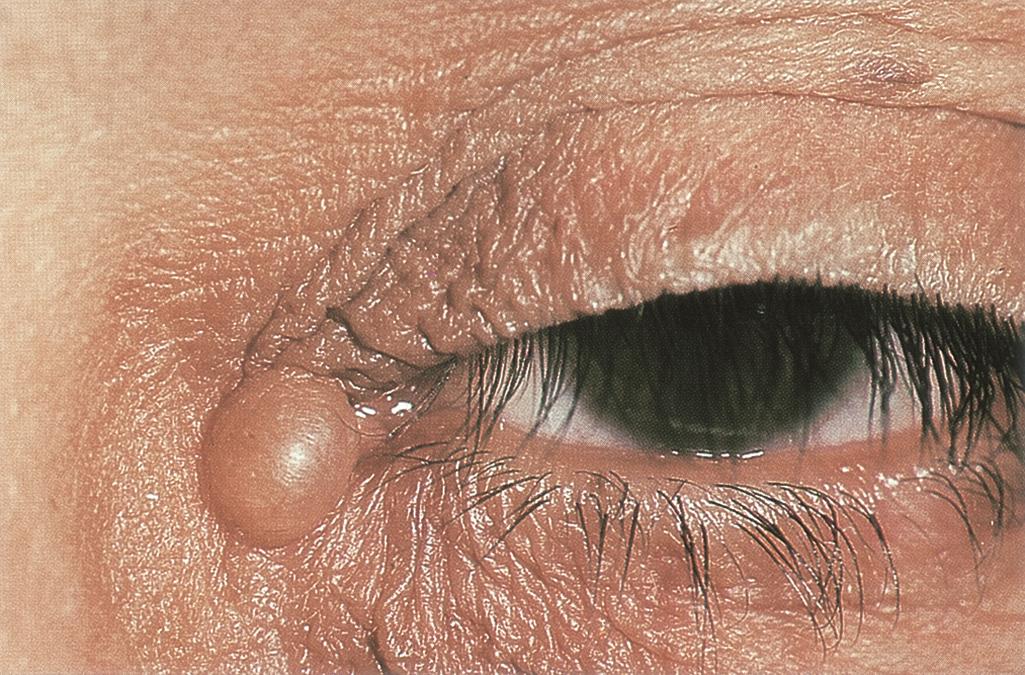
An eyelid hidrocystoma is a benign, fluid-filled cyst that arises from a sweat gland of the lid or the skin around the eye. It looks like a smooth, dome-shaped, translucent or bluish papule, usually near the lid margin or the canthi, and it is painless and slow growing. There are two types, apocrine and eccrine, and the case below shows the apocrine type. Complete excision is curative, and the main task is to rule out a pigmented or cystic skin tumor.
CASE REPORT
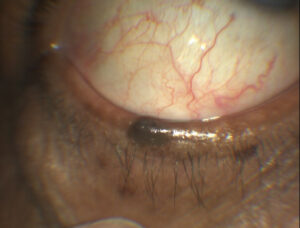
A 75-year-old male patient presented with small, translucent, cystic papules which were filled with a watery fluid, which had been present for five years and he was asymptomatic.
On local examination, the largest cyst measured 2×2 mm. The patient underwent, under local anesthesia, an excisional biopsy of the mass, and the specimen was subjected to a histopathological examination.
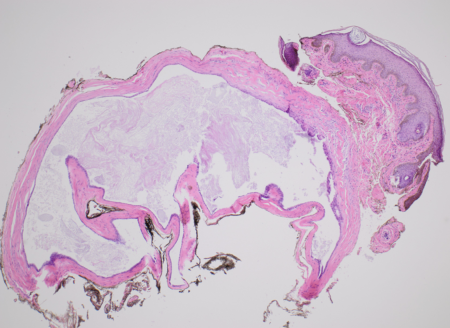
The gross examination of this specimen showed a grey-white cyst that measured 1.5×1 cm. The histopathologic examination of the paraffin sections which were stained with hematoxylin-eosin revealed the presence of a cyst in the dermis.
It was lined by an inner layer of a secretory columnar epithelium, which lay above an outer myoepithelial cell layer. At places, the secretory epithelium showed decapitation, which suggested an apocrine hidrocystoma.
Apocrine Hidrocystoma entity
Apocrine Hidrocystomas are benign cystic tumors and are thought to be an adenomatous cystic proliferation of apocrine sweat glands.
These are frequently found in the head and neck region as apocrine glands are found in higher concentration in these areas, these lesions can be presented on the eyebrows, upper and lower eyelids, and medial or lateral canthi.
Apocrine Hidrocystomas do not follow any inheritance pattern and have been observed in middle-aged and elderly people with no predilection for sex and race.
These are usually asymptomatic or may have a symptom cosmetically unappealing for the patient. Others mild symptoms of itching, eye irritation, and foreign body sensation can also be present.
These are mobile upon palpation and are presented as a dome–shaped, translucent, or blue-gray-purple cystic nodule with a size ranging from 3-15mm.
All-fit Slit-Lamp Adapter
Record and share exactly what you see at the slit lamp. One adapter fits any slit lamp or surgical microscope — and any smartphone.
From Choroida — the team behind this siteApocrine Hidrocystoma MANAGEMENT
- Complete surgical excision along with the walls of cysts is the best treatment option for apocrine hidrocystomas.
- Needle puncture is another method. When apocrine hidrocystomas are incised a brownish fluid is released. However, this treatment provides a temporary recovery, and the recurrence chances are greater.
- Removal with trichloroacetic acid is another best treatment plan for apocrine lesions. In this method after local anesthesia first, the cyst content is aspirated with an empty syringe and then refilled with another syringe containing 20% TCA. Left it for 1 minute in the cyst and then aspirated and washed with distilled water.
- Intradermal injections of low-dose botulinum toxin A around the cyst are also being performed nowadays.
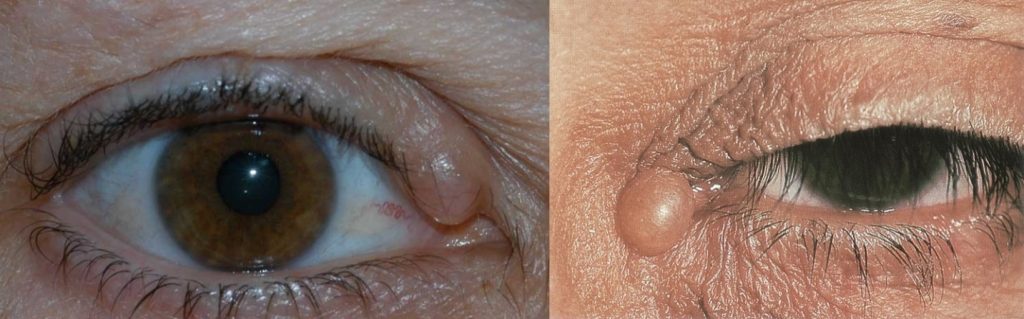
Apocrine Versus Eccrine Eyelid Hidrocystoma
Apocrine hidrocystoma is usually a solitary cyst, most often on the lid margin or at a canthus, and it may look blue or brown because of its contents. Eccrine hidrocystoma is typically multiple, small, clear papules on the lower lid and cheek that swell in hot weather and with sweating. Multiple apocrine cysts of the lids can also occur in Schöpf-Schulz-Passarge syndrome, together with palmoplantar keratoderma, hypodontia and hypotrichosis.
Differential Diagnosis of an Eyelid Hidrocystoma
A blue or brown cyst can mimic a pigmented basal cell carcinoma, a nevus or a melanoma, so a doubtful lesion deserves a biopsy (see basal cell carcinoma of the eyelid). Other cystic lumps include epidermal inclusion cysts, milia and molluscum contagiosum, and a firm lid nodule that persists may be a chalazion. A hidrocystoma transilluminates, which helps to separate it from a solid tumor.
Treatment Options for Eyelid Hidrocystoma
Excision of the whole cyst wall prevents recurrence. For multiple eccrine cysts, other options include drainage, electrodesiccation, laser ablation, topical atropine and botulinum toxin.
Recurrence is uncommon after complete excision, whereas needle aspiration alone usually leads to refilling. Send the specimen for histology when the lesion is pigmented, ulcerated or atypical. In contrast, a patient with a few small, painless cysts can simply be observed and reassured, since the lesions are benign.


Document what you see
Two smartphone imaging tools built for everyday clinic use — one for the slit lamp, one for the fundus.
From Choroida — the team behind this siteREFERENCES
- Hafsi W, Badri T, Shah F. Apocrine Hidrocystoma. [Updated 2021 Sep 9]. In: StatPearls [Internet]. Treasure Island (FL): StatPearls Publishing; 2021 Jan.
- Mehregan AH. Apocrine Cystadenoma; A Clinicopathologic Study With Special Reference To The Pigmented Variety. Arch Dermatol. 1964;90:274–9.
- Magdaleno-Tapial J, Valenzuela-Oñate C, Martínez-Doménech Á, García-Legaz-Martínez M, Martínez-Aparicio A, Alegre-de Miquel V, Pérez-Ferriols A. Apocrine hidrocystoma on the nipple: the first report in this unusual location. Dermatol Online J. 2019 Oct 15;25(10)
- Nam JH, Lee GY, Kim WS, Kim KJ. Eccrine hidrocystoma in a child: an atypical presentation. Ann Dermatol. 2010 Feb;22(1):69-72.
- Birkenbeuel J, Goshtasbi K, Mahboubi H, Djalilian HR. Recurrent apocrine hidrocystoma of the external auditory canal. Am J Otolaryngol. 2019 Mar – Apr;40(2):312-313.
- Sarabi K, Khachemoune A. Hidrocystomas–a brief review. MedGenMed. 2006 Sep 06;8(3):57.
Test yourself
A few questions straight from this article.
-
Apocrine hidrocystomas are thought to arise from which process in apocrine sweat glands?
Apocrine hidrocystomas are benign cystic tumours thought to be an adenomatous cystic proliferation of apocrine sweat glands. -
Why are apocrine hidrocystomas frequently found in the head and neck region?
They favour the head and neck because apocrine glands are found in higher concentration there, including the brows, eyelids and canthi. -
Which population is typically affected by apocrine hidrocystomas?
Apocrine hidrocystomas follow no inheritance pattern and occur in middle-aged and elderly people with no sex or race predilection. -
What is the typical clinical appearance of an apocrine hidrocystoma?
The lesion is mobile on palpation and appears as a dome-shaped, translucent or blue-gray-purple cystic nodule. -
What size range is typical for an apocrine hidrocystoma?
Apocrine hidrocystomas present as cystic nodules ranging in size from 3 to 15 mm. -
On histology, what lines the dermal cyst of an apocrine hidrocystoma?
The dermal cyst is lined by an inner secretory columnar epithelium lying above an outer myoepithelial cell layer. -
Which histological feature of the lining epithelium suggests an apocrine hidrocystoma?
Decapitation of the secretory epithelium in places is the feature that points to an apocrine hidrocystoma. -
What is the best treatment option for an apocrine hidrocystoma?
Complete surgical excision together with the cyst walls is described as the best treatment option. -
What is the main drawback of needle puncture for an apocrine hidrocystoma?
Needle puncture releases brownish fluid but gives only temporary recovery, and the chance of recurrence is greater. -
What concentration of trichloroacetic acid is instilled into an apocrine hidrocystoma after aspiration?
After local anaesthesia the cyst is aspirated, refilled with 20% TCA for 1 minute, then aspirated and washed with distilled water.

Writes and reviews the clinical articles on Educate. Every post is checked against peer-reviewed sources before it goes live.