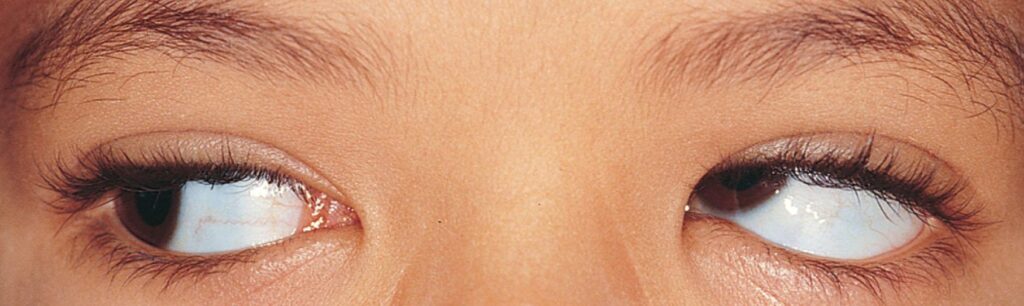
Inferior oblique overaction is excess elevation of the eye as it moves into adduction.
Parents often describe one eye that “shoots up” when the child looks to the side. Accurate grading therefore guides both the diagnosis and the choice of surgery.
What Inferior Oblique Overaction Looks Like
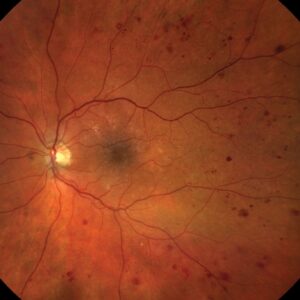
On versions, the adducting eye rises above the abducting eye in lateral gaze, and the upshoot is usually most obvious in the field up and toward the nose. Because the inferior oblique also abducts, a V pattern often accompanies the overaction, and the fundus may show excyclotorsion, with the fovea sitting low relative to the disc.
Examining the Oblique Fields
First, ask the child to follow a target into all nine gaze positions, and hold the head steady so a compensatory turn does not hide the finding. Then cover the abducting eye briefly, because fixation preference can change the apparent height.
Grading Inferior Oblique Overaction
Most clinicians use a +1 to +4 scale based on the vertical gap between the two eyes, which the examiner judges in the oblique fields while the abducting eye fixes. However, inter-observer agreement is modest, so the same examiner should ideally follow the patient.
A Practical Grading Scale
Descriptions vary between textbooks, although one common version reads as follows:
- +1: slight upshoot visible only in extreme up-and-in gaze
- +2: clear upshoot in up-and-in gaze, minimal in direct adduction
- +3: obvious upshoot in direct side gaze
- +4: marked upshoot with even small amounts of adduction
Primary Inferior Oblique Overaction
Primary overaction has no detectable superior oblique weakness, and it usually appears in early childhood, often after a horizontal strabismus has developed. For example, it frequently follows infantile esotropia (see infantile esotropia surgical timing). Its mechanism remains uncertain, and Kushner argued that several processes can produce the same clinical picture.
Secondary Inferior Oblique Overaction
Secondary overaction results from a paretic superior oblique muscle, and typically the hypertropia increases on gaze away from the affected eye and on ipsilateral head tilt. Therefore, the Parks three-step test helps separate the two forms.
Secondary cases also tend to be unilateral, while primary overaction is usually bilateral and roughly symmetric. Adults may also report vertical or torsional diplopia, which children rarely mention.
Inferior Oblique Overaction Versus Its Mimics
Dissociated vertical deviation (DVD) can also elevate an eye in adduction. However, in DVD the eye drifts up slowly under cover, without a matching hypotropia of the fellow eye, and DVD also lacks a V pattern and often lacks fundus torsion.
Because both conditions often coexist after infantile esotropia, examine carefully before planning surgery. Finally, Duane syndrome can cause an upshoot, while globe retraction and limited horizontal movement give the clue.
When Inferior Oblique Overaction Needs Surgery
The surgeon may simply observe mild overaction without a V pattern or vertical deviation. Surgery becomes reasonable for a noticeable upshoot, a significant V pattern or symptomatic hypertropia, and many surgeons also combine oblique weakening with horizontal muscle surgery under one anesthetic.
Recession and Myectomy
Recession moves the inferior oblique insertion to a new point near the inferior rectus, so the surgeon can match the amount of weakening to the grade. Myectomy removes a muscle segment and offers a simple, fast alternative, and published comparisons suggest broadly similar results, although techniques and grading differ between studies.
Anterior Transposition in Inferior Oblique Overaction
Anterior transposition places the insertion near the lateral end of the inferior rectus insertion, and Elliott and Nankin described this technique in 1981. It produces strong weakening and also limits elevation of the operated eye, so many surgeons choose it when DVD coexists with overaction.
Risks of Inferior Oblique Surgery
Undercorrection and recurrence remain the most common problems. In addition, excessive anterior placement can cause antielevation syndrome with limited elevation in abduction, and a breach of the orbital fat may also lead to adherence syndrome and restrictive hypotropia.
Counseling Families About Inferior Oblique Overaction
First, explain that the upshoot reflects muscle imbalance and does not threaten sight, and show parents a photograph so they understand what surgery aims to change. Also warn that a second procedure is sometimes needed, and remind them that glasses and amblyopia treatment must still continue, because surgery does not treat amblyopia.
Follow-Up
Re-grade the overaction at each visit with the same scale and fixation conditions. Then watch the fellow eye, because unilateral surgery may unmask overaction on the other side, and persistent hypertropia after surgery suggests an unrecognized superior oblique palsy.
Pitfalls to Avoid
- Do not grade an upshoot with the head turned or tilted
- Never confuse a slow DVD drift with true oblique overaction
- Do not skip the three-step test in a unilateral case
- Avoid ignoring subtle overaction in the fellow eye before unilateral surgery


Document what you see
Two smartphone imaging tools built for everyday clinic use — one for the slit lamp, one for the fundus.
From Choroida — the team behind this siteReferences
- von Noorden GK, Campos EC. Binocular Vision and Ocular Motility: Theory and Management of Strabismus. 6th ed. St Louis: Mosby; 2002.
- American Academy of Ophthalmology. Basic and Clinical Science Course, Section 6: Pediatric Ophthalmology and Strabismus. San Francisco: AAO.
- Kushner BJ. Multiple mechanisms of extraocular muscle “overaction”. Arch Ophthalmol. 2006;124:680-688.
- Elliott RL, Nankin SJ. Anterior transposition of the inferior oblique. J Pediatr Ophthalmol Strabismus. 1981;18:35-38.
- Stager DR. The neurofibrovascular bundle of the inferior oblique muscle as its ancillary origin. Trans Am Ophthalmol Soc. 1996;94:1073-1100.
- Guyton DL. Dissociated vertical deviation: etiology, mechanism, and associated phenomena. J AAPOS. 2000;4:131-144.
Test yourself
A few questions straight from this article.
-
How is inferior oblique overaction defined?
The article defines inferior oblique overaction as excess elevation of the eye as it moves into adduction. Parents often describe one eye that shoots up on side gaze. -
Which fundus finding may accompany inferior oblique overaction?
The article states the fundus may show excyclotorsion, with the fovea low relative to the disc. A V pattern often accompanies the overaction as well. -
Which horizontal pattern often accompanies inferior oblique overaction, because the muscle also abducts?
Because the inferior oblique also abducts, a V pattern often accompanies the overaction. DVD lacks a V pattern, which helps tell them apart. -
In grading inferior oblique overaction, what does a +3 grade describe?
In the common scale, +3 is an obvious upshoot in direct side gaze. +4 is a marked upshoot with even small adduction. -
Why should the same examiner ideally follow a patient with inferior oblique overaction over time?
The article notes that inter-observer agreement for the +1 to +4 grading scale is modest. Consistent grading by one examiner is therefore preferred. -
Which test helps separate primary from secondary inferior oblique overaction caused by superior oblique palsy?
Secondary overaction results from a paretic superior oblique muscle, so the Parks three-step test helps separate the two forms. It should not be skipped in unilateral cases. -
Which feature suggests primary rather than secondary inferior oblique overaction?
Primary overaction has no detectable superior oblique weakness and is usually bilateral and roughly symmetric. Secondary cases tend to be unilateral. -
How does dissociated vertical deviation differ from inferior oblique overaction?
In DVD the eye drifts up slowly under cover without a matching fellow-eye hypotropia, and it lacks a V pattern. Globe retraction points to Duane syndrome instead. -
Why do many surgeons choose anterior transposition for inferior oblique overaction when DVD coexists?
Anterior transposition produces strong weakening and also limits elevation of the operated eye. That is why it is favored when DVD coexists with overaction. -
What does persistent hypertropia after inferior oblique surgery suggest?
The article states that persistent hypertropia after surgery suggests an unrecognized superior oblique palsy. Follow-up should also watch the fellow eye for unmasked overaction.

Writes and reviews the clinical articles on Educate. Every post is checked against peer-reviewed sources before it goes live.