Genetic testing for inherited retinal disease confirms the diagnosis, defines the inheritance, and may open the door to trials and approved therapy.
Panels and exomes now find the causal gene in many patients, and results can change counseling.
Clinicians need to know what to order, how to read the result, and how to counsel.
Why Genetic Testing for Inherited Retinal Disease Matters
More than 300 genes cause inherited retinal disease, and phenotypes overlap widely.
A precise genotype refines the prognosis and may reveal syndromic disease before other organs fail.
Therapies, such as gene replacement for RPE65, require confirmed mutations (see gene therapy for inherited retinal disease).
Choosing Genetic Testing for Inherited Retinal Disease
- Targeted gene panels, covering known retinal genes
- Whole exome sequencing, with a retinal gene filter
- Whole genome sequencing, for unsolved cases
- Single-gene tests for classic phenotypes, such as ABCA4 or RPGR
Stone and colleagues reported the results of testing in 1000 consecutive families and gave benchmarks for yield.
Fundus Explorer Pro
Photograph the retinal findings described here with the phone already in your pocket — 22 D optics and built-in illumination in one handheld unit.
From Choroida — the team behind this siteExpected Yield of Genetic Testing for Inherited Retinal Disease
Diagnostic yield in typical series is about 50 to 70 percent.
It is higher in classic phenotypes and in consanguineous families.
Some genes, such as RPGR ORF15, need special coverage, so ask the laboratory about gaps.
Berger and colleagues reviewed the molecular basis of these disorders and the challenges in testing.
Interpreting Genetic Testing for Inherited Retinal Disease
Variants fall into pathogenic, likely pathogenic, uncertain, and benign groups.
Variants of uncertain significance need segregation analysis and clinical correlation.
Confirm that the genotype fits the phenotype before acting.
Share the report with the family, and explain the limits.
Counseling and Consent for Genetic Testing for Inherited Retinal Disease
The American Academy of Ophthalmology task force recommends pre-test and post-test counseling.
Explain inheritance patterns, the chance of an unclear result, and implications for relatives.
Discuss data use, insurance concerns, and the possibility of incidental findings.
Practical Steps
- Record a three-generation pedigree
- Document the phenotype with imaging and ERG
- Choose a panel with RPGR ORF15 coverage when relevant
- Plan reanalysis of unsolved cases every year or two
Refer to a genetics clinic when available (see Leber congenital amaurosis).
An Example Case
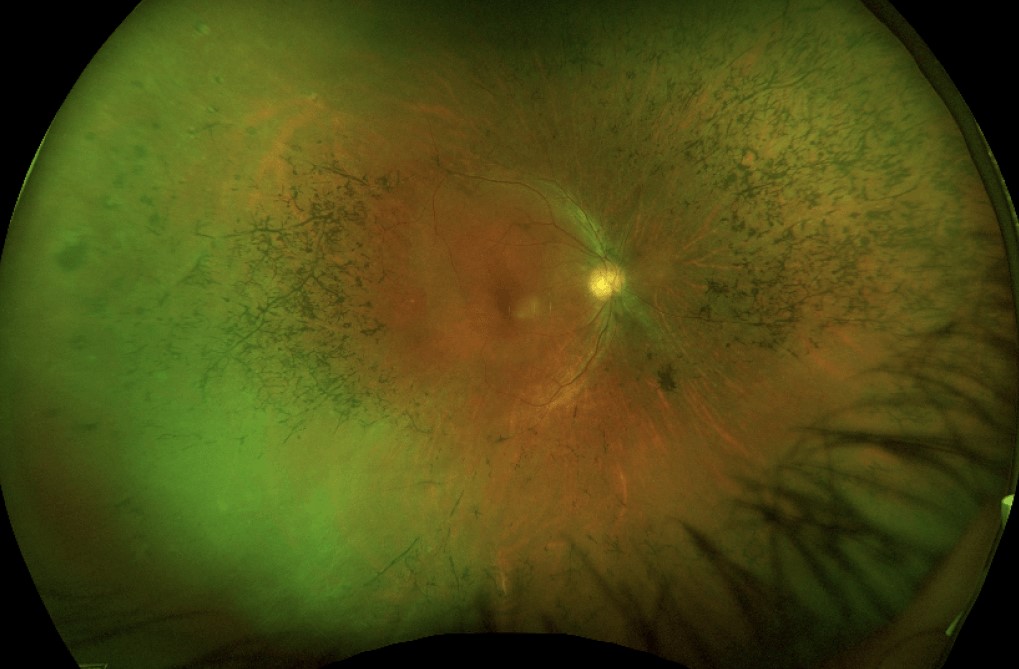
A 31-year-old man has night blindness and constricted fields, and his OCT shows outer retinal thinning.
He has no family history, and the clinician orders a retinal gene panel.
The result shows two variants in USH2A, and clinical review finds a mild hearing loss.
The diagnosis is Usher syndrome type 2, and he is referred for audiology and counseling.
Questions Patients Ask
Patients ask whether the result will affect insurance, and rules vary by country, so discuss this beforehand.
They also ask what to do with an unclear result, and the answer is to follow up and retest in time.
Because the process can be long, set expectations about time to results.
Pitfalls to Avoid
- Ordering a panel without examining the phenotype first
- Accepting a variant of uncertain significance as proof
- Failing to explain the limits of testing
- Skipping segregation studies when relatives are available
Looking Ahead
Long-read sequencing and RNA studies will resolve more unsolved cases.
Also, more therapies will depend on genotype.
Therefore, testing will become routine in inherited retinal disease clinics.
Practical Points
Collect clinical data, imaging, and ERG before ordering a test.
Then pick a laboratory with experience in retinal genes.
Also record consent, and plan to review unsolved cases.
Syndromic Clues
Hearing loss suggests Usher syndrome, and kidney disease suggests nephronophthisis.
Obesity and polydactyly suggest Bardet-Biedl syndrome.
Because syndromic disease needs multidisciplinary care, search for systemic signs.
Access and Cost
Costs have fallen, but access differs between regions.
Some programs offer free testing for inherited retinal disease.
Therefore, check available resources and trials.
Choosing a Laboratory
Pick a laboratory that is accredited and that reports its coverage of difficult regions.
Then ask how it classifies variants and how it handles copy number changes.
Because quality varies, review sample reports before sending patients.
Also check turnaround time and costs.
Reanalysis of Unsolved Cases
About a third of patients remain unsolved after first testing.
Therefore, ask the laboratory to reanalyze data every year or two.
Also consider genome sequencing or RNA studies for puzzling cases.
Finally, update the family on new findings.
For the latest studies, see the PubMed results for genetic testing for inherited retinal disease.


Document what you see
Two smartphone imaging tools built for everyday clinic use — one for the slit lamp, one for the fundus.
From Choroida — the team behind this siteReferences
- Stone EM, Andorf JL, Whitmore SS, et al. Clinically focused molecular investigation of 1000 consecutive families with inherited retinal disease. Ophthalmology. 2017;124:1314-1331.
- Berger W, Kloeckener-Gruissem B, Neidhardt J. The molecular basis of human retinal and vitreoretinal diseases. Prog Retin Eye Res. 2010;29:335-375.
- American Academy of Ophthalmology Task Force on Genetic Testing. Recommendations for Genetic Testing of Inherited Eye Diseases. AAO; 2014.
- American Academy of Ophthalmology. Basic and Clinical Science Course, Section 12: Retina and Vitreous. AAO; current edition.
Test yourself
A few questions straight from this article.
-
Roughly how many genes are known to cause inherited retinal disease?
More than 300 genes cause inherited retinal disease, and phenotypes overlap widely, which is why a precise genotype matters. -
What diagnostic yield does genetic testing for inherited retinal disease achieve in typical series?
Typical series find the causal gene in about 50 to 70 percent of patients tested. -
In which patients is the yield of genetic testing for inherited retinal disease highest?
Yield is higher in classic phenotypes and in consanguineous families. -
Which gene region needs special coverage when choosing an inherited retinal disease gene panel?
Some regions, such as RPGR ORF15, need special coverage, so the laboratory should be asked about gaps and a panel with ORF15 coverage chosen when relevant. -
How should a variant of uncertain significance in inherited retinal disease testing be handled?
Variants of uncertain significance need segregation analysis and clinical correlation; accepting one as proof is a listed pitfall. -
What does the AAO task force recommend around genetic testing for inherited retinal disease?
The AAO task force recommends both pre-test and post-test counseling, covering inheritance, unclear results and implications for relatives. -
What must be in place before gene replacement therapy for RPE65-related retinal disease?
Therapies such as gene replacement for RPE65 require confirmed mutations, which is one reason genotyping matters. -
In inherited retinal disease, obesity with polydactyly suggests which syndrome?
Obesity and polydactyly suggest Bardet-Biedl syndrome, whereas hearing loss suggests Usher syndrome and kidney disease nephronophthisis. -
What should be documented before ordering genetic testing for inherited retinal disease?
Document the phenotype with imaging and ERG first; ordering a panel without examining the phenotype is a listed pitfall. -
How often should unsolved inherited retinal disease genetic results be reanalyzed?
Ask the laboratory to reanalyze unsolved cases every year or two, and consider genome sequencing or RNA studies for puzzling cases.

Writes and reviews the clinical articles on Educate. Every post is checked against peer-reviewed sources before it goes live.