A pattern and V pattern strabismus is a horizontal eye misalignment whose size changes between upgaze and downgaze. In a V pattern the eyes diverge more in upgaze than in downgaze, and in an A pattern they diverge more in downgaze than in upgaze. Recognizing it changes the surgical plan, since primary-position correction alone leaves a gaze-dependent error.
What Are A Pattern and V Pattern Strabismus?
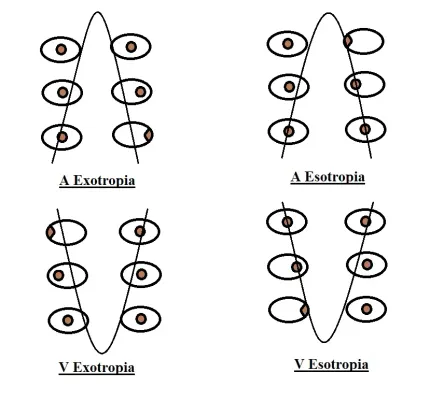
Both patterns are defined by the difference in horizontal deviation between 25 degrees of upgaze and 25 degrees of downgaze. Either one can sit on top of esotropia or exotropia, which gives four combinations. Clinicians also call the group AV pattern squint.
- V pattern: the deviation is more divergent (or less convergent) in upgaze than in downgaze, and a difference of at least 15 prism diopters is the usual threshold for significance.
- A pattern: the deviation is more convergent (or less divergent) in upgaze than in downgaze, and a difference of at least 10 prism diopters is the usual threshold.
These patterns are common, appearing in an estimated 15 to 25 percent of patients with horizontal strabismus. A full motility assessment with upgaze and downgaze measurements therefore belongs in every comprehensive strabismus evaluation, rather than being reserved for children with an obvious craniofacial syndrome.
A Pattern vs V Pattern: How to Tell Them Apart
The difference is the direction of change. In a V pattern, the eyes are most divergent in upgaze and most convergent in downgaze, so the letter opens upward. In an A pattern, the eyes are most convergent in upgaze and most divergent in downgaze, so the letter opens downward.
Head posture often gives the first clue. A child with V esotropia may fuse best in upgaze and hold the chin down, while a child with A esotropia may fuse best in downgaze and hold the chin up. Missing the pattern leaves function-limiting misalignment in reading position even after the primary-position deviation is corrected.
Less common variants follow the same logic. A Y pattern shows divergence only in upgaze, a lambda pattern shows divergence only in downgaze, and an X pattern shows divergence in both upgaze and downgaze with the eyes straighter in primary position.
All-fit Slit-Lamp Adapter
Record and share exactly what you see at the slit lamp. One adapter fits any slit lamp or surgical microscope — and any smartphone.
From Choroida — the team behind this siteV Pattern Esotropia and V Pattern Exotropia
V pattern esotropia is an esotropia that grows larger in downgaze, and it often accompanies infantile esotropia with inferior oblique overaction. V pattern exotropia is an exotropia that grows larger in upgaze, and it occurs in intermittent and constant forms.
Alternating esotropia with a V pattern follows the same rule: the esotropia measures larger in downgaze whichever eye fixes. Surgical planning treats it as V esotropia and looks for inferior oblique overaction when the eyes move into adduction.
A Pattern Esotropia and A Pattern Exotropia
A pattern esotropia is an esotropia that grows larger in upgaze. A pattern exotropia is an exotropia that grows larger in downgaze, and it often goes with superior oblique overaction. Overall, V pattern is seen more often than A pattern, but A pattern exotropia is well recognized in children with hydrocephalus or other neurologic conditions.
What Causes a Pattern Deviation?
Oblique muscle dysfunction is the most widely accepted explanation. The secondary action of both oblique muscles is abduction, so inferior oblique overaction widens the divergence in upgaze and produces a V pattern, while superior oblique overaction widens it in downgaze and produces an A pattern.
Other proposed mechanisms include abnormal horizontal rectus pulley positions and, in some craniofacial conditions, orbital anatomy that alters the vector of muscle pull. Because several mechanisms can coexist, the surgical plan follows the degree of oblique overaction actually observed on examination rather than a single presumed cause.
Associated Conditions
- Craniosynostosis syndromes (Crouzon, Apert, and related conditions): V pattern is particularly common, related to abnormal orbital and craniofacial bone structure.
- Down syndrome: an association with A and V patterns has been reported.
- Hydrocephalus and other conditions affecting the fourth ventricle or superior oblique function.
- Idiopathic cases with no identified syndrome or structural cause, which make up a substantial share of cases in general pediatric practice.
Craniosynostosis and related syndromes carry their own systemic implications, so a significant pattern in a child with craniofacial features should prompt broader evaluation for an associated syndrome. The strabismus is rarely an isolated, unrelated finding in that setting.
How Is a Pattern Deviation Measured?
Measure the horizontal deviation in primary position, then in upgaze and downgaze 25 degrees from primary, using prisms and a controlled fixation target so that convergence effort does not distort the numbers. If only primary-position alignment is recorded, the pattern is simply missed.
Next, look for oblique overaction: elevation of the adducting eye suggests inferior oblique overaction, and depression of the adducting eye suggests superior oblique overaction. This confirms the likely mechanism and directly informs the surgical plan. Check for fundus torsion as well, and consider orbital imaging when a craniofacial anomaly or atypical motility suggests structural disease.
Symptoms and When to See an Eye Doctor
Children rarely complain, so parents usually notice an eye that turns in or out, a chin-up or chin-down posture, or squinting when looking up or down. Adults may report double vision or discomfort when reading. Any persistent head posture or misalignment deserves a motility examination by an ophthalmologist.
Differential Diagnosis
- Simple horizontal strabismus without a significant pattern: the deviation stays relatively comitant across upgaze and downgaze and does not reach the diagnostic threshold.
- Dissociated vertical deviation coexisting with horizontal strabismus: a distinct entity that complicates the clinical picture and needs separate management.
- Isolated oblique muscle palsy without a horizontal pattern: vertical misalignment dominates rather than the gaze-dependent horizontal change.
- Sensory strabismus: a deviation driven by poor vision in one eye, which has its own cause and should be separated from a primary pattern.
Treatment of Pattern Strabismus
Surgery corrects both the primary-position deviation and the pattern. The most common approach is vertical transposition of the horizontal rectus insertions, moving the medial or lateral rectus up or down from its standard position. The rule is that medial recti move toward the apex of the letter and lateral recti toward its open end.
When significant oblique overaction is present, the surgeon weakens the overacting muscle: the inferior oblique for a V pattern, and the superior oblique, often with a tenotomy-type procedure, for an A pattern. This is often combined with transposition, or sometimes used instead of it. The horizontal correction itself rests on standard recession and resection principles.
Correcting a symptomatic pattern can meaningfully improve functional binocular vision in reading position and other everyday tasks involving up or downgaze, even when the primary-position deviation alone was well tolerated. That benefit is the main reason to treat a clinically significant pattern rather than watch it.
Postoperative visits should re-measure alignment in upgaze and downgaze as well as primary position. A technically successful primary correction that leaves a significant residual pattern has not solved the original functional problem, so a meaningful residual pattern is a reasonable indication for further surgical planning.


Document what you see
Two smartphone imaging tools built for everyday clinic use — one for the slit lamp, one for the fundus.
From Choroida — the team behind this siteReferences
- von Noorden GK, Campos EC. Binocular Vision and Ocular Motility.
- Wright KW. Color Atlas of Strabismus Surgery: Strategies and Techniques.
- American Academy of Ophthalmology. Basic and Clinical Science Course, Section 6: Pediatric Ophthalmology and Strabismus.
Test yourself
A few questions straight from this article.
-
How is V-pattern strabismus defined in terms of horizontal deviation across vertical gaze?
In V-pattern the horizontal deviation is more divergent, or less convergent, in upgaze than in downgaze, producing the V-shaped configuration when eye positions are plotted. -
Which prism dioptre thresholds are generally used to call an A- or V-pattern clinically significant?
A difference of at least 15 prism dioptres between upgaze and downgaze is the usual threshold for a clinically significant V-pattern, while at least 10 prism dioptres is used for A-pattern. -
Overaction of which muscles is classically associated with V-pattern strabismus?
Inferior oblique overaction is classically associated with V-pattern deviations, while superior oblique overaction is classically associated with A-pattern deviations. -
Which examination finding indicates inferior oblique overaction in a patient with pattern strabismus?
Inferior oblique overaction produces characteristic elevation of the adducting eye, whereas superior oblique overaction produces depression; identifying this confirms the presumed mechanism and informs surgical planning. -
At which gaze positions should the horizontal deviation be measured to detect A- and V-pattern strabismus?
Measuring the horizontal deviation in upgaze and downgaze, typically 25 degrees above and below primary position, is essential; a pattern is simply missed if only primary-position alignment is measured. -
In which group of conditions is V-pattern strabismus particularly common?
V-pattern strabismus is particularly common in craniosynostosis syndromes including Crouzon and Apert, related to the abnormal orbital and craniofacial bone structure. -
Which surgical manoeuvre most commonly corrects the pattern itself in A- and V-pattern strabismus?
Moving the medial and/or lateral rectus insertions up or down relative to their standard position shifts their relative effect between upgaze and downgaze, directly correcting the pattern. -
Which oblique muscle procedure is used when significant oblique overaction underlies an A-pattern?
When superior oblique overaction is the presumed mechanism of an A-pattern, superior oblique weakening or a tenotomy-type procedure is combined with, or sometimes replaces, transposition surgery. -
What distinguishes simple horizontal strabismus from true A- or V-pattern strabismus?
In simple horizontal strabismus the deviation remains relatively comitant between upgaze and downgaze and never meets the diagnostic threshold required to call it a true pattern. -
What must postoperative follow-up after pattern strabismus surgery specifically include?
A primary-position correction that leaves a significant residual pattern has not addressed the functional problem, so follow-up re-measures upgaze and downgaze; a meaningful residual pattern justifies further surgical planning.

Writes and reviews the clinical articles on Educate. Every post is checked against peer-reviewed sources before it goes live.