Prostaglandin periorbitopathy is a group of periocular changes caused by topical prostaglandin analogs used for glaucoma.
The drops lower intraocular pressure well and need only one dose a day. However, they act on tissues around the eye as well as on the ciliary body, and many patients notice the cosmetic changes long before their doctor does.
What Is Prostaglandin Periorbitopathy?
The term covers several signs that often appear together. These include a deepened upper lid sulcus, loss of lower lid fullness, lash growth and darker lid skin, and some authors also include a tight orbit, mild ptosis and inferior scleral show.
Which Drops Cause It
All prostaglandin analogs can produce these changes, however published series report them most often with bimatoprost. Travoprost appears intermediate, while latanoprost seems to cause them least often.
All-fit Slit-Lamp Adapter
Record and share exactly what you see at the slit lamp. One adapter fits any slit lamp or surgical microscope — and any smartphone.
From Choroida — the team behind this siteDeepened Sulcus in Prostaglandin Periorbitopathy
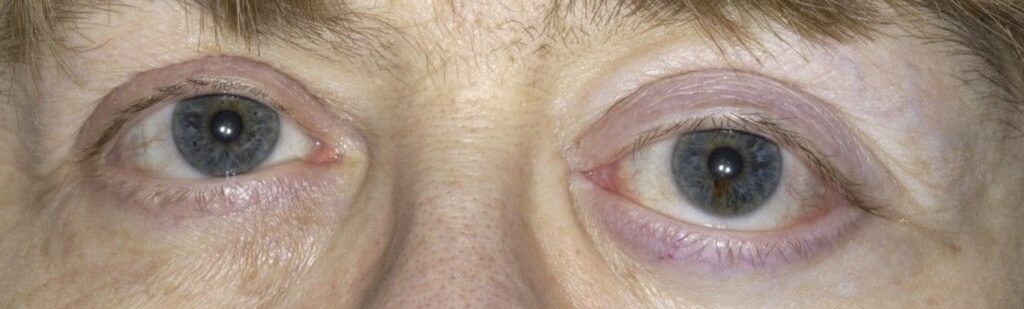
Deepening of the upper eyelid sulcus is the hallmark sign. The upper lid looks hollow, and the lid crease may rise. Patients often describe it as looking tired or older, and because the change is gradual, family members may notice it first.
Orbital Fat Atrophy and Enophthalmos
Laboratory work suggests that FP receptor stimulation inhibits adipocyte differentiation, and as a result, orbital fat volume decreases over time. The globe can then sit slightly deeper in the orbit, and mild enophthalmos is best judged against the fellow eye.
Lower Lid Changes and Lid Tightness
Lower lid fat pads may flatten, and baggy lids can appear smoother. In addition, the lids often feel firm and less elastic, and this tightness can make lid eversion and examination harder.
Eyelash Growth and Trichomegaly
Lashes grow longer, thicker and darker during treatment. Then, with unilateral therapy, the asymmetry becomes obvious to the patient, and vellus hairs on the lid skin may also darken.
Periocular Skin Pigmentation
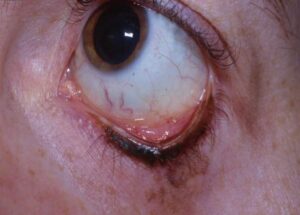
Prostaglandins increase melanin production in lid skin, and therefore the lids may develop a brown or gray tint. Blotting excess fluid after instillation is a simple preventive habit.
Iris Color Change
Iris darkening is generally considered permanent, and it occurs most often in mixed-color irides, such as green-brown or hazel eyes. Warn patients before starting therapy, especially with one-eyed treatment.
Grading Prostaglandin Periorbitopathy
Simple grading systems combine cosmetic signs with how easily the examiner can perform tonometry. For example, one Japanese system grades eyes from none to severe, and a standardized photograph at baseline helps document later change.
Asymmetry as a Diagnostic Clue
Unilateral or asymmetric treatment produces asymmetric findings, so ask which eye receives drops and for how long. A hollow sulcus only on the treated side strongly suggests a drug effect.
Differential Diagnosis of Prostaglandin Periorbitopathy
- Involutional fat loss with aging
- Silent sinus syndrome with enophthalmos
- Orbital floor fracture
- Weight loss or lipodystrophy
- Aponeurotic ptosis with a high lid crease
Is Prostaglandin Periorbitopathy Reversible?
Sulcus deepening often improves after stopping the drug or switching agents. For example, one study showed recovery after switching from bimatoprost to latanoprost. However, recovery is often partial and may take months, while skin pigment and lash changes usually regress and iris color does not.
IOP Measurement in Prostaglandin Periorbitopathy
Tight lids make Goldmann applanation technically difficult, and pressure on the globe while holding the lids can falsely raise readings. Therefore, avoid pressing on the globe when you hold the lids open (see IOP measurement pitfalls).
Surgical Impact of Prostaglandin Periorbitopathy
A deep-set globe and tight lids reduce surgical exposure. As a result, trabeculectomy, tube surgery and cataract surgery can be harder to perform, so plan exposure carefully and consider a traction suture.
Switching Therapy
Switching to latanoprost may reduce progression in a susceptible patient. Alternatively, consider a beta blocker, a carbonic anhydrase inhibitor or a rho kinase inhibitor, and review all classes with the patient (see glaucoma eye drops).
Counseling Patients About Prostaglandin Periorbitopathy
First, explain the possible changes before the first prescription. Next, reassure patients that most changes improve after stopping the drug, but they should never stop drops without a pressure plan. Finally, cosmetic concerns can reduce adherence, so address them openly.
Pitfalls to Avoid
- Do not label a hollow sulcus as aging without a drug history
- Never stop prostaglandins without arranging alternative pressure control
- Do not squeeze tight lids during applanation
- Avoid promising full reversal of iris color


Document what you see
Two smartphone imaging tools built for everyday clinic use — one for the slit lamp, one for the fundus.
From Choroida — the team behind this siteReferences
- Kucukevcilioglu M, Bayer A, Uysal Y, Altinsoy HI. Prostaglandin associated periorbitopathy in patients using bimatoprost, latanoprost and travoprost. Clin Exp Ophthalmol. 2014;42:126-131.
- Inoue K, Shiokawa M, Wakakura M, Tomita G. Deepening of the upper eyelid sulcus caused by 5 types of prostaglandin analogs. J Glaucoma. 2013;22:626-631.
- Sakata R, Shirato S, Miyata K, Aihara M. Recovery from deepening of the upper eyelid sulcus after switching from bimatoprost to latanoprost. Jpn J Ophthalmol. 2013;57:179-184.
- Johnstone MA. Hypertrichosis and increased pigmentation of eyelashes and adjacent hair in the region of the ipsilateral eyelids of patients treated with unilateral topical latanoprost. Am J Ophthalmol. 1997;124:544-547.
- Tanito M, Ishida A, Ichioka S, et al. Proposal of a simple grading system integrating cosmetic and tonometric aspects of prostaglandin-associated periorbitopathy. Medicine (Baltimore). 2021;100:e26874.
Test yourself
A few questions straight from this article.
-
What is the hallmark sign of prostaglandin periorbitopathy?
A deepened upper lid sulcus is the hallmark: the lid looks hollow, the crease may rise, and patients often feel they look tired or older. -
Which prostaglandin analog is reported most often to cause prostaglandin periorbitopathy?
All analogs can cause it, but published series report it most often with bimatoprost, travoprost intermediate and latanoprost least often. -
What mechanism is thought to cause orbital fat loss in prostaglandin periorbitopathy?
Laboratory work suggests FP receptor stimulation inhibits adipocyte differentiation, so orbital fat volume falls and the globe may sit slightly deeper. -
In patients using prostaglandin analogs, which irides most often develop colour change?
Iris darkening occurs most often in mixed-colour irides and is generally considered permanent, so patients should be warned before treatment, especially for one eye. -
Which finding most strongly suggests that a hollow upper sulcus is a prostaglandin drug effect?
Unilateral or asymmetric treatment produces asymmetric findings, so a hollow sulcus only on the treated side strongly suggests a drug effect; ask which eye gets drops and for how long. -
What usually happens to upper sulcus deepening after a prostaglandin analog is stopped or switched?
Sulcus deepening often improves after stopping or switching, as after a switch from bimatoprost to latanoprost, but recovery is often partial and slow; iris colour does not regress. -
How can lid handling distort Goldmann applanation readings in prostaglandin periorbitopathy?
Tight lids make applanation technically difficult, and pressure on the globe while holding them open can falsely raise readings, so avoid pressing on the globe. -
Which surgical precaution suits an eye with prostaglandin periorbitopathy undergoing trabeculectomy or cataract surgery?
A deep-set globe and tight lids reduce surgical exposure, so exposure should be planned carefully and a traction suture considered. -
A glaucoma patient wants to stop a prostaglandin drop because of periorbital changes. What is essential?
Most changes improve after stopping, but drops must never be stopped without a pressure plan; latanoprost, a beta blocker, a carbonic anhydrase inhibitor or a rho kinase inhibitor are options. -
What simple habit helps prevent periocular skin darkening from prostaglandin drops?
Prostaglandins increase melanin production in lid skin, giving a brown or grey tint, and blotting excess fluid after instillation is a simple preventive habit.

Writes and reviews the clinical articles on Educate. Every post is checked against peer-reviewed sources before it goes live.