IOP measurement is the most repeated test in glaucoma care.
Small errors change decisions about diagnosis and treatment, so knowing the pitfalls makes every reading more useful.
Why IOP Measurement Matters
Pressure is the only modifiable risk factor for glaucoma, and every treatment target depends on a reliable number. A reading that is wrong by three millimeters can mislead care, and therefore you should treat IOP measurement as a skill, not a routine.
Goldmann Applanation as the Reference
Goldmann tonometry flattens a fixed area of the cornea and reads the force needed, and it remains the standard against which other devices are judged (see Goldmann applanation tonometry). However, it has known sources of error, so learn those errors before relying on it.
All-fit Slit-Lamp Adapter
Record and share exactly what you see at the slit lamp. One adapter fits any slit lamp or surgical microscope — and any smartphone.
From Choroida — the team behind this siteCalibration and Equipment
Check the calibration of the tonometer every month, because a tip that sits loosely or is dirty will give a false reading. Disinfect prisms between patients, and also replace damaged prisms.
Central Corneal Thickness and IOP Measurement
A thick cornea resists flattening and overestimates pressure, while a thin cornea underestimates pressure. The Ocular Hypertension Treatment Study found thin corneas to be a risk factor for glaucoma, and therefore you should measure thickness in every glaucoma suspect (see ocular hypertension).
Correcting for Corneal Thickness
Correction formulas exist, but none is accurate for every eye, so use thickness to adjust the risk, not to alter the number blindly. A thin cornea raises the concern even when pressure is normal, so interpret both values together.
Fluorescein Amount
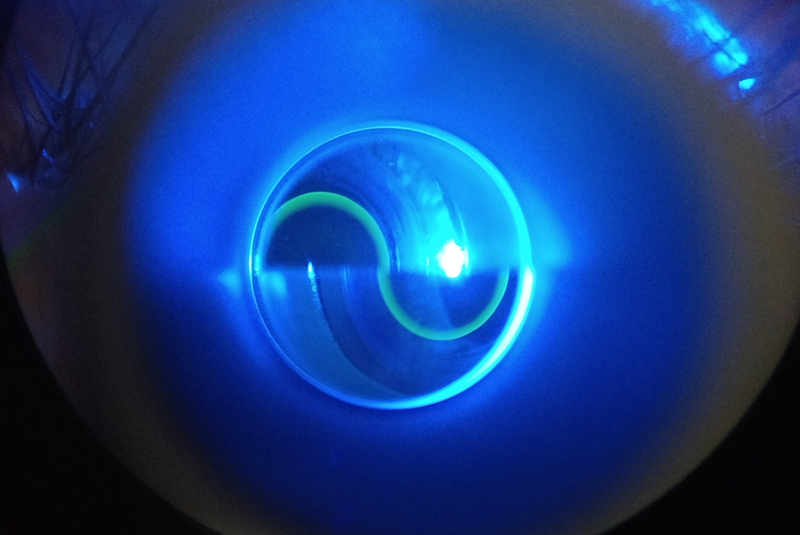
Too much fluorescein makes thick mires and overestimates the pressure, while too little makes thin, faint mires and underestimates it. Aim for thin, bright semicircles, and also dry the eye if the tear meniscus is large.
Astigmatism and IOP Measurement
Corneal astigmatism above three diopters distorts the reading, so align the red mark on the prism with the least curved axis. Alternatively, average readings from two perpendicular positions, and therefore check keratometry in high astigmatism.
Patient Factors
Squeezing the lids, holding breath or straining raises pressure, and a tight collar can do the same. Ask patients to relax and breathe normally, and in addition avoid pressing on the globe with a finger.
Corneal Disease and Surgery
Corneal edema raises measured pressure, while scarring and thick grafts distort it. Refractive surgery thins the cornea and lowers readings. Therefore, record the surgical history in the chart, and expect underestimation after LASIK.
Diurnal Variation
Pressure varies by several millimeters within a day, and peaks often occur in the early morning. A single clinic reading can miss these peaks, so also record the time of each visit.
Alternatives to Applanation
Rebound tonometers need no anesthetic and suit children and home use, while dynamic contour tonometry is less affected by corneal thickness. Non-contact devices are good for screening, but confirm abnormal readings with applanation.
Patient Positioning and Consistency
Measure pressure with the patient seated at the slit lamp, and use the same technique and the same hand at each visit. Document the device you used, so changes in pressure reflect the eye, not the method.
Recording and Using the Results
Write the time, the device and the pressure, and compare with previous values before deciding on treatment. Look at the trend as well as the single number, and therefore review the chart at every visit.
IOP Measurement: Practical Summary
Check calibration, use a thin line of fluorescein and measure thickness, and if the readings are inconsistent, repeat them. Because the stakes are high, trust the trend, and finally correlate pressure with the optic nerve and the visual field.
Pitfalls to Avoid
- Do not use a single reading to start or stop treatment
- Never forget the effect of central corneal thickness
- Avoid ignoring high astigmatism
- Do not skip tonometer cleaning
IOP Measurement in Children
Children rarely tolerate applanation tonometry, but rebound devices are quick and need no drops. If the child will not cooperate, an exam under anesthesia may be needed. Because anesthetics change pressure, interpret those readings with care.
IOP Measurement at Home
Home rebound tonometers capture pressure peaks outside the clinic, and patients who track values can show diurnal swings. However, device accuracy varies, so confirm unusual values in clinic. Therefore, use home readings as a trend only.
IOP Measurement After Corneal Surgery
Grafts and scars distort the reading, so when the cornea is irregular, use an alternative device. Because no method is perfect, correlate pressure with the optic nerve, and then record which device you used.
IOP Measurement Training
Teach trainees to look at the mires as well as the dial, since supervised practice improves accuracy within weeks. If two examiners disagree, repeat the measurement together, so that errors become teaching points.


Document what you see
Two smartphone imaging tools built for everyday clinic use — one for the slit lamp, one for the fundus.
From Choroida — the team behind this siteReferences
- Whitacre MM, Stein R. Sources of error with use of Goldmann-type tonometers. Surv Ophthalmol. 1993;38:1-30.
- Brandt JD, Beiser JA, Kass MA, Gordon MO. Central corneal thickness in the Ocular Hypertension Treatment Study (OHTS). Ophthalmology. 2001;108:1779-1788.
- Gordon MO, Beiser JA, Brandt JD, et al. The Ocular Hypertension Treatment Study: baseline factors that predict the onset of primary open-angle glaucoma. Arch Ophthalmol. 2002;120:714-720.
- Cook JA, Botello AP, Elders A, et al. Systematic review of the agreement of tonometers with Goldmann applanation tonometry. Ophthalmology. 2012;119:1552-1557.
Test yourself
A few questions straight from this article.
-
Why is accurate intraocular pressure measurement central to glaucoma care?
Pressure is the only modifiable risk factor for glaucoma and every treatment target depends on a reliable number, so a reading wrong by three millimeters can mislead care. -
Which tonometry method is the reference standard against which other IOP devices are judged?
Goldmann tonometry flattens a fixed area of cornea and reads the force needed; it remains the standard against which other devices are judged, despite known error sources. -
How often should the calibration of a Goldmann tonometer be checked?
Tonometer calibration should be checked every month, because a loose or dirty tip gives a false reading; prisms are disinfected between patients and replaced if damaged. -
How does a thick central cornea affect applanation IOP measurement?
A thick cornea resists flattening and overestimates pressure, while a thin cornea underestimates it, so thickness should be measured in every glaucoma suspect. -
How should central corneal thickness be used when interpreting applanation IOP?
Correction formulas exist but none is accurate for every eye; thickness is used to adjust risk, and a thin cornea raises concern even when pressure is normal. -
What is the effect of too much fluorescein during Goldmann IOP measurement?
Too much fluorescein makes thick mires and overestimates pressure, whereas too little gives thin faint mires and underestimates it; the aim is thin, bright semicircles. -
Above what level of corneal astigmatism does Goldmann IOP measurement become distorted?
Corneal astigmatism above three diopters distorts the reading, so the prism is aligned with the least curved axis or readings from two perpendicular positions are averaged. -
How does previous LASIK affect applanation IOP measurement?
Refractive surgery thins the cornea and lowers readings, so the surgical history should be recorded and underestimation expected after LASIK. -
Why can a single clinic IOP reading be misleading in glaucoma?
Pressure varies by several millimeters within a day with peaks often in the early morning, so a single clinic reading can miss them and the time of each visit is recorded. -
Which tonometer needs no anesthetic and suits children and home use?
Rebound tonometers need no anesthetic and suit children and home use, although abnormal readings from alternative devices should be confirmed with applanation.

Writes and reviews the clinical articles on Educate. Every post is checked against peer-reviewed sources before it goes live.