Voretigene neparvovec is an adeno-associated virus vector that carries a normal copy of the RPE65 gene, and surgeons inject it under the retina.
It was the first gene therapy approved for an inherited retinal disease, and it treats biallelic RPE65-related dystrophy.
This article reviews who qualifies, how the surgery works, and what to tell patients.
How Voretigene Neparvovec Works
RPE65 encodes an enzyme in the visual cycle of the retinal pigment epithelium.
Without it, photoreceptors cannot regenerate visual pigment, and patients develop severe night blindness and progressive loss of vision.
The vector delivers a working copy of the gene into RPE cells, and the cells then restore part of the visual cycle.
Treatment gives one dose per eye, and the effect aims to last for years (see Leber congenital amaurosis).
Who Qualifies for Voretigene Neparvovec
Patients need biallelic RPE65 mutations confirmed by genetic testing.
They also need enough viable retinal cells, which the treating team judges with OCT.
The label covers children and adults, and the age range depends on the region.
Patients with advanced atrophy gain little, so early referral matters (see gene therapy for inherited retinal disease).
Fundus Explorer Pro
Photograph the retinal findings described here with the phone already in your pocket — 22 D optics and built-in illumination in one handheld unit.
From Choroida — the team behind this siteThe Surgical Procedure for Voretigene Neparvovec
The surgeon performs a vitrectomy, then induces a posterior vitreous detachment if the hyaloid is attached.
Next, the surgeon uses a fine cannula to create a small retinotomy and injects the vector under the retina to form a bleb.
The bleb should cover the macula and the surrounding area, without touching the fovea more than needed.
The second eye usually receives treatment after a gap of at least six days, since the vector may trigger an immune response.
Steroids by mouth cover the perioperative period.
Trial Evidence for Voretigene Neparvovec
The phase 3 trial randomized patients to treatment or control and measured functional vision with a multi-luminance mobility test.
Treated patients passed the test at lower light levels, and full-field light sensitivity improved markedly.
Visual acuity did not change much on average.
Longer follow-up showed that the gain in light sensitivity persisted for several years (see electroretinography for functional testing).
Risks of Voretigene Neparvovec
- Conjunctival hyperemia and eye irritation
- Cataract and raised intraocular pressure
- Retinal tears, macular holes, and subretinal deposits
- Chorioretinal atrophy, which may appear months later
Some patients develop perifoveal atrophy that extends over time, and the cause is still unclear.
An Example Case
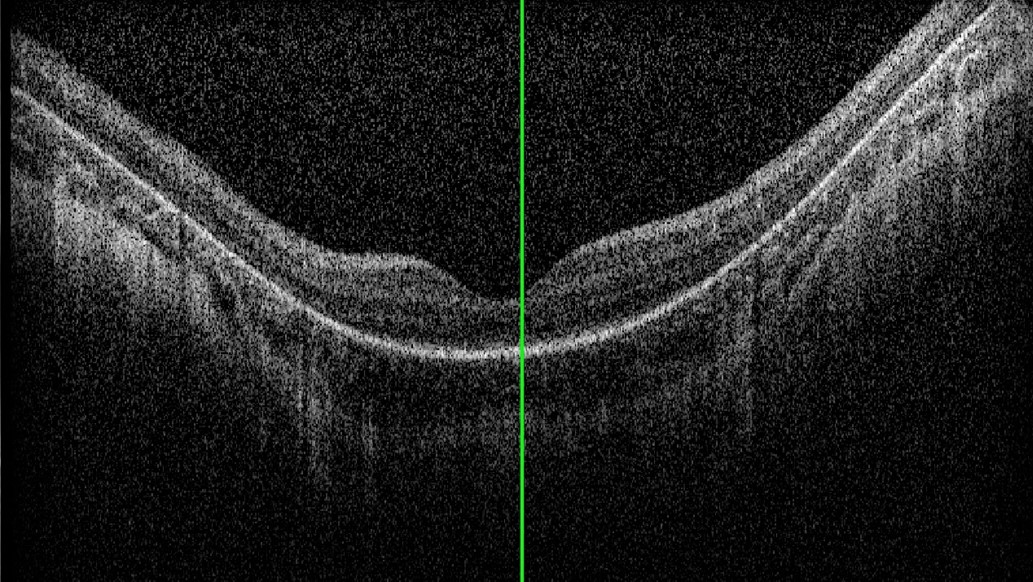
A 9-year-old boy cannot move safely in dim light and has nystagmus.
Genetic testing finds two pathogenic RPE65 variants, and OCT shows a preserved outer retina.
After a counseling visit, he receives surgery in one eye and then in the other eye two weeks later.
His parents report that he navigates a dim hallway within months, and the team continues long-term follow-up.
Counselling Families
Explain that the therapy improves light sensitivity, not full normal vision.
Warn about the need for surgery, steroids, and long follow-up.
Discuss the limited data on very long-term results, so families know what is still unknown.
Questions Families Ask
Families ask whether the treatment cures the disease, and the answer is that it improves light sensitivity but does not cure it.
They also ask how long the effect lasts, and studies show benefit at four years, although longer data are still limited.
Because the therapy needs surgery, many ask about the risks, so review them openly.
Pitfalls to Avoid
- Offering therapy without confirmed biallelic RPE65 mutations
- Waiting too long in patients with advanced atrophy
- Neglecting steroid coverage around surgery
- Skipping long-term OCT follow-up for atrophy
Looking Ahead
Gene therapy for other genes is advancing, although RPE65 remains the main approved target.
Researchers also study safer delivery routes and ways to reduce atrophy.
Therefore, expect rapid change in this field, and keep patients enrolled in registries.
Practical Points
Order genetic testing early in every child with unexplained night blindness.
Then refer to a center with experience in subretinal surgery.
Also record baseline mobility and light sensitivity, since these outcomes guide follow-up.
Perioperative Care
Start oral prednisone a few days before surgery and continue it for about a week after, then taper.
Also use topical antibiotics and steroids after surgery.
Because the vector is a biologic agent, the pharmacy handles it under strict protocols.
Finally, schedule visits at day one, week one, and month one.


Document what you see
Two smartphone imaging tools built for everyday clinic use — one for the slit lamp, one for the fundus.
From Choroida — the team behind this siteReferences
- Russell S, Bennett J, Wellman JA, et al. Efficacy and safety of voretigene neparvovec (AAV2-hRPE65v2) in patients with RPE65-mediated inherited retinal dystrophy: a randomised, controlled, open-label, phase 3 trial. Lancet. 2017;390:849-860.
- Maguire AM, High KA, Auricchio A, et al. Age-dependent effects of RPE65 gene therapy for Leber’s congenital amaurosis. Lancet. 2009;374:1597-1605.
- Gange WS, Sisk RA, Besirli CG, et al. Perifoveal chorioretinal atrophy after subretinal voretigene neparvovec-rzyl for RPE65-mediated Leber congenital amaurosis. Ophthalmol Retina. 2022;6:58-64.
- American Academy of Ophthalmology. Basic and Clinical Science Course, Section 12: Retina and Vitreous. AAO; current edition.

Writes and reviews the clinical articles on Educate. Every post is checked against peer-reviewed sources before it goes live.