Ocriplasmin is a recombinant protease that dissolves the protein bonds between the vitreous and the macula.
It was the first drug approved for symptomatic vitreomacular adhesion, and it offered an injection instead of vitrectomy.
Its use has fallen since approval because of modest success rates and visual side effects.
How Ocriplasmin Works
The enzyme cleaves fibronectin and laminin at the vitreoretinal interface.
This action weakens the adhesion, so the posterior hyaloid may separate from the macula.
A single intravitreal dose of 125 micrograms was the labeled treatment.
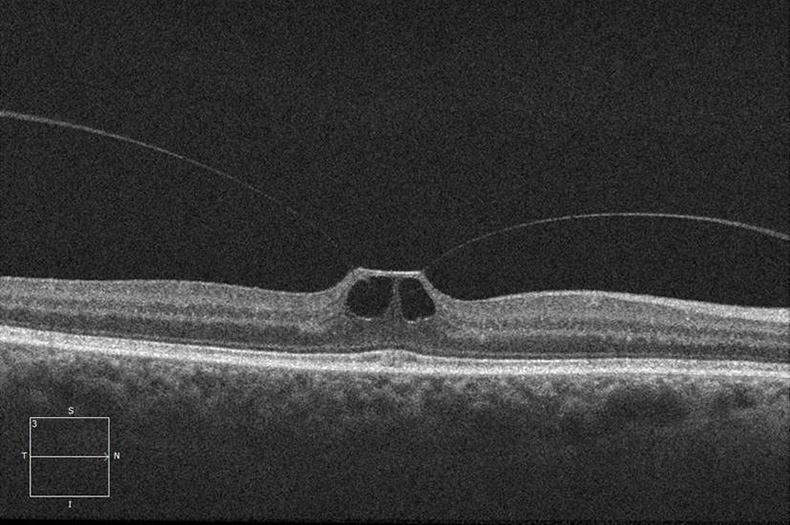
Success depends on the size of the adhesion and on the absence of an epiretinal membrane (see vitreomacular traction).
Trial Evidence for Ocriplasmin
MIVI-TRUST randomized eyes with vitreomacular adhesion to ocriplasmin or placebo.
Adhesion released in about one in four treated eyes at day 28, compared with about one in ten placebo eyes.
In eyes with a full-thickness macular hole, closure occurred in roughly four in ten treated eyes without surgery.
Small holes with a narrow adhesion and no epiretinal membrane did best (see full-thickness macular hole).
Fundus Explorer Pro
Photograph the retinal findings described here with the phone already in your pocket — 22 D optics and built-in illumination in one handheld unit.
From Choroida — the team behind this siteOcriplasmin Dosing and Procedure
The labeled dose is 0.125 mg in 0.1 mL after dilution, injected into the vitreous cavity through the pars plana.
Use standard sterile technique, and check the optic nerve perfusion after the injection as for any intravitreal drug.
Because the drug needs time to act, review the patient at one week and again at one month.
The label allows one injection per eye, so a second dose is not an option when the first one fails.
Side Effects of Ocriplasmin
Many patients notice floaters and photopsias in the days after injection.
Some develop transient dimming of vision, color changes, or a drop in acuity.
OCT may show subretinal fluid or disruption of the ellipsoid zone, and the ERG can change temporarily (see ellipsoid zone disruption on OCT).
Most changes settle within weeks, although a few patients report persistent defects.
However, the visual symptoms alarm many patients, so warn them before the injection.
Who Is a Candidate
Consider ocriplasmin only for symptomatic vitreomacular adhesion with a small adhesion and a clear view.
Avoid it in eyes with a large macular hole, high myopia, a prior vitrectomy, or an epiretinal membrane.
Counsel the patient that surgery may still be needed.
Ocriplasmin Compared With Vitrectomy
Overall, vitrectomy closes most macular holes and releases traction in nearly all eyes.
Ocriplasmin is less invasive, but its success rate is far lower.
Also, pneumatic vitreolysis with an intravitreal gas bubble is under study as another office option, though results vary.
Because of cost and side effects, many surgeons now use observation or early surgery instead.
Availability has also been limited in some regions.
Practical Points
- Check the OCT for adhesion width and any epiretinal membrane
- Warn the patient about floaters and transient visual changes
- Review the patient at one week and one month with OCT
- Plan vitrectomy if the adhesion persists with symptoms
An Example Case
A 66-year-old woman has distorted vision in her right eye and acuity of 20/50.
OCT shows focal vitreomacular traction with a 300 micrometer adhesion, a small cyst, and no epiretinal membrane.
She receives a single ocriplasmin injection after a discussion of risks.
She notices floaters and dimness for a week, and OCT at day 28 shows release of the traction.
Her vision returns to 20/30, and she avoids surgery.
Ocriplasmin Versus Observation
Some adhesions release by themselves over months, and symptoms may settle.
Ocriplasmin speeds release in a minority of eyes, though side effects occur.
Therefore, watching a mild case for a few months is often reasonable when vision is good.
Pitfalls to Avoid
- Avoid injecting an eye with a large macular hole or an epiretinal membrane
- Record a baseline OCT and color vision check before the injection
- Avoid promising a cure, since many eyes still need surgery
- Warn patients about transient vision loss
Questions Patients Ask
Patients ask whether the injection avoids an operation.
In a minority of eyes it does, and the chance depends on the size of the adhesion.
They also ask whether the changes in vision are permanent, and most settle within weeks.
Key Points
Ocriplasmin dissolves vitreoretinal adhesions with a single injection.
It helps selected eyes with small adhesions and has visual side effects.
Vitrectomy remains the more reliable option for most patients with symptoms.
For the latest studies, see the PubMed results for ocriplasmin.


Document what you see
Two smartphone imaging tools built for everyday clinic use — one for the slit lamp, one for the fundus.
From Choroida — the team behind this siteReferences
- Stalmans P, Benz MS, Gandorfer A, et al. Enzymatic vitreolysis with ocriplasmin for vitreomacular traction and macular holes. N Engl J Med. 2012;367:606-615.
- Duker JS, Kaiser PK, Binder S, et al. The International Vitreomacular Traction Study Group classification of vitreomacular adhesion, traction, and macular hole. Ophthalmology. 2013;120:2611-2619.
- Sebag J. Vitreous: In Health and Disease. Springer; 2014.
- American Academy of Ophthalmology. Basic and Clinical Science Course, Section 12: Retina and Vitreous. AAO; current edition.

Writes and reviews the clinical articles on Educate. Every post is checked against peer-reviewed sources before it goes live.