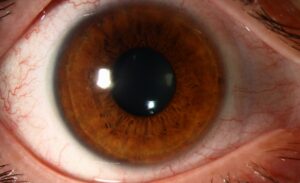
Topiramate angle closure is a rare idiosyncratic reaction in which the drug causes swelling of the ciliary body, forward rotation of the lens-iris diaphragm, and acute bilateral closure of the angle.
It usually appears within the first two weeks of treatment, and unlike the usual form of angle closure it does not come from pupillary block (see acute angle closure glaucoma).
Recognizing it early prevents permanent damage, and it avoids a laser that will not help.
Who Takes Topiramate and When Does It Occur?
Clinicians use topiramate for epilepsy, migraine prevention, weight control, and mood disorders.
Reported cases come mostly from women aged 20 to 50, in the first days to weeks after starting or increasing the dose, with bilateral involvement in nearly all (see the references).
Symptoms of Topiramate Angle Closure
- Sudden blurred vision, often with a myopic shift of several diopters
- Eye pain and headache, in some patients
- Redness, halos, and nausea
- No history of narrow angles in most patients
Patients may first go to an optician because their distance vision suddenly became blurred.
All-fit Slit-Lamp Adapter
Record and share exactly what you see at the slit lamp. One adapter fits any slit lamp or surgical microscope — and any smartphone.
From Choroida — the team behind this siteExamination Findings in Topiramate Angle Closure
- Elevated pressure, often above 40 mmHg
- Shallow anterior chamber, with a mid-dilated pupil in some
- A deep angle may be narrowed from rotation of the ciliary body, and the angle closure is appositional
- Choroidal effusion or ciliochoroidal detachment on ultrasound biomicroscopy or OCT (see choroidal detachment)
- Induced myopia from forward lens movement
Why the Mechanism of Topiramate Angle Closure Matters
In pupillary block the iris bows forward because aqueous cannot pass the pupil, and an iridotomy relieves it.
In topiramate angle closure the ciliary body swells and rotates forward, pushing the lens and iris forward, so an iridotomy gives no benefit (see Nd:YAG laser peripheral iridotomy).
Imaging with anterior segment OCT or ultrasound biomicroscopy shows the rotated ciliary body and effusion (see anterior segment OCT).
Treatment for Topiramate Angle Closure
- Stop topiramate, in consultation with the prescriber, and avoid abrupt withdrawal in patients with epilepsy
- Cycloplegics such as atropine 1 percent, to tighten the zonules and pull the lens back
- Aqueous suppressants and, when needed, hyperosmotic agents
- Topical steroids to reduce inflammation
- Avoid miotics, which worsen the condition
Pressure usually drops within a few days after stopping the drug, and the myopia resolves over days to weeks (see the references).
Other Causes of Drug-Induced Angle Closure
- Other sulfonamides, such as acetazolamide, hydrochlorothiazide, and sulfa antibiotics
- Drugs with anticholinergic or sympathomimetic effects, which dilate the pupil in a narrow angle, such as antidepressants and decongestants (see the references)
- Anticoagulants and others, through hemorrhagic effusions in rare cases
Prevention
Warn patients to call if they develop sudden blurred vision or eye pain after starting the drug.
Routine screening of angles before topiramate is not recommended, though gonioscopy is wise for those with known narrow angles (see gonioscopy).
Follow-Up for Topiramate Angle Closure
Check the pressure and angle after recovery, and screen for other causes if the angles remain narrow.
An Example Case
A 34-year-old woman starts topiramate for migraine prevention and, ten days later, wakes with blurred distance vision, headache, and aching eyes.
Her acuity has dropped to 20/200 in each eye, with a myopic shift of about 5 diopters, pressures of 44 and 46 mmHg, and shallow chambers with open-appearing but narrowed angles.
Ultrasound biomicroscopy shows ciliochoroidal effusions, so topiramate is stopped with her neurologist, atropine and aqueous suppressants are started, and pressures normalize in three days.
Practical Steps in the Clinic
- Ask every patient with acute bilateral blur and high pressure about new drugs
- Refract the patient, since a large myopic shift supports the diagnosis
- Perform gonioscopy and imaging of the angle and ciliary body
- Avoid miotics and avoid relying on iridotomy
- Contact the prescriber the same day
Counselling
Explain that the reaction is rare and idiosyncratic, that it usually clears when the drug is stopped, and that the eyes should recover fully when treated promptly.
Advise patients not to restart the drug, and to tell future doctors about the reaction.
Key Points to Remember
- Onset within weeks of starting topiramate
- Bilateral, with myopic shift and shallow chambers
- Not pupillary block, so iridotomy does not help
- Stop the drug and use cycloplegics and pressure-lowering drops
Other Drugs to Keep in Mind
Other sulfa-containing drugs and some antidepressants can cause a similar picture, so ask about all recent medicines.
Why Early Recognition Matters
Patients are often first seen by opticians or primary care doctors, who may treat the blur as a simple refractive change.
A high index of suspicion, a quick pressure check, and a call to the prescriber prevent damage to the optic nerve within days.
For the latest studies, see the PubMed results for topiramate angle closure.


Document what you see
Two smartphone imaging tools built for everyday clinic use — one for the slit lamp, one for the fundus.
From Choroida — the team behind this siteReferences
- Fraunfelder FW, Fraunfelder FT, Keates EU. Topiramate-associated acute, bilateral, secondary angle-closure glaucoma. Ophthalmology. 2004;111:109-111.
- Banta JT, Hoffman K, Budenz DL, Ceballos C, Greenfield DS. Presumed topiramate-induced bilateral acute angle-closure glaucoma. Am J Ophthalmol. 2001;132:112-114.
- Lachkar Y, Bouassida W. Drug-induced acute angle closure glaucoma. Curr Opin Ophthalmol. 2007;18:129-133.
- American Academy of Ophthalmology. Basic and Clinical Science Course, Section 10: Glaucoma. AAO; current edition.

Writes and reviews the clinical articles on Educate. Every post is checked against peer-reviewed sources before it goes live.