The Advanced Glaucoma Intervention Study (AGIS) was a large American trial that compared two sequences of laser and surgery in patients whose glaucoma was not controlled by medicine.
It also became famous for a secondary analysis that tied the level and consistency of intraocular pressure to the course of the visual field (see the references).
Design of the Advanced Glaucoma Intervention Study
The trial enrolled 789 eyes of 591 patients with open-angle glaucoma that had failed medical therapy, and randomized each eye to one of two sequences.
- ATT: argon laser trabeculoplasty, then trabeculectomy, then a repeat trabeculectomy if needed
- TAT: trabeculectomy first, then laser trabeculoplasty, then a repeat trabeculectomy
Investigators followed patients for up to ten years, with visual field scores and acuity as the main outcomes (see trabeculectomy and selective laser trabeculoplasty).
Advanced Glaucoma Intervention Study: Results by Race
African American patients did better with the laser first sequence, with less visual loss at seven years, and white patients did slightly better with trabeculectomy first (see the references).
The difference was in the rate of failure of the first procedure.
It led to the use of laser early in the care of patients with African ancestry.
All-fit Slit-Lamp Adapter
Record and share exactly what you see at the slit lamp. One adapter fits any slit lamp or surgical microscope — and any smartphone.
From Choroida — the team behind this siteAdvanced Glaucoma Intervention Study: The Pressure and Field Relationship
In the most cited analysis, eyes with an intraocular pressure below 18 mmHg at all visits showed almost no mean progression of the field over six years (see the references).
Eyes with a pressure above 18 mmHg at more than half of the visits progressed, on average.
Fluctuation mattered too, and eyes with a stable pressure over time did better than eyes with the same mean pressure and larger swings.
What the Trial Taught
- Lowering and keeping the pressure low protects the field
- A single pressure reading can mislead, since averages and variability both matter
- Early failure of the first procedure predicts further loss
- Patient factors such as race, age, and diabetes affect the outcome
Advanced Glaucoma Intervention Study: Visual Acuity Findings
Visual acuity declined in some patients after trabeculectomy, mostly from cataract.
Surgery in an eye with advanced disease needs a frank discussion of risk.
The study cannot tell how the newer techniques perform, since investigators ran it before antimetabolites and tube shunts became standard.
Limits of the Study
The population had advanced, uncontrolled disease, and the results may not apply to early cases.
Selective laser, minimally invasive surgery, and mitomycin-enhanced procedures have replaced its sequences in many clinics, so the findings give principles, not a protocol (see glaucoma drainage devices).
Advanced Glaucoma Intervention Study: Practical Use
Set a target pressure for each eye, measure the response over several visits, and tighten the target when the field worsens.
An Example Case
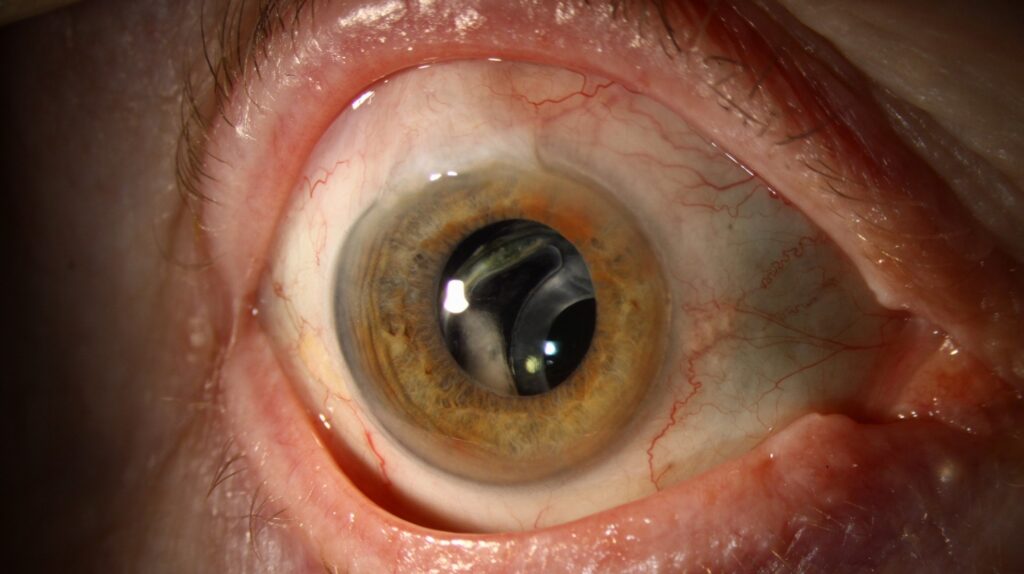
A 60-year-old woman with advanced glaucoma has a pressure of 22 mmHg on three drops and a field with a mean deviation of -15 dB.
In line with the lessons of AGIS, the goal is a pressure that stays below 18 mmHg at every visit.
She has a trabeculectomy with mitomycin, after which the pressure is steady at 11 to 13 mmHg.
Her field remains stable over four years, and she has cataract surgery later.
How to Explain the Study
Tell patients that a large study followed people with difficult glaucoma, and that those whose pressure stayed low at every visit kept their fields, while those with high readings lost more.
Explain that this is why doctors set a target and look for steady control.
Questions Patients Ask
- Why do I need so many visits? Pressure varies, and several readings show whether treatment controls it.
- Is surgery safer than laser? Both have risks, and the choice depends on the eye.
- Does race affect the choice? In AGIS it changed outcomes on average, but each patient is assessed on their own.
What Came After
Selective laser trabeculoplasty is now used more than argon laser, and the LiGHT trial showed good results with laser first.
Tube shunts and minimally invasive procedures offer more choices, and the principle from AGIS, steady low pressure, still holds.
Key Points to Remember
- Pressure that stayed below 18 mmHg at all visits was linked to stable fields
- Fluctuation and early procedure failure predicted loss
- The first treatment choice differed by race, but individual care matters most
- Principles from AGIS still guide target setting
Use in Clinical Practice
Plot the pressure at every visit on one chart, so that fluctuations and values above target stand out at once, and act on repeated readings above the goal.


Document what you see
Two smartphone imaging tools built for everyday clinic use — one for the slit lamp, one for the fundus.
From Choroida — the team behind this siteReferences
- Advanced Glaucoma Intervention Study Investigators. The Advanced Glaucoma Intervention Study (AGIS): 7. The relationship between control of intraocular pressure and visual field deterioration. Am J Ophthalmol. 2000;130:429-440.
- Advanced Glaucoma Intervention Study Investigators. The Advanced Glaucoma Intervention Study (AGIS): 4. Comparison of treatment outcomes within race. Seven-year results. Ophthalmology. 1998;105:1146-1164.
- Ederer F, Gaasterland DE, Sullivan EK. The Advanced Glaucoma Intervention Study (AGIS): 1. Study design and methods and baseline characteristics of study patients. Control Clin Trials. 1994;15:299-325.
- American Academy of Ophthalmology. Basic and Clinical Science Course, Section 10: Glaucoma. AAO; current edition.

Writes and reviews the clinical articles on Educate. Every post is checked against peer-reviewed sources before it goes live.