After an electric shock, the first concern is the heart, the skin, and the muscles.
The eye is often forgotten until weeks or months later, when the patient notices that their vision is cloudy.
Electric cataract is a lens opacity that follows the passage of current close to the head, and it is a classic example of a cataract with a latent period.
Who gets it
Most cases follow high-voltage injury, over about 1000 volts, at work in electrical, utility and construction trades.
Lightning strike is another cause, and sometimes lower-voltage household current is blamed if the current passes through the head.
The risk is greatest when the contact point is on the head or neck, and when the current passes through the head on its way to ground.
What the lens looks like
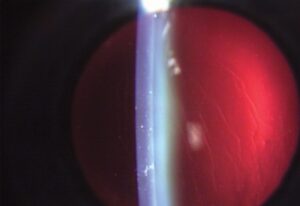
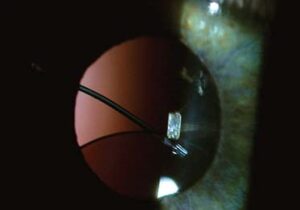
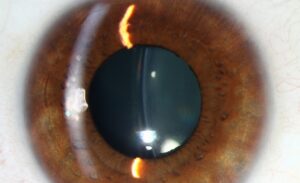
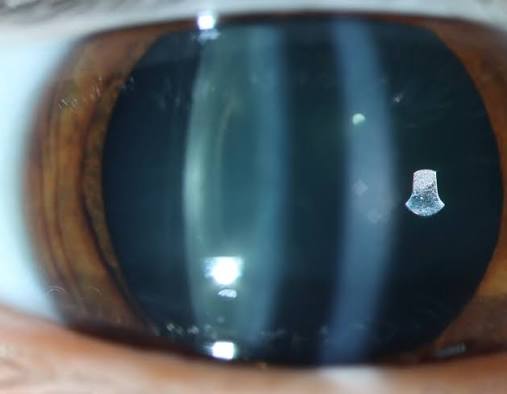
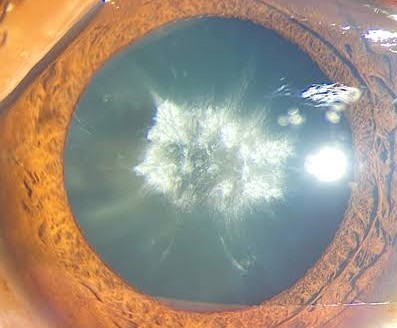
The first changes are usually in the anterior subcapsular zone: fine vacuoles and small white opacities beneath the anterior capsule, often in a star-shaped or flower-like pattern.
These may remain stable, or they may progress to a mature cataract.
Posterior subcapsular changes also occur.
The cataract is often bilateral if the current passed through both sides of the head, but it can be unilateral.
Because the changes are fine at first, they can be missed unless the pupil is dilated and the lens is examined carefully with retroillumination.
All-fit Slit-Lamp Adapter
Record and share exactly what you see at the slit lamp. One adapter fits any slit lamp or surgical microscope — and any smartphone.
From Choroida — the team behind this siteTiming
A few cases develop opacities within days, but the majority appear months after the injury, and some as late as a year or two.
For this reason, every patient who survives a significant electrical injury to the head should have a baseline eye examination and be reexamined periodically.
How current damages the lens
The lens has no blood supply, and it depends on a delicate balance of ions and water.
Electric current may coagulate lens proteins directly, damage the cell membranes of the lens epithelium and fibers, and upset the sodium-potassium pump.
The result is a disruption in ion balance, which allows water to enter and proteins to aggregate.
Heat produced by the current and the effects of free radicals may add to the damage.
Other ocular injuries
- Corneal burns and epithelial defects at the site of arc flash
- Uveitis, with cells and flare in the anterior chamber
- Retinal edema, macular hole, and chorioretinal scars
- Optic neuropathy, which may be delayed
- Vitreous hemorrhage and retinal detachment in more severe injuries
- Eyelid burns and lagophthalmos, which can cause exposure keratopathy
Lightning strike can produce a wide range of injuries, including pupil abnormalities, hyphema and keratitis (see photokeratitis for a related injury from arc flash).
Management
- Immediate: treat the life-threatening injuries first and examine the eyes when feasible
- Document visual acuity and examine the lens, retina, and optic nerve
- Follow-up examination at intervals for at least a year
- Treat the cataract with standard surgery when vision is affected
- Manage associated inflammation and corneal injury as required
Cataract surgery in electrical injury is usually straightforward, but surgeons should check the zonules and the posterior capsule, and examine the retina carefully before and after surgery.
What to ask the patient
Ask about the voltage and the type of source, where the current entered and exited the body, whether the patient lost consciousness, and whether there were burns on the head or face. A contact on the hand with exit through the feet carries a lower risk to the lens than contact at the head. Ask also about flashes of light and visual changes at the time, which may indicate retinal injury, and about other symptoms such as headache and hearing loss.
Counselling about the latent period
Tell patients that the lens may stay clear for months, and that a normal examination on the day of the injury does not rule out later cataract. A schedule of examination at three, six, and twelve months is a reasonable plan, and the patient should report any blur, glare, or reading problem in the meantime.
Occupational aspects
Many cases occur at work, and accurate documentation of the findings, with dated photographs and visual acuity, is important for medical and compensation purposes. The employer and occupational health service should be informed about eye protection and safe working practice.
Eye protection and prevention
Insulating gloves, face shields, and eye protection against arc flash reduce the risk of injury. Workers who handle high-voltage equipment should be trained in safe practice, and an incident report should include an eye examination. Prompt treatment of corneal burns from arc flash also prevents infection and scarring.
Prognosis
Visual results after surgery are usually good if the retina and optic nerve are intact.
The final visual outcome is limited by any associated retinal or optic nerve damage.
Document what you see
Two smartphone imaging tools built for everyday clinic use — one for the slit lamp, one for the fundus.
From Choroida — the team behind this siteReferences
- Fraunfelder FT, Hanna C. Electric cataracts. I. Sequential changes, unusual and prognostic findings. Arch Ophthalmol. 1972;87:179-183.
- Hanna C, Fraunfelder FT. Electric cataracts. II. Ultrastructural lens changes. Arch Ophthalmol. 1972;87:184-188.
- Norman ME, Albertson D, Younge BR. Ophthalmic manifestations of lightning strike. Surv Ophthalmol. 2001;46:19-24.
- Saffle JR, Crandall A, Warden GD. Cataract: a long-term complication of electrical injury. J Trauma. 1985;25:17-21.
Test yourself
A few questions straight from this article.
-
Electric cataract is best characterised by which feature?
Electric cataract is a lens opacity following the passage of current close to the head, and it is a classic example of a cataract with a latent period. -
Most cases of electric cataract follow electrical injury above which voltage?
Most cases follow high-voltage injury above roughly 1000 volts, typically occurring at work in electrical, utility and construction trades. -
Which exposure pattern carries the greatest risk to the lens in electrical injury?
Risk is greatest when the contact point is on the head or neck and the current passes through the head on its way to ground; a hand-to-feet path carries lower lens risk. -
What is the characteristic early lens finding in electric cataract?
The first changes are fine vacuoles and small white opacities beneath the anterior capsule, often arranged in a star-shaped or flower-like pattern; posterior subcapsular change also occurs. -
How are the earliest lens changes of electric cataract best detected?
Because the early changes are fine, they are easily missed unless the pupil is dilated and the lens is examined carefully with retroillumination. -
When do most electric cataracts become apparent after the electrical injury?
A few cases develop opacities within days, but the majority appear months after injury and some as late as one or two years, which is why periodic reexamination is needed. -
Which mechanism underlies lens damage after electrical injury?
Current can coagulate lens proteins, damage lens epithelial and fibre membranes, and upset the sodium-potassium pump, so ion balance fails, water enters and proteins aggregate; the lens has no blood supply. -
Which follow-up schedule suits a patient after significant electrical injury to the head?
A normal examination on the day of injury does not exclude later cataract, so a schedule of examination at three, six and twelve months is a reasonable plan. -
What should the surgeon check particularly when operating on an electric cataract?
Surgery is usually straightforward, but the zonules and posterior capsule should be checked and the retina examined carefully before and after the operation. -
What limits the final visual outcome after surgery for electric cataract?
Visual results after surgery are usually good when the retina and optic nerve are intact; any associated retinal or optic nerve damage limits the final outcome.

Writes and reviews the clinical articles on Educate. Every post is checked against peer-reviewed sources before it goes live.