Bleb leak is aqueous escaping through the conjunctiva over a filtering bleb after trabeculectomy.
It can appear within days of surgery or many years later. However, its clinical meaning differs between these two settings. An early leak threatens bleb function, while a late leak threatens the eye through infection.
What Causes a Bleb Leak
Early leaks usually come from wound gaps, buttonholes or loose conjunctival sutures. Late leaks, in contrast, arise from thin, avascular bleb walls that slowly break down. Antimetabolites such as mitomycin C raise this risk because they suppress fibroblast healing, and some surgeons also associate limbus-based flaps with thin, cystic blebs near the limbus.
Early Bleb Leak After Surgery
An early leak usually appears in the first weeks after trabeculectomy, and the patient may report tearing or no symptoms at all. On examination, the bleb looks low, and the chamber may be shallow. Many early leaks close spontaneously as the conjunctiva heals.
All-fit Slit-Lamp Adapter
Record and share exactly what you see at the slit lamp. One adapter fits any slit lamp or surgical microscope — and any smartphone.
From Choroida — the team behind this siteLate-Onset Bleb Leak
Late leaks occur months or years after surgery, often over a cystic, avascular bleb, and patients may notice a watery eye, blurred vision or discomfort. Because the barrier is broken, bacteria can enter the bleb directly. Therefore, every late leak needs a clear plan and close follow-up.
Seidel Testing for Bleb Leak
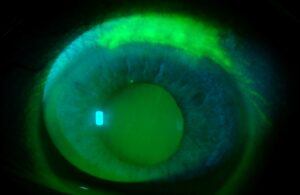
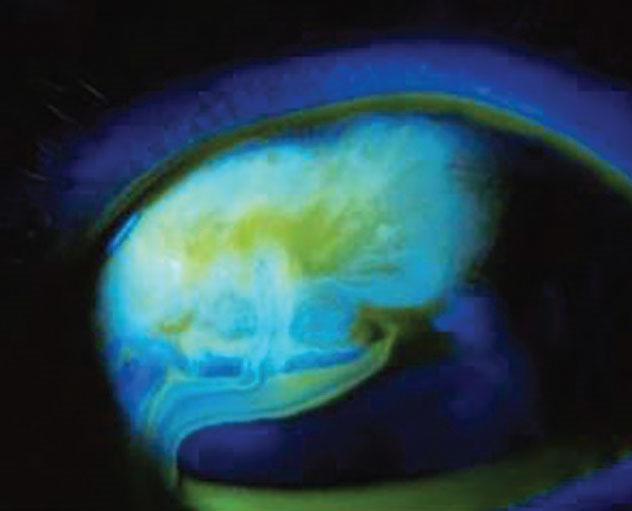
The Seidel test confirms the diagnosis at the slit lamp. First, paint concentrated fluorescein over the bleb with a moistened strip, then look under cobalt blue light for a dark stream diluting the dye. Gentle digital pressure on the globe can reveal a slow, intermittent leak, and you should also separate a focal pinpoint stream from diffuse sweating through a porous wall.
Other Signs of a Bleb Leak
- Low intraocular pressure or a sudden pressure drop
- Shallow or flat anterior chamber
- Low, flat or cystic bleb morphology
- Choroidal effusion on fundus examination or ultrasound
- Hypotony maculopathy with chorioretinal folds
Hypotony and the Leaking Bleb
Prolonged hypotony can cause choroidal effusions and maculopathy. As a result, vision may decline even when the bleb looks quiet. OCT shows retinal and choroidal folds through the macula, so persistent hypotony pushes the surgeon toward earlier repair.
Bleb Leak and Blebitis Risk
A leaking bleb gives organisms a direct path into the eye, and Soltau and colleagues identified bleb leak as a risk factor for bleb-related infection. Untreated blebitis can progress to endophthalmitis (see blebitis), and a milky, injected bleb with a leak needs urgent cultures and intensive antibiotics.
Conservative Options for a Bleb Leak
Small early leaks often respond to observation with topical antibiotic cover, and clinicians may also taper topical steroids to allow wound healing. Aqueous suppressants lower flow through the defect and may help it seal. However, these measures must not hide a deepening hypotony.
Contact Lens and Patching
A large-diameter bandage contact lens can tamponade a small leak, and pressure patching or a Simmons shell offers other mechanical options. These methods work best for small, early leaks with healthy surrounding tissue. Because a lens can harbor bacteria, antibiotic cover and regular review are wise.
Tissue Glue and Sutures
Cyanoacrylate or fibrin glue can seal a focal hole in selected cases, and glue usually needs a bandage lens on top for comfort. Direct suture closure may also repair a defect in healthy conjunctiva. Autologous blood injection has been reported, although results vary.
Surgical Revision of the Bleb
Conjunctival advancement is the usual repair for persistent late leaks, where the surgeon excises the thin bleb and advances healthy conjunctiva to the limbus. Budenz and colleagues found advancement more successful than nonincisional treatment for late leaks. However, pressure may rise afterward, and some patients need medication again.
Choosing Among Bleb Leak Treatments
First, decide whether the leak is early or late, and next assess pressure, chamber depth, macular status and signs of infection. Then, weigh bleb function, because revision can reduce filtration. Finally, consider visual field status and patient reliability.
Counseling After Bleb Leak
Explain that a filtering bleb carries a lifelong infection risk (see bleb-associated endophthalmitis). Teach the patient to report redness, discharge, pain or blurred vision the same day, and also advise against eye rubbing and swimming while the leak persists.
Follow-Up Plan
Review active leaks frequently until the Seidel test turns negative, and measure pressure and chamber depth and examine the macula at each visit. After closure, check the bleb with fluorescein periodically for life. For recurrent leaks, surgeons may consider a tube instead (see glaucoma drainage devices).
Pitfalls to Avoid
- Do not skip Seidel testing when pressure is unexpectedly low
- Apply gentle pressure during the test to catch slow leaks
- Never leave a late leak without infection counseling
- Avoid bandage lens wear without antibiotic cover and review


Document what you see
Two smartphone imaging tools built for everyday clinic use — one for the slit lamp, one for the fundus.
From Choroida — the team behind this siteReferences
- Soltau JB, Rothman RF, Budenz DL, et al. Risk factors for glaucoma filtering bleb infections. Arch Ophthalmol. 2000;118:338-342.
- Budenz DL, Chen PP, Weaver YK. Conjunctival advancement versus nonincisional treatment for late-onset glaucoma filtering bleb leaks. Arch Ophthalmol. 1999;117:1014-1019.
- Greenfield DS, Suñer IJ, Miller MP, et al. Endophthalmitis after filtering surgery with mitomycin. Arch Ophthalmol. 1996;114:943-949.
- Gedde SJ, Herndon LW, Brandt JD, et al. Postoperative complications in the Tube Versus Trabeculectomy (TVT) study during five years of follow-up. Am J Ophthalmol. 2012;153:804-814.
- American Academy of Ophthalmology. Basic and Clinical Science Course, Section 10: Glaucoma. San Francisco: AAO.
Test yourself
A few questions straight from this article.
-
What is a bleb leak after glaucoma filtering surgery?
A bleb leak is aqueous escaping through the conjunctiva over a filtering bleb after trabeculectomy, appearing within days of surgery or many years later. -
After trabeculectomy, what is the main threat posed by a late-onset bleb leak?
An early leak mainly threatens bleb function, whereas a late leak threatens the eye through infection because bacteria can enter the bleb directly. -
Why does mitomycin C raise the risk of a late bleb leak after trabeculectomy?
Late leaks arise from thin, avascular bleb walls that slowly break down, and antimetabolites such as mitomycin C raise this risk by suppressing fibroblast healing. -
What confirms a bleb leak on Seidel testing at the slit lamp?
Concentrated fluorescein is painted over the bleb and viewed under cobalt blue light, where escaping aqueous appears as a dark stream diluting the dye. -
During Seidel testing of a filtering bleb, what helps reveal a slow, intermittent leak?
Gentle digital pressure on the globe can reveal a slow, intermittent leak, and the examiner should also separate a focal pinpoint stream from diffuse sweating through a porous wall. -
In a leaking glaucoma bleb, which macular finding pushes the surgeon toward earlier repair?
Prolonged hypotony from a leak causes choroidal effusions and maculopathy, with folds on OCT and declining vision, so persistent hypotony favours earlier repair. -
How should a milky, injected filtering bleb with a leak be managed?
A leak is a recognized risk factor for bleb-related infection, and untreated blebitis can progress to endophthalmitis, so a milky, injected leaking bleb needs urgent cultures and intensive antibiotics. -
How is a small early bleb leak after trabeculectomy usually managed first?
Many early leaks close spontaneously as the conjunctiva heals, so small early leaks are often observed with antibiotic cover, steroid taper and aqueous suppressants, watching for deepening hypotony. -
What is the usual surgical repair for a persistent late-onset bleb leak?
Conjunctival advancement, excising the thin bleb and bringing healthy conjunctiva to the limbus, outperformed nonincisional treatment for late leaks, though pressure may rise afterward. -
Which bleb leaks respond best to a large-diameter bandage contact lens?
A bandage lens, pressure patch or Simmons shell can tamponade a leak and works best for small, early leaks with healthy surrounding tissue, under antibiotic cover and regular review.

Writes and reviews the clinical articles on Educate. Every post is checked against peer-reviewed sources before it goes live.