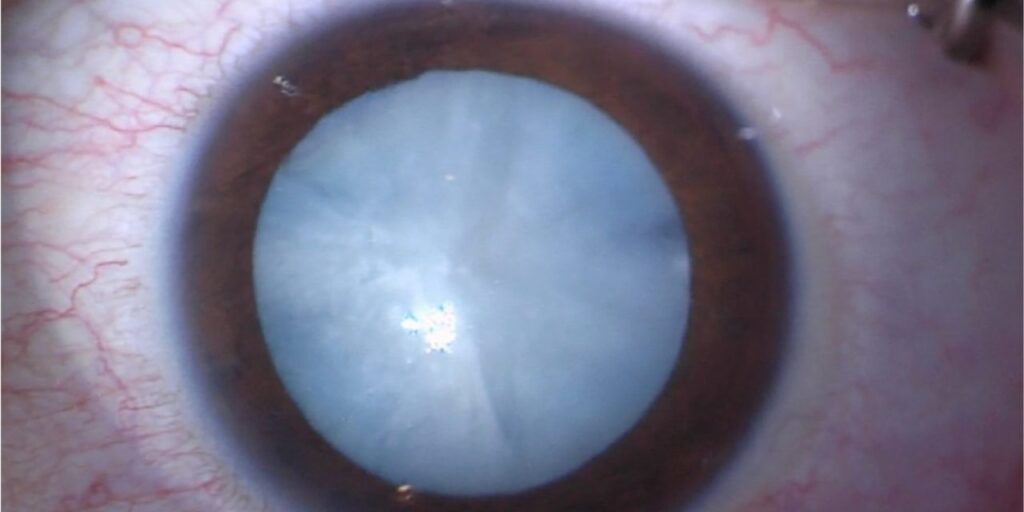
Cataract surgery timing is a decision about function, not a number on a chart.
Patients need surgery when vision limits daily life.
Some eyes need earlier surgery for medical reasons.
Why Cataract Surgery Timing Is Not About the Chart Alone
Snellen acuity may be 20/40 while glare makes driving unsafe.
Contrast loss and night vision problems also matter.
Therefore, ask about daily tasks.
So acuity is only one part.
Typical Symptoms
Patients report blur, glare, halos and washed-out colors.
Reading and driving become harder.
Some notice a change in glasses prescription.
Also ask about falls.
All-fit Slit-Lamp Adapter
Record and share exactly what you see at the slit lamp. One adapter fits any slit lamp or surgical microscope — and any smartphone.
From Choroida — the team behind this siteVisual Function Questionnaires
Simple questions about reading, driving and recognizing faces guide the decision.
Validated questionnaires exist but are not essential.
A focused history works well.
So take time to listen.
Cataract Surgery Timing and Driving
Glare at night is a common reason for surgery.
Patients should not drive if vision falls below legal limits.
Offer surgery before safety is at risk.
Therefore, discuss driving at every visit.
Cataract Surgery Timing and Occupation
Pilots, drivers and surgeons need excellent vision.
Surgery may be advised earlier.
Patients with demanding hobbies also benefit.
So tailor the timing to the person.
Medical Indications
Phacomorphic glaucoma and lens-induced inflammation need prompt removal.
Dense cataracts block the view of the retina in diabetes.
Surgery may be needed to treat retinal disease.
Therefore, monitor patients with comorbidity.
Risks of Waiting
Very dense cataracts are harder to remove.
The risk of complications rises as the lens hardens.
Falls and fractures increase with poor vision.
Also, depression can follow vision loss.
Risks of Operating Too Early
Surgery carries small risks.
Waiting until the patient is symptomatic gives a better balance.
Patients with mild symptoms may delay safely.
So avoid pushing surgery.
Cataract Surgery Timing in Diabetes
Diabetic eyes need careful preoperative assessment.
Control retinopathy and edema first when possible.
Delay can allow progression, so coordinate care.
Therefore, involve the retina specialist.
Cataract Surgery Timing in Uveitis
Inflammation should be quiet for weeks before surgery.
Steroid cover is often needed.
Timing affects outcomes (see cataract surgery in uveitis).
So plan with the uveitis team.
Cataract Surgery Timing and Both Eyes
The second eye is often operated soon after the first.
Delay causes imbalance.
Immediate sequential surgery is used in some centers.
Also discuss individual risks.
Anticoagulants and Medical Fitness
Most anticoagulants do not need to be stopped for routine surgery (see cataract surgery and anticoagulants).
Medical fitness for lying flat and staying still matters.
Plan anesthesia accordingly.
Therefore, review general health.
Shared Decision Making
Explain the benefits and risks in plain terms.
Ask what matters most to the patient.
Respect the decision to wait.
So the final choice belongs to the patient.
Cataract Surgery Timing: Practical Summary
Ask about function, check for medical indications and discuss risks.
If daily tasks are limited, offer surgery.
Because delay has risks, review at intervals.
Finally, document the reasoning.
Pitfalls to Avoid
- Do not rely on visual acuity alone
- Never ignore glare and driving problems
- Avoid delaying surgery in phacomorphic glaucoma
- Do not push surgery on asymptomatic patients
Cataract Surgery Timing and Falls
Poor vision increases the risk of falls in older adults.
Surgery lowers the rate of falls and fractures.
Because injuries are costly, consider earlier surgery in frail patients.
Therefore, ask about falls at each visit.
Cataract Surgery Timing and Dementia
Poor vision may worsen confusion in people with cognitive decline.
Surgery can improve function in some patients.
However, the ability to cooperate matters.
So plan carefully with the family.
Cataract Surgery Timing in Young Patients
Young adults with cataract need a cause.
Look for steroids, trauma, uveitis or metabolic disease.
Because the cause may need treatment, investigate it.
Then time the surgery to the eye and the cause.
Cataract Surgery Timing and Waiting Lists
Long waiting lists delay care in many systems.
Prioritize patients with severe function loss.
If symptoms worsen, advance the date.
Therefore, communicate with the patient while they wait.
Cataract Surgery Timing: Patient Questions
Patients ask whether the cataract must be ripe.
Modern surgery does not require this.
They also ask whether waiting makes surgery harder.
It can, so review the lens density.
Cataract Surgery Timing: Informed Consent
Describe the benefits, the risks and the alternatives.
Mention the option of waiting.
Because consent is a process, allow questions.
Finally, record the discussion.
For the latest studies, see the PubMed results for cataract surgery timing.


Document what you see
Two smartphone imaging tools built for everyday clinic use — one for the slit lamp, one for the fundus.
From Choroida — the team behind this siteReferences
- Miller KM, Oetting TA, Tweeten JP, et al. Cataract in the adult eye preferred practice pattern. Ophthalmology. 2022;129:P1-P126.
- Liu YC, Wilkins M, Kim T, Malyugin B, Mehta JS. Cataracts. Lancet. 2017;390:600-612.
- Congdon N, Vingerling JR, Klein BE, et al. Prevalence of cataract and pseudophakia/aphakia among adults in the United States. Arch Ophthalmol. 2004;122:487-494.
- Lundstrom M, Barry P, Henry Y, Rosen P, Stenevi U. Evidence-based guidelines for cataract surgery. J Cataract Refract Surg. 2012;38:1086-1093.
Test yourself
A few questions straight from this article.
-
What mainly determines when routine cataract surgery should be offered?
Timing is a decision about function, not a chart number: acuity may be 20/40 while glare makes driving unsafe, so daily tasks are asked about. -
Which symptom is a common reason for cataract surgery in patients who drive?
Night glare is a common reason for surgery, and surgery is offered before safety is at risk, with driving discussed at every visit. -
Which lens-related condition is a medical indication for prompt cataract removal?
Phacomorphic glaucoma and lens-induced inflammation need prompt removal regardless of how the patient rates their vision. -
Why may cataract surgery be medically indicated in a patient with diabetes?
Dense cataracts block the view of the retina in diabetes, and surgery may be needed so that retinal disease can be treated. -
What is a surgical risk of delaying cataract surgery too long?
Very dense cataracts are harder to remove and the risk of complications rises as the lens hardens; falls and depression can also follow vision loss. -
In a patient with uveitis, what is required before cataract surgery?
Inflammation should be quiet for weeks before surgery, steroid cover is often needed, and timing is planned with the uveitis team. -
How are most anticoagulants managed for routine cataract surgery?
Most anticoagulants do not need to be stopped for routine surgery; fitness to lie flat and stay still matters more for planning anesthesia. -
Why may earlier cataract surgery be considered in frail older patients?
Poor vision increases falls in older adults and surgery lowers falls and fractures, so earlier surgery is considered in frail patients. -
What should be done before timing cataract surgery in a young adult?
Young adults with cataract need a cause sought, such as steroids, trauma, uveitis or metabolic disease, and surgery is timed to the eye and the cause. -
Must a cataract be ripe before modern cataract surgery?
Modern surgery does not require a ripe cataract, and waiting can make surgery harder, so lens density is reviewed.

Writes and reviews the clinical articles on Educate. Every post is checked against peer-reviewed sources before it goes live.