A navigated laser places photocoagulation burns using a planned map and eye tracking.
The surgeon plans the pattern on a fundus image and the system fires the laser at each point. Therefore, treatment becomes more accurate and more repeatable than freehand laser.
Why the Navigated Laser Was Developed
Conventional laser depends on the surgeon aiming each shot by hand, and eye movements and lens distortion add error, while burns near the fovea carry a risk of damage. As a result, a system that corrects for motion has clear appeal.
How a Navigated Laser Works
The device captures a fundus image and registers it with an angiogram or photograph, and the surgeon marks treatment targets on the image. Also, an eye tracker follows the retina in real time, so the laser fires only when the beam aligns with the planned spot.
Fundus Explorer Pro
Photograph the retinal findings described here with the phone already in your pocket — 22 D optics and built-in illumination in one handheld unit.
From Choroida — the team behind this siteComponents of the Navigated Laser
A confocal imaging module captures the live fundus view, and a green 532 nanometer laser delivers the burns. Also, software handles planning, tracking and safety limits, while the surgeon controls the treatment from a screen.
Navigated Laser Planning for Focal Treatment
In diabetic macular edema, the surgeon marks leaking microaneurysms from angiography, and the system then targets each one. Also, a safe zone around the fovea can be set, and as a result the risk of burns near the center falls (see diabetic macular edema).
Navigated Laser Evidence in Diabetic Macular Edema
Kozak and colleagues studied the system in diabetic macular edema, where treatment accuracy was high and thickness decreased after treatment. The results were similar to those of conventional focal laser in small series, and therefore accuracy is the main gain, while efficacy is similar.
Panretinal Photocoagulation
Kernt and colleagues reported use of the system for panretinal treatment, where the planned pattern allows even spacing of burns. Also, the system reduces pain in some patients because of shorter sessions, and the tracker keeps the pattern in place.
Comparison with Pattern Scan Lasers
Pattern scan lasers fire multiple burns in a preset grid with short pulses, and they reduce pain and treatment time. They do not track eye movement, so the navigated laser adds tracking and planning to this concept.
Other Retinal Conditions
The device has been used for central serous chorioretinopathy, retinal tears and vein occlusion, and targeting is helpful when a lesion is small and near the fovea. Also, retreatment can use the same map, so follow-up laser is more precise.
Treatment Documentation
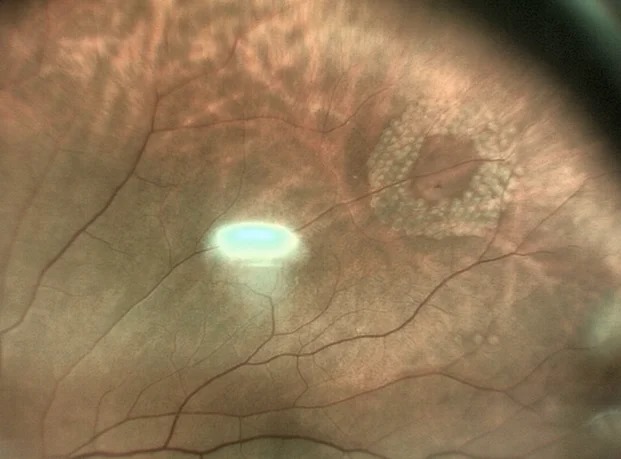
The system saves the fundus image with the burns marked, and this record helps with follow-up and retreatment. Also, it adds medicolegal safety, and the map can be compared with later images.
Advantages of a Navigated Laser
Accuracy is higher than with freehand treatment, and eye movement is compensated, so the surgeon can focus on the plan. Also, results are reproducible and documented, and therefore teaching and quality control improve.
Limitations of a Navigated Laser
The system is costly and needs training, and image quality in cataract or small pupils can limit tracking. Also, the evidence for better vision than conventional laser is limited, and as a result it remains a specialist tool.
Safety Considerations
Use eye protection for staff and follow laser safety rules, and check the settings and the safe zone before treatment. Also, confirm the registration of the images, and stop if the patient cannot hold still.
Role Next to Anti-VEGF Therapy
Anti-VEGF drugs are the first choice for center-involving edema, but laser still has a role for extrafoveal leaks and some retinopathy cases (see panretinal photocoagulation). Also, it suits patients who cannot attend frequent injections, and therefore a navigated laser keeps laser useful.
Cost and Access
The device is expensive and available in limited centers, while costs of disposables are small. Also, insurance rules vary, and as a result access shapes use.
Pitfalls to Avoid
- Do not trust the plan if the images are poorly registered
- Never treat close to the fovea without a safety margin
- Do not use laser alone for center-involving edema without considering injections
- Never skip documentation of the burn map
Pain and Patient Comfort
Short pulses and planned spacing reduce pain in many patients, and sessions are shorter than with conventional laser. Also, topical anesthesia usually suffices, and as a result patients tolerate treatment well.
Training and Learning Curve
Surgeons learn to plan on the image and to trust the tracker. Training sessions with a technician help. Also, the first cases take longer. Therefore, plan extra time at the start.


Document what you see
Two smartphone imaging tools built for everyday clinic use — one for the slit lamp, one for the fundus.
From Choroida — the team behind this siteReferences
- Kozak I, Oster SF, Cortes MA, et al. Clinical evaluation and treatment accuracy in diabetic macular edema using navigated laser photocoagulator NAVILAS. Ophthalmology. 2011;118:1119-1124.
- Kernt M, Cheuteu R, Vounotrypidis E, et al. Focal and panretinal photocoagulation with a navigated laser (NAVILAS). Acta Ophthalmol. 2011;89:e662-e664.
- Chhablani J, Kozak I, Barteselli G, El-Emam S. A novel navigated laser system brings new efficacy to the treatment of retinovascular disorders. Oman J Ophthalmol. 2013;6:18-22.
- Early Treatment Diabetic Retinopathy Study Research Group. Photocoagulation for diabetic macular edema: Early Treatment Diabetic Retinopathy Study report number 1. Arch Ophthalmol. 1985;103:1796-1806.
Test yourself
A few questions straight from this article.
-
What distinguishes navigated laser photocoagulation (Navilas) from conventional freehand laser?
The surgeon plans the burn pattern on a fundus image and the system fires at each point while tracking the eye, making treatment more accurate and repeatable than freehand laser. -
During navigated laser photocoagulation, when does the system fire the laser?
An eye tracker follows the retina in real time, so the navigated laser fires only when the beam lines up with the planned treatment target. -
Which laser does the Navilas navigated photocoagulation system use to deliver its burns?
The system combines a confocal imaging module for the live fundus view with a green 532 nanometer laser, while software handles planning, tracking and safety limits. -
In navigated focal laser for diabetic macular edema, how are the treatment targets chosen?
The surgeon marks leaking microaneurysms from angiography and the system targets each one, with a safe zone set around the fovea to lower the risk of central burns. -
Compared with conventional focal laser for diabetic macular edema, what is the main gain of navigated laser in published series?
Kozak and colleagues found high treatment accuracy and reduced thickness, with results similar to conventional focal laser, so accuracy rather than efficacy is the main gain. -
How does a navigated laser differ from a pattern scan laser for retinal photocoagulation?
Pattern scan lasers fire multiple short-pulse burns in a preset grid but do not track eye movement; the navigated laser adds tracking and planning to that concept. -
Which patient factor can limit eye tracking during navigated laser photocoagulation?
Image quality in eyes with cataract or small pupils can limit tracking, which, with cost and training needs, keeps the navigated laser a specialist tool. -
In diabetic macular edema, where does navigated laser retain a role alongside anti-VEGF therapy?
Anti-VEGF drugs are the first choice for center-involving edema, but laser still serves extrafoveal leaks, some retinopathy cases and patients who cannot attend frequent injections. -
Before treating with a navigated laser, which check is essential before the treatment plan can be trusted?
The plan relies on images registered to the live fundus, so confirm registration and the foveal safe zone first, and stop if the patient cannot hold still. -
What does a navigated laser system store after treatment that helps with later retreatment?
The saved fundus image with the burn map supports follow-up, lets retreatment reuse the same map and adds medicolegal documentation.

Writes and reviews the clinical articles on Educate. Every post is checked against peer-reviewed sources before it goes live.