Orthokeratology uses a rigid gas-permeable contact lens worn overnight to temporarily reshape the corneal epithelium, correcting refractive error so the patient sees clearly during the day without any lens or glasses.
Its appeal has grown considerably as evidence has accumulated for a second effect beyond simple refractive correction: a genuine slowing of myopic progression in children, which has made it as much a myopia control tool as a convenience for daytime lens-free vision.
How Orthokeratology Works
The lens is designed with a reverse-geometry profile, flatter centrally and steeper in the mid-periphery, which is the opposite curvature relationship to a standard rigid contact lens.
Worn overnight, this profile applies gentle pressure that flattens the central corneal epithelium and causes relative mid-peripheral thickening, through redistribution of epithelial cells rather than any permanent structural change to the stroma.
This temporary reshaping flattens central corneal curvature enough to correct low to moderate myopia, and the effect persists through the day after the lens is removed each morning, gradually fading if lens wear is stopped.
Myopia Control
Beyond correcting central refractive error, orthokeratology induces relative myopic defocus in the peripheral retina, since the mid-peripheral corneal steepening shifts the peripheral image plane in front of the retina rather than behind it.
This peripheral defocus is thought to be the mechanism behind orthokeratology’s effect on axial elongation, since animal and clinical studies both suggest that peripheral hyperopic defocus drives myopic progression, and reversing that defocus appears to slow it.
Multiple clinical studies have found that children wearing orthokeratology lenses show meaningfully slower axial length growth compared with children in standard spectacle correction, positioning it alongside atropine and myopia-control spectacle lenses as an evidence-supported option for children at risk of progressive myopia.
All-fit Slit-Lamp Adapter
Record and share exactly what you see at the slit lamp. One adapter fits any slit lamp or surgical microscope — and any smartphone.
From Choroida — the team behind this sitePatient Selection
- Low to moderate myopia, generally most predictably corrected up to around 4 to 6 dioptres depending on the specific lens design and corneal parameters
- Regular corneal astigmatism within a moderate range, since higher amounts of astigmatism are less reliably corrected with standard orthokeratology designs
- A motivated patient or, in children, a motivated family, given the discipline required for consistent nightly wear and lens hygiene
- No active ocular surface disease, significant dry eye, or corneal irregularity that would increase infection risk or compromise fitting accuracy
Fitting and Follow-Up
Fitting requires detailed corneal topography to design a lens matched to the individual eye’s shape, and this is a more involved process than fitting a standard soft contact lens.
Follow-up in the initial weeks is more frequent than with conventional contact lenses, checking both the refractive outcome and corneal health, since the lens is actively reshaping the cornea rather than simply sitting passively on its surface.
Once a stable fit and refractive result are achieved, ongoing monitoring continues at regular intervals, both to confirm the corneal surface remains healthy and, in children, to track axial length as a marker of myopia control.
Complications
- Microbial keratitis, the most serious complication, with overnight wear of any contact lens carrying a higher infection risk than daytime-only wear; strict lens hygiene is essential to minimise this risk
- Corneal staining and mild epithelial disruption, common in the early fitting period and usually resolving with adjustment of lens fit
- Transient blur or glare, particularly if the lens decentres on the cornea rather than sitting centrally
- Reversibility of effect if lens wear is discontinued, meaning the myopia control and refractive benefit requires ongoing, consistent use rather than being a one-time permanent correction
The infection risk associated with overnight lens wear is the central safety conversation to have with any patient or family considering orthokeratology, and it is directly tied to how consistently lens hygiene instructions are followed.
Prognosis
Refractive correction with orthokeratology is effective and predictable in appropriately selected patients, typically achieving good uncorrected daytime vision within one to two weeks of starting lens wear.
For myopia control specifically, the evidence supports a meaningful reduction in the rate of axial elongation compared with no intervention, though the effect is a slowing of progression rather than a complete stop, and results vary between individual children.
Both the refractive and myopia control benefits require continued, consistent lens wear, since discontinuing orthokeratology allows the cornea to return to its original shape and myopic progression to resume at whatever rate it would otherwise have followed.
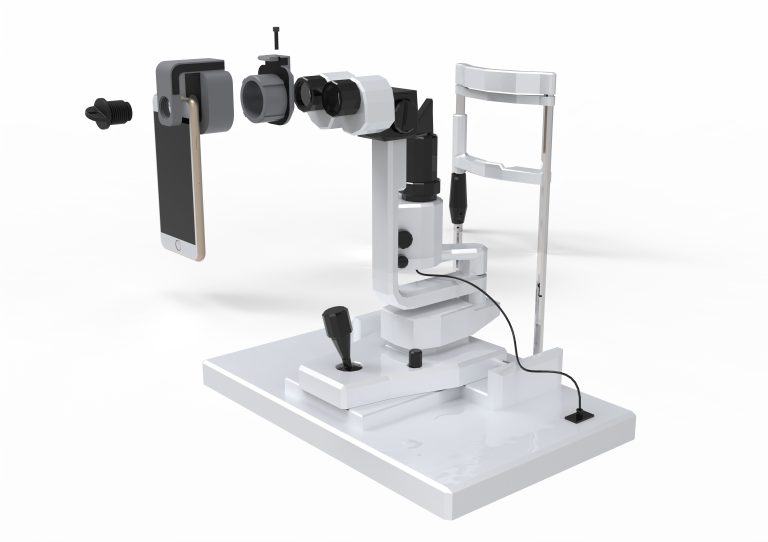
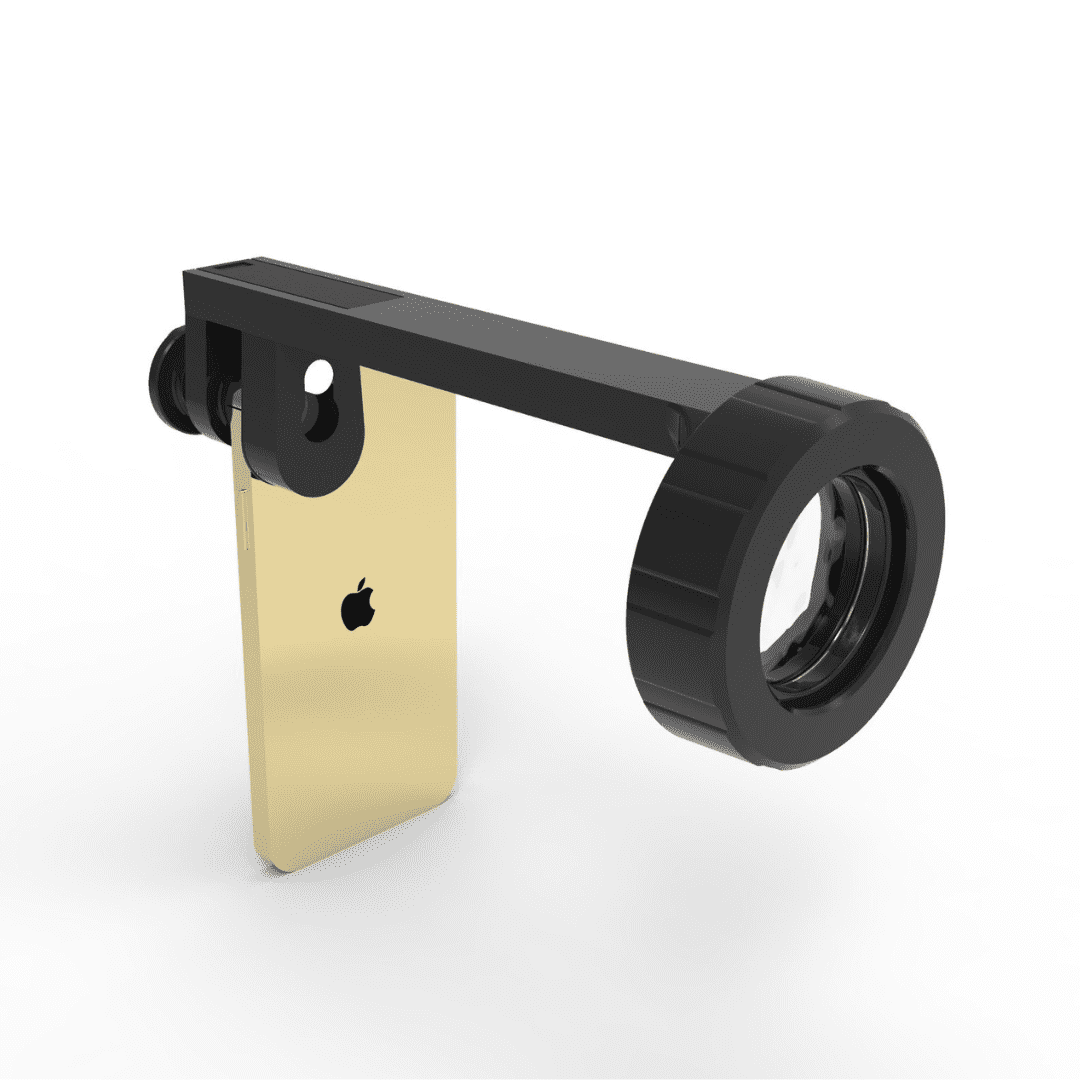
Document what you see
Two smartphone imaging tools built for everyday clinic use — one for the slit lamp, one for the fundus.
From Choroida — the team behind this siteReferences
- Cho P, Cheung SW. Retardation of myopia in Orthokeratology (ROMIO) study: a 2-year randomized clinical trial. Investigative Ophthalmology and Visual Science. 2012.
- Bullimore MA, Johnson LA. Overnight orthokeratology. Contact Lens and Anterior Eye. 2020.
- Vincent SJ, Cho P, Chan KY, et al. CLEAR – Orthokeratology. Contact Lens and Anterior Eye. 2021.
- Orthokeratology. EyeWiki, American Academy of Ophthalmology.
- Orthokeratology. StatPearls, NCBI Bookshelf.
Test yourself
A few questions straight from this article.
-
How does orthokeratology correct refractive error?
A rigid gas-permeable lens worn overnight reshapes the cornea so the patient sees clearly all day without any lens or glasses. The effect fades if wear stops. -
What is distinctive about the orthokeratology lens design?
Flatter centrally and steeper in the mid-periphery is the opposite curvature relationship to a standard rigid lens, and it is what produces the reshaping. -
Which corneal change produces the refractive effect of orthokeratology?
Gentle overnight pressure flattens the central epithelium and thickens it relatively in the mid-periphery. No permanent structural change to the stroma occurs. -
How is orthokeratology thought to slow myopic progression?
Mid-peripheral corneal steepening shifts the peripheral image plane in front of the retina. Peripheral hyperopic defocus is thought to drive axial elongation, so reversing it appears to slow progression. -
Up to roughly what degree of myopia is orthokeratology most predictably effective?
The exact ceiling depends on the specific lens design and the individual corneal parameters. Higher degrees of astigmatism are also less reliably corrected. -
Which finding is a contraindication to fitting orthokeratology lenses?
It raises infection risk and compromises fitting accuracy, as does corneal irregularity. The other listed features describe a suitable candidate. -
What does fitting an orthokeratology lens require?
The lens must be designed to the eye's own shape, which makes this a more involved process than fitting a standard soft lens. Early follow-up is also more frequent. -
What is the most serious complication of orthokeratology?
Overnight wear of any contact lens carries a higher infection risk than daytime-only wear, and the risk is tied directly to how well hygiene instructions are followed. -
What happens if orthokeratology lens wear is discontinued?
Myopic progression also resumes at whatever rate it would otherwise have followed. Both benefits depend on continued, consistent nightly wear. -
How soon does good uncorrected daytime vision usually develop with orthokeratology?
Refractive correction is effective and predictable in appropriately selected patients over this timescale.

Writes and reviews the clinical articles on Educate. Every post is checked against peer-reviewed sources before it goes live.