HAWK and HARRIER were two phase 3 trials that compared brolucizumab with aflibercept in neovascular age-related macular degeneration.
They tested whether a longer dosing interval could match the effect of every-eight-week aflibercept.
Therefore, they shaped both the approval and the later safety debate.
Why HAWK and HARRIER Were Run
Frequent injections burden patients, families and clinics.
A drug with a longer effect could cut visits without losing vision.
Also, brolucizumab is a very small single-chain antibody fragment that allows a high molar dose.
As a result, the sponsor expected stronger and longer VEGF suppression.
HAWK and HARRIER Trial Design
HAWK enrolled about 1,080 patients and tested brolucizumab 3 mg and 6 mg.
HARRIER enrolled about 740 patients and tested brolucizumab 6 mg only.
In both trials, brolucizumab followed three monthly loading doses and then moved to every 12 weeks, with a switch to every 8 weeks if disease activity appeared.
The comparator was aflibercept 2 mg every 8 weeks after loading.
Fundus Explorer Pro
Photograph the retinal findings described here with the phone already in your pocket — 22 D optics and built-in illumination in one handheld unit.
From Choroida — the team behind this siteHAWK and HARRIER Primary Outcome
The primary outcome was the change in best-corrected visual acuity at week 48.
Brolucizumab 6 mg met noninferiority to aflibercept in both trials.
Also, vision gains were similar across arms, at roughly six letters.
Therefore, longer intervals did not cost vision in most patients.
Dosing Interval Results
About half of the brolucizumab 6 mg patients stayed on the every-12-week schedule through week 48.
Many of them stayed on it through week 96.
In addition, the share on the extended interval was higher in HARRIER than in HAWK.
However, a share of patients needed the shorter interval after a first activity.
Anatomic Results
Central subfield thickness fell more with brolucizumab than with aflibercept.
Also, fewer eyes had intraretinal or subretinal fluid at week 16 and week 48.
Disease activity assessments at week 16 favored brolucizumab.
Because of this, the drug looked anatomically stronger, although vision did not differ.
The Safety Signal in HAWK and HARRIER
Intraocular inflammation occurred more often with brolucizumab than with aflibercept.
Some cases came with retinal vasculitis or retinal vascular occlusion.
A post hoc review of the trials found that these events could cause severe vision loss.
As a result, the labels carried warnings (see brolucizumab intraocular inflammation).
Recognizing Inflammation After Injection
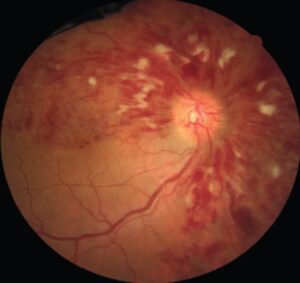
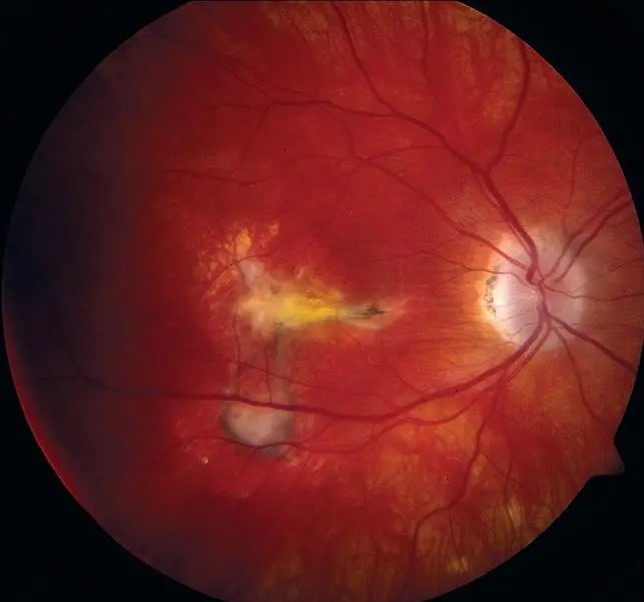
Patients present with blurred vision, floaters, redness or pain days to weeks after an injection.
The eye shows cells in the anterior chamber or vitreous, and sometimes sheathed vessels.
Also, fluorescein angiography can reveal occlusive vasculitis.
Therefore, examine every post-injection complaint with the pupil dilated.
Management Principles
Stop brolucizumab at the first sign of inflammation.
Topical and sometimes systemic or periocular steroids are the usual treatment.
In addition, switch to another agent once the eye is quiet.
Finally, document the event and report it.
Also, follow the patient for several weeks, since vasculitis and occlusion can appear late.
HAWK and HARRIER in Practice Today
Brolucizumab remains an option for patients who need fewer injections and have no history of inflammation.
Many clinicians now reserve it for eyes with heavy fluid that respond poorly to other drugs.
Also, careful patient selection and consent are required.
Because other long-acting agents exist, many practices use it less often.
Pitfalls to Avoid
- Do not read the anatomic gains as proof of better vision
- Never ignore a red, painful eye after an injection
- Do not restart brolucizumab in an eye that had retinal vasculitis
- Never treat all post-injection inflammation as infectious without examining the vitreous
Disease Activity Assessment
Masked investigators judged activity from acuity change, anatomic findings and new hemorrhage.
Patients with activity at the first assessment moved to every 8 weeks.
Also, the aflibercept arm kept a fixed schedule.
Therefore, the 12-week share is a conservative measure.
Patient Counseling
Explain that longer intervals reduce visits but add a small risk of inflammation.
Ask patients to call at once for pain, redness or new floaters.
Also, give clear contact details.
In addition, record baseline vision to ease later comparison.
Imaging Follow-Up
Optical coherence tomography guides each interval decision.
Look for fluid, pigment epithelial detachment and new hemorrhage.
Also, widefield angiography helps when vasculitis is suspected.
Therefore, add imaging whenever symptoms appear after an injection.
For the latest studies, see the PubMed results for HAWK and HARRIER.


Document what you see
Two smartphone imaging tools built for everyday clinic use — one for the slit lamp, one for the fundus.
From Choroida — the team behind this siteReferences
- Dugel PU, Koh A, Ogura Y, et al. HAWK and HARRIER: phase 3, multicenter, randomized, double-masked trials of brolucizumab for neovascular age-related macular degeneration. Ophthalmology. 2020;127:72-84.
- Dugel PU, Singh RP, Koh A, et al. HAWK and HARRIER: ninety-six-week outcomes from the phase 3 trials of brolucizumab for neovascular age-related macular degeneration. Ophthalmology. 2021;128:89-99.
- Monés J, Srivastava SK, Jaffe GJ, et al. Risk of inflammation, retinal vasculitis, and retinal occlusion-related events with brolucizumab: post hoc review of HAWK and HARRIER. Ophthalmology. 2021;128:1050-1059.
- Baumal CR, Spaide RF, Vajzovic L, et al. Retinal vasculitis and intraocular inflammation after intravitreal injection of brolucizumab. Ophthalmology. 2020;127:1345-1359.

Writes and reviews the clinical articles on Educate. Every post is checked against peer-reviewed sources before it goes live.