Retinoblastoma treatment aims to save the child’s life first, the eye second, and vision third.
Modern care combines systemic or local chemotherapy with focal therapy, and surgery remains for advanced eyes.
Survival now exceeds 95 percent in settings with early diagnosis and good access to care.
Principles of Retinoblastoma Treatment
Treatment depends on the stage, the laterality, and whether the child carries a germline RB1 mutation.
Teams use the International Classification of Intraocular Retinoblastoma, which groups eyes from A to E by tumor size and seeding.
Murphree proposed this system, and it guides the choice between focal therapy, chemotherapy, and enucleation (see retinoblastoma).
Early detection through red reflex screening and a high suspicion for leukocoria lowers the stage at diagnosis (see leukocoria differential).
Systemic Chemoreduction in Retinoblastoma Treatment
Chemoreduction uses vincristine, etoposide, and carboplatin to shrink tumors.
Shields and Shields described the approach as a way to avoid external beam radiation.
After tumors shrink, focal therapy consolidates the result.
Systemic chemotherapy also lowers the risk of trilateral disease in bilateral cases.
Fundus Explorer Pro
Photograph the retinal findings described here with the phone already in your pocket — 22 D optics and built-in illumination in one handheld unit.
From Choroida — the team behind this siteFocal Therapy in Retinoblastoma Treatment
- Laser photocoagulation or thermotherapy for small tumors
- Cryotherapy for peripheral tumors
- Plaque radiotherapy for medium tumors that do not respond to other treatment
Focal therapy treats residual disease and prevents recurrence (see plaque brachytherapy).
Intra-Arterial Chemotherapy in Retinoblastoma Treatment
Abramson and colleagues described selective ophthalmic artery infusion of melphalan.
The catheter reaches the ophthalmic artery, and the drug goes directly to the eye with limited systemic exposure.
Many centers now use it for advanced eyes that once required enucleation.
Risks include vascular occlusion, retinal ischemia, and neutropenia.
Intravitreal Chemotherapy in Retinoblastoma Treatment
Vitreous seeds respond poorly to systemic drugs, so surgeons inject melphalan or topotecan into the vitreous.
Munier and colleagues described a safe technique that prevents tumor spread along the needle track.
Strict safety measures include lowering the pressure first, freezing the entry site, and sealing the wound.
Enucleation
Surgeons remove eyes with advanced disease, optic nerve invasion, or glaucoma and orbital signs.
Pathology guides adjuvant chemotherapy, based on high-risk features such as optic nerve and choroidal invasion.
Place an orbital implant, and fit a prosthesis after healing.
Follow-Up and Genetic Counseling
Examine the child under anesthesia at intervals, since new tumors may appear.
Test for RB1 mutations and offer screening to siblings and relatives.
Counsel families about second cancer risks in germline carriers.
An Example Case
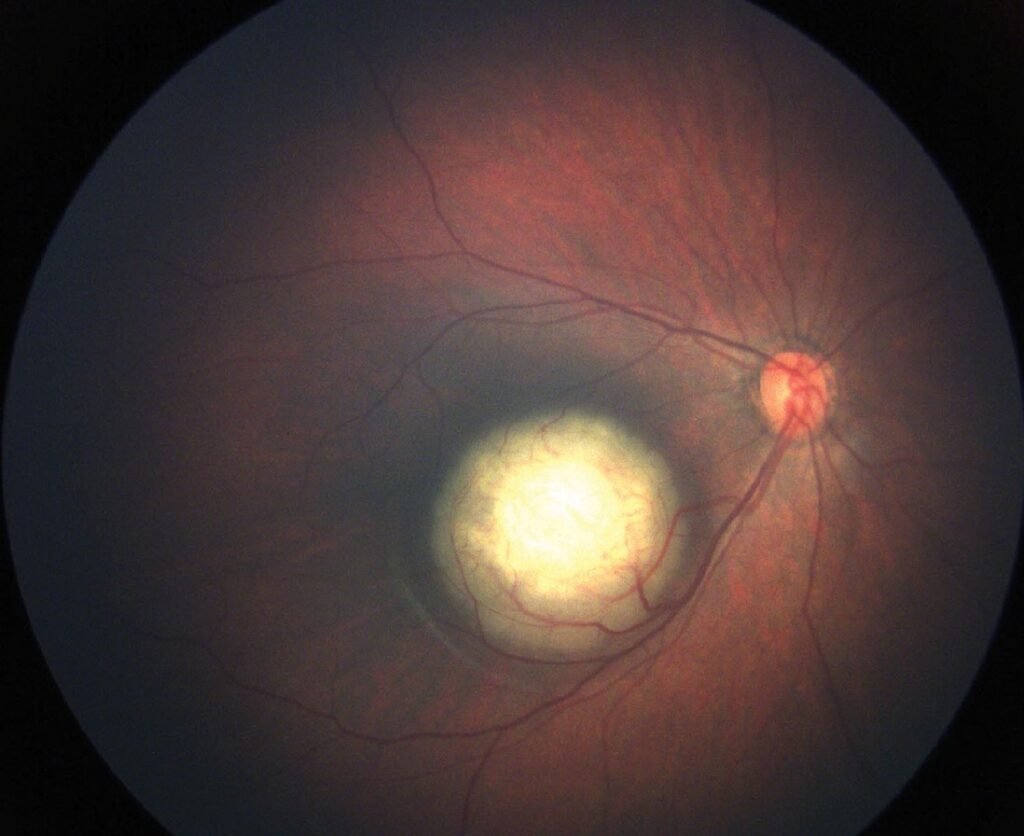
A 14-month-old girl presents with leukocoria in her right eye, and examination under anesthesia shows a large tumor with vitreous seeds, group D.
The left eye is normal, and genetic testing shows no germline RB1 mutation.
She receives intra-arterial melphalan, with intravitreal melphalan for the seeds, and focal laser to residual disease.
The tumor regresses over months, and the eye is salvaged with useful vision.
Questions Parents Ask
Parents ask whether their child will survive, and the answer is that survival is high with early treatment.
They also ask whether the eye can be saved, and many eyes can be saved with modern therapy.
Because parents face difficult decisions, provide clear information and support.
Pitfalls to Avoid
- Delaying referral for a child with leukocoria
- Using external beam radiation when other options exist
- Skipping genetic testing and family screening
- Underestimating the risk of invasion in advanced eyes
Looking Ahead
Gene-based and targeted therapies are under study.
Also, liquid biopsy of aqueous humor may help to track tumor activity.
Therefore, future care may become less invasive.
Practical Points
Refer urgently to a specialized center when you suspect retinoblastoma.
Then avoid biopsy, which risks tumor spread.
Also arrange anesthesia examinations at regular intervals.
Supportive Care
Children need psychological support for themselves and their families.
Because treatment may last months, coordinate care among oncology, ophthalmology, and social support.
Then plan long-term follow-up for second cancers in germline carriers.
Role of the Primary Care Team
Pediatricians and family doctors detect leukocoria during routine visits.
Therefore, teach parents to report a white pupil in photographs.
Also use the red reflex test at every well-child visit.
Because early referral changes outcomes, never wait.
Late Effects
Survivors face risks of vision loss, orbital growth changes after radiation, and second cancers.
Therefore, plan lifelong follow-up with the oncology team.
Psychological Support
Because treatment spans months, arrange psychological support early.
Also connect families with parent groups and social workers.
For the latest studies, see the PubMed results for retinoblastoma treatment.


Document what you see
Two smartphone imaging tools built for everyday clinic use — one for the slit lamp, one for the fundus.
From Choroida — the team behind this siteReferences
- Shields CL, Shields JA. Basic understanding of current classification and management of retinoblastoma. Curr Opin Ophthalmol. 2006;17:228-234.
- Abramson DH, Dunkel IJ, Brodie SE, et al. A phase I/II study of direct intraarterial (ophthalmic artery) chemotherapy with melphalan for intraocular retinoblastoma: initial results. Ophthalmology. 2008;115:1398-1404.
- Munier FL, Gaillard MC, Balmer A, et al. Intravitreal chemotherapy for vitreous disease in retinoblastoma revisited: from prohibition to conditional indications. Br J Ophthalmol. 2012;96:1078-1083.
- Murphree AL. Intraocular retinoblastoma: the case for a new group classification. Ophthalmol Clin North Am. 2005;18:41-53.

Writes and reviews the clinical articles on Educate. Every post is checked against peer-reviewed sources before it goes live.