A refractive surprise after cataract surgery is a final refraction that is well away from the planned target.
Modern biometry has made this rare, but not extinct, and the disappointment of patients with a surprise is great.
A structured approach finds the cause and offers a fix in most cases.
How Common Is Refractive Surprise After Cataract Surgery?
With optical biometry and modern formulas, about 70 to 80 percent of eyes are within half a diopter of the target, and about 95 percent within one diopter, in normal eyes (see the references).
Rates are worse in eyes with extreme axial lengths, previous refractive surgery, and corneal disease.
A surprise is usually defined as an error of more than one diopter, though patients may be unhappy with smaller errors.
Causes of Refractive Surprise After Cataract Surgery
- Biometry errors: wrong axial length, especially with dense cataracts, staphyloma, or poor fixation, and wrong keratometry from a dry or irregular surface (see dry eye disease)
- Formula errors: a formula not suited to the eye, such as a short or long eye or a post-LASIK cornea (see cataract surgery in high myopia)
- Estimated lens position errors, including a tilted or decentered lens, and a lens in the sulcus instead of the bag
- IOL errors: wrong power in the box, wrong lens implanted, or a mix-up between patients
- Data entry errors, such as swapped eyes or mistyped numbers
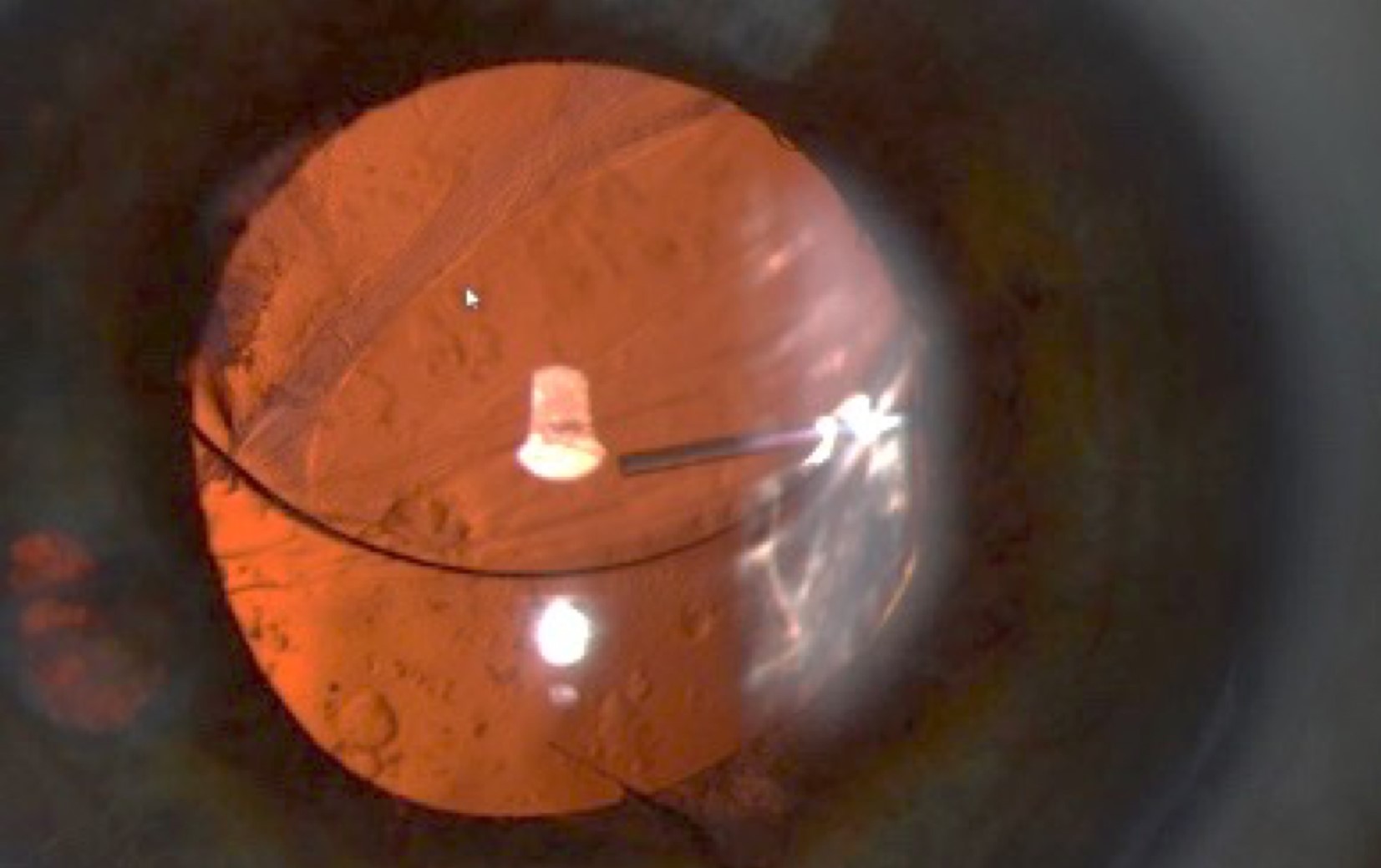
- Capsular bag problems, such as capsular block or contraction (see capsular bag distension syndrome)
All-fit Slit-Lamp Adapter
Record and share exactly what you see at the slit lamp. One adapter fits any slit lamp or surgical microscope — and any smartphone.
From Choroida — the team behind this siteRefractive Surprise After Cataract Surgery: What to Do First
- Confirm the refraction, with a careful manifest refraction, and repeat after several weeks, since the eye may shift
- Measure the corneal shape with topography, and check for dry eye, which may change keratometry
- Perform a new biometry, and compare it with the preoperative values
- Examine the lens position, and check for tilt, decentration, or capsular problems
- Check the operative record, and the IOL label and power
- Review the formula and constants used
Refractive Surprise After Cataract Surgery: Management Options
- Glasses or contact lenses: the simplest, and enough for small errors
- Laser vision correction, with PRK or LASIK, after the refraction has stabilized, usually after three months (see LASIK enhancement)
- Limbal relaxing incisions, for astigmatic errors (see limbal relaxing incisions)
- Piggyback lens: a second IOL in the sulcus, which is effective for hyperopic surprise (see piggyback IOL)
- IOL exchange, when the error is large, or the lens type is wrong (see IOL exchange)
Choice depends on the size of the error, the cornea, the lens position, and the patient’s wishes.
Preventing Surprises
- Use optical biometry, and repeat if the values do not match the other eye
- Check the difference between the two eyes, and between the keratometry and the topography
- Use modern, validated formulas, and choose them by axial length
- Use special methods in post-laser eyes
- Verify the lens power and the patient identity at the time of surgery, with a time-out
- Audit the outcomes, and optimize the lens constants
Intraoperative aberrometry may help in selected eyes (see intraoperative aberrometry).
Communication
Tell the patient early about the surprise, explain the cause if known, and offer the options.
Allow time for the refraction to stabilize, and document the discussion.
Honest communication reduces distress and the risk of complaints.
Reviewing After the First Eye
The result in the first eye gives data on the biometry and the formula in that patient.
If the first eye has an unexpected result, repeat the biometry for the second eye, and consider adjusting the target to reduce the difference between the eyes (see second-eye cataract surgery).
Special Eyes
- Post-LASIK or PRK eyes: use methods designed for them, such as the Barrett True-K or other validated calculators
- Short eyes: errors tend to be hyperopic, and formulas for short eyes help
- Eyes with silicone oil, or previous vitrectomy: axial length and lens position may change
- Eyes with posterior staphyloma: axial length may be wrong at the fovea
When to Wait
Refractions need time to settle, especially in eyes with edema or a changing cornea, and a decision on laser or exchange is best made after the refraction is stable at several weeks apart.
Premature surgery may lead to a second surprise.
Records to Keep
Keep the biometry printouts, the formula used, the lens model and serial number, and the refraction at each visit, because these records make it possible to find the cause and to answer the patient’s questions with confidence.
Offering a second opinion from a colleague can help patients to feel supported, and it often brings a fresh idea about the most suitable correction.
For the latest studies, see the PubMed results for refractive surprise after cataract surgery.


Document what you see
Two smartphone imaging tools built for everyday clinic use — one for the slit lamp, one for the fundus.
From Choroida — the team behind this siteReferences
- Melles RB, Holladay JT, Chang WJ. Accuracy of intraocular lens calculation formulas. Ophthalmology. 2018;125:169-178.
- Behndig A, Montan P, Stenevi U, Kugelberg M, Lundström M. Aiming for emmetropia after cataract surgery: Swedish National Cataract Register study. J Cataract Refract Surg. 2012;38:1181-1186.
- Olsen T. Calculation of intraocular lens power: a review. Acta Ophthalmol Scand. 2007;85:472-485.
- American Academy of Ophthalmology. Basic and Clinical Science Course, Section 11: Lens and Cataract. AAO; current edition.

Writes and reviews the clinical articles on Educate. Every post is checked against peer-reviewed sources before it goes live.