LASIK enhancement is a second laser treatment to correct the refractive error that remains after the first operation.
Between one and a few percent of eyes need one, and the risk is higher after treatment of high hyperopia, high myopia, or high astigmatism.
The decision depends on the stability of the refraction and on the tissue left in the cornea.
Why Eyes Need LASIK Enhancement
- Undercorrection or overcorrection from variation in healing and in the laser effect
- Regression, the slow return of myopia, more frequent after high corrections
- Epithelial hyperplasia, which thickens the surface and shifts the refraction
- Change in the eye with age, including early cataract or hyperopic shift
- Residual astigmatism from cyclotorsion or healing differences
A change in refraction that keeps moving points to another cause, such as ectasia or lens change, and not to a simple residual error (see post-LASIK ectasia).
LASIK Enhancement: When to Treat
- Wait until the refraction is stable on at least two visits, usually three months apart, and most surgeons wait three to six months
- Confirm that the patient is symptomatic and wants correction, since small residual errors may not need treatment
- Check that the cornea is healthy and the surface is stable (see dry eye after LASIK)
- Review the original data, flap thickness, and the ablation
Treating too early risks chasing a refraction that has not settled.
All-fit Slit-Lamp Adapter
Record and share exactly what you see at the slit lamp. One adapter fits any slit lamp or surgical microscope — and any smartphone.
From Choroida — the team behind this siteSafety Checks Before Retreatment
- Residual stromal bed: most surgeons require at least 250 to 300 micrometers after the new ablation, and a lower value raises the risk of ectasia (see the references)
- Topography and tomography: look for irregularity, a thin cornea, or early ectasia
- Pachymetry and a review of the flap thickness
- Stability of keratometry, and a review of risk factors for ectasia, such as young age and high myopia (see corneal topography)
If the safety limits are not met, avoid enhancement and consider other options.
LASIK Enhancement: Flap Lift or Surface Ablation?
- Flap lift: the surgeon lifts the flap and applies the laser to the bed. The surgeon replaces the flap; this is fast and comfortable, and works well in the first few years
- Surface ablation over the flap: a safer choice when the flap is old, thin, or has had problems, since it avoids lifting
- Recut of the flap: used less often, and adds stromal loss
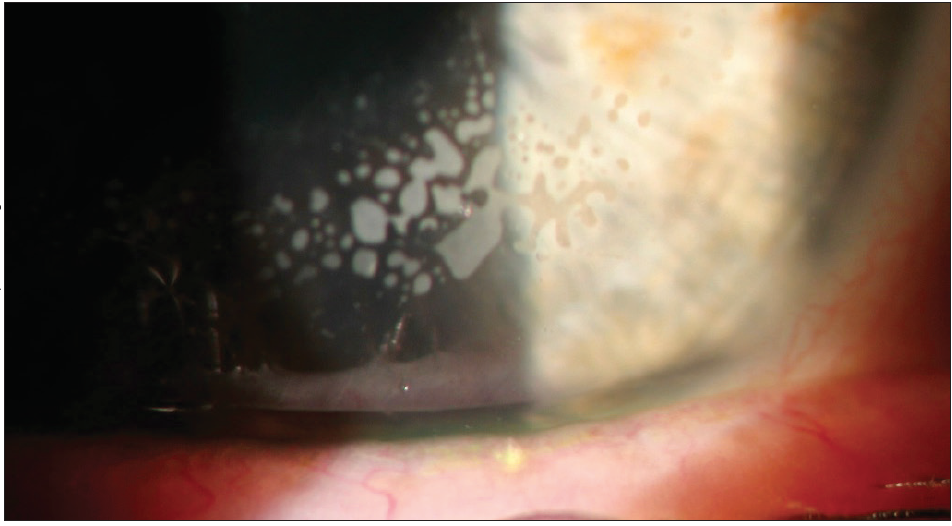
Epithelial ingrowth is more frequent after a flap lift, especially several years after the original surgery, and the risk rises with time (see the references and epithelial ingrowth after LASIK).
Alternatives
- Glasses or contact lenses for small errors
- Phakic lens implantation or refractive lens exchange, when the cornea cannot be treated (see refractive lens exchange)
- Treatment of the cause, such as dry eye or early cataract
The patient should know that these options exist.
Complications of LASIK Enhancement
Enhancement carries the same risks as the first operation, with a higher chance of ingrowth, flap problems, and dry eye.
Ectasia is the most serious, and surgeons avoid it by respecting the limits and screening for risk factors.
Infection and diffuse lamellar keratitis can occur, and doctors treat them promptly (see diffuse lamellar keratitis).
Counselling
Explain the chance of improvement, that the second treatment may not remove the need for glasses, and that stability is needed first.
Review the reasons for waiting, and plan the follow-up.
A Worked Example
A patient who had LASIK for moderate myopia three years ago returns with blurred distance vision and a refraction of minus 0.75 diopters, stable on two visits six months apart.
The tomography is normal, the residual stromal bed is well above the limit, and the epithelium is regular.
The surgeon discusses a flap lift, and chooses surface ablation over the flap because of the time since the first surgery, which lowers the chance of ingrowth.
Also, the surgeon tells the patient that glasses may still be needed for night driving.
Preventing Ingrowth After Retreatment
- Clean the flap interface and the bed thoroughly before replacing the flap
- Make sure the flap edge is dry and well aligned, and that no epithelial cells are carried under it
- Use a bandage lens in some eyes, and check the interface at the first day and the first week
- Treat any growth early, since small nests may resolve and larger ones need lifting and scraping
Careful review at one month and three months catches problems before they affect vision.
Documentation and Expectations
Record the original refraction, the ablation depth, the flap thickness, the new refraction, and the planned treatment.
Tell patients that enhancement improves most eyes, that results are not always perfect, and that the chance of a second enhancement is small.
For the latest studies, see the PubMed results for LASIK enhancement.


Document what you see
Two smartphone imaging tools built for everyday clinic use — one for the slit lamp, one for the fundus.
From Choroida — the team behind this siteReferences
- Randleman JB, Woodward M, Lynn MJ, Stulting RD. Risk assessment for ectasia after corneal refractive surgery. Ophthalmology. 2008;115:37-50.
- Davis EA, Hardten DR, Lindstrom M, et al. LASIK enhancements: a comparison of lifting to recutting the flap. Ophthalmology. 2002;109:2308-2313.
- Wang MY, Maloney RK. Epithelial ingrowth after laser in situ keratomileusis. Am J Ophthalmol. 2000;129:746-751.
- American Academy of Ophthalmology. Basic and Clinical Science Course, Section 13: Refractive Surgery. AAO; current edition.

Writes and reviews the clinical articles on Educate. Every post is checked against peer-reviewed sources before it goes live.